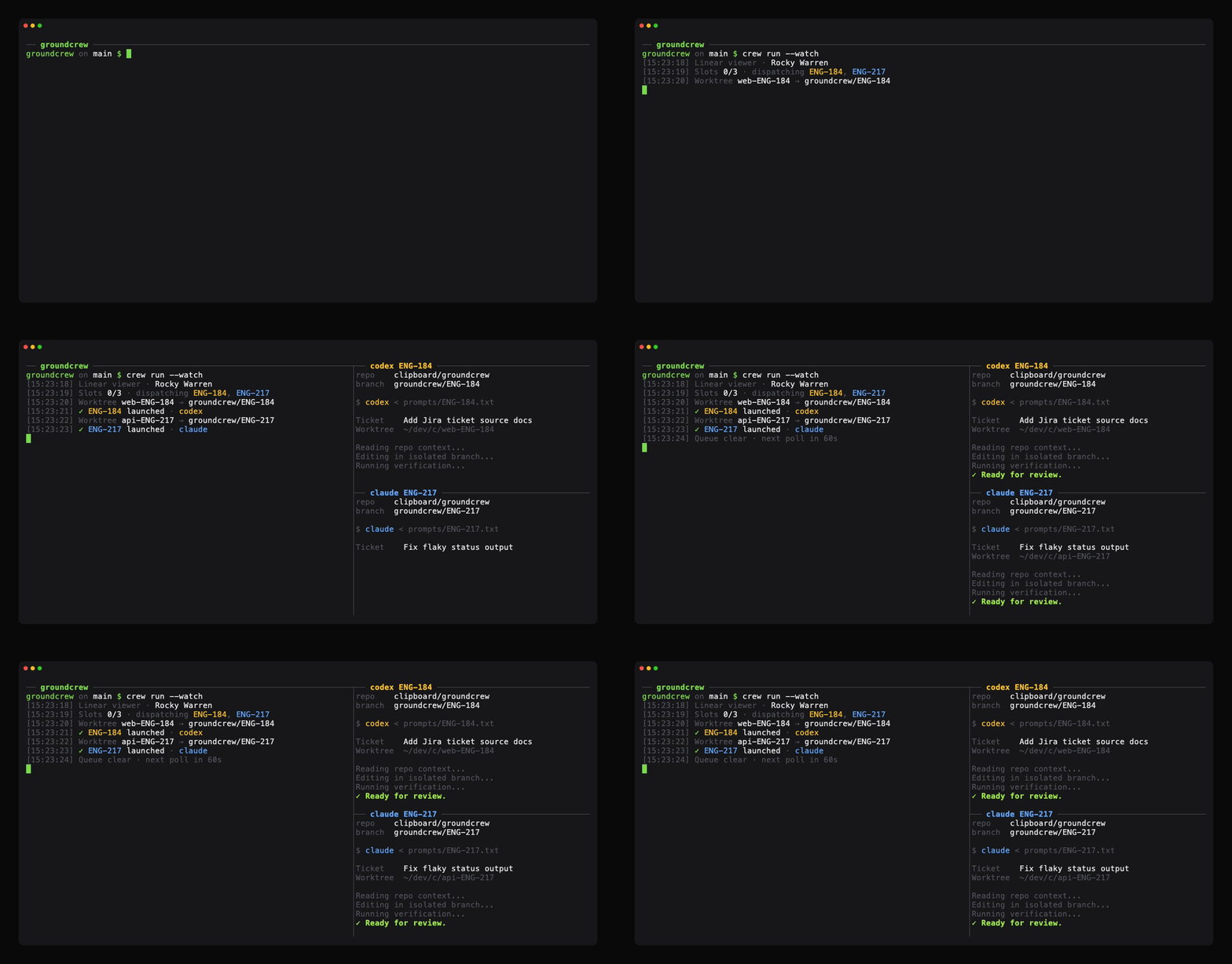
Dispatch your task backlog to local, interactive AI coding agents. One git worktree per task, sandboxed by default.
Groundcrew watches assigned tasks, creates isolated worktrees, launches agent CLIs in dedicated terminals, and leaves each task's work on its own PR-ready branch. For the backstory, read _[Tickets to pull requests while you sleep](https://www.clipboardworks.com/resources/blog/tickets-to-pull-requests-while-you-sleep)_.
## Why
- **Local.** Agents run on your machine with your tools, shell, and credentials. That makes them more steerable than remote agents, and easy to nudge when they drift.
- **Interactive.** Each task launches the real `claude`, `codex`, `cursor-agent`, or `pi` CLI in its own terminal pane, not a wrapper that approximates it. Watch any session live and take over when you need to.
- **One worktree per task.** Agents work in parallel without stepping on each other.
- **Sandboxed by default.** Safehouse or Docker Sandboxes isolate each agent on the host; `none` is an explicit escape hatch.
- **Pluggable task sources.** Linear by default; Jira and local files via [task sources](./docs/task-sources.md).
- **Multi-agent routing.** Ships `claude`, `codex`, `cursor` (plus a `cursor-grok` variant), and `pi` presets; bring your own CLI in config.
## Prerequisites
`crew doctor` checks all of these, so you can install as you go.
- **Node 24.14.1:** [nvm](https://github.com/nvm-sh/nvm): `nvm install 24.14.1`.
- **git:** e.g., `brew install git`, `apt install git`.
- **A terminal multiplexer:** [tmux](https://github.com/tmux/tmux/wiki/Installing) (cross-platform), [cmux](https://cmux.com/) (macOS), or [zellij](https://zellij.dev/).
- **An agent CLI:** [Claude Code](https://code.claude.com/docs/en/quickstart), [Codex](https://developers.openai.com/codex/quickstart?setup=cli), the [Cursor CLI](https://docs.cursor.com/en/cli/overview) (`cursor-agent`, for the `cursor` and `cursor-grok` presets), and/or [Pi](https://pi.dev/).
- **A sandbox runner:** [Docker Sandboxes](https://docs.docker.com/ai/sandboxes/) (cross-platform) or [Safehouse](https://agent-safehouse.dev/) on macOS. Skip only with `--runner none`.
## Quickstart
```bash
# 1. Install groundcrew.
npm install -g @clipboard-health/groundcrew@latest
# 2. Scaffold a global config. Agents are sandboxed by default
# (Safehouse/Docker Sandboxes); add --runner none to run unsandboxed on the host.
crew init --global --project-dir ~/dev --repo OWNER/REPO --agent claude
# 3. Run the clone commands printed by `crew init`.
# 4. Safehouse runs use groundcrew's bundled clearance allowlist automatically.
# Add extra hosts later via CLEARANCE_ALLOW_HOSTS or CLEARANCE_ALLOW_HOSTS_FILES.
# 5. Using Linear? Export your API key. (Jira and other trackers: see Task Pickup.)
export GROUNDCREW_LINEAR_API_KEY="lin_api_..."
# 6. Verify setup, then dispatch.
crew doctor
crew run --watch
```
`crew init --global` writes config to `${XDG_CONFIG_HOME:-$HOME/.config}/groundcrew/`. Pass `--repo` more than once for multiple repos. `--agent claude`, `--agent codex`, `--agent cursor`, or `--agent pi` chooses the single built-in agent preset to enable in the generated config.
Pi needs credentials only for the provider its selected model uses—not every provider. Authenticate that provider before unattended use; see [Pi provider authentication](./docs/credentials.md#pi-provider-authentication).
When using Pi through tmux 3.5 or later, add the following to `~/.tmux.conf` so tmux preserves modified keys such as `Shift+Enter` and `Ctrl+Enter`:
```tmux
set -g extended-keys on
set -g extended-keys-format csi-u
```
Stop or finish every active Groundcrew task and save work in every other tmux session before running `tmux kill-server`; it terminates the entire shared tmux server, including unrelated user sessions. The change takes effect the next time tmux starts. These are server-wide options, so Groundcrew deliberately does not change them for you. With tmux 3.2–3.4, omit `extended-keys-format`; see [Pi's tmux setup](https://github.com/earendil-works/pi/blob/main/packages/coding-agent/docs/tmux.md).
## Task Pickup
**Not on Linear?** Use Jira or local files via [task sources](./docs/task-sources.md).
Linear works out of the box: assign tasks to yourself and add an `agent-*` label.
- `agent-claude`, `agent-codex`, `agent-pi`, or `agent-` routes to that enabled launch profile.
- `agent-any` routes to the enabled agent with the most session headroom, after skipping agents over their session limit or weekly paced budget.
- Tasks without an `agent-*` label are ignored by `crew run`; dispatch one manually with `crew start `.
Agent names are launch profiles, so you can use them to pick model tiers. For example,
define `claude-fable` with `claude --model claude-fable-5 --permission-mode auto`
and `claude-opus` with `claude --model claude-opus-4-8 --permission-mode auto`,
then label tasks with `agent-claude-fable` or `agent-claude-opus`.
Groundcrew scans `workspace.knownRepositories` to infer which repo a task belongs to.
A task blocked by non-terminal blockers is skipped until those blockers are done.
### The task description is the prompt
Groundcrew sends each agent a generic unattended-execution prompt plus the task title and description. The prompt says how to work: read the repo instructions, make the smallest sensible change, verify it, and produce the requested output. The task description says what to do.
Write tasks as complete agent instructions: the goal, the context and constraints, links to logs or screenshots, how to verify, and the output you want. A vague task gets a vague PR.
## Commands
```bash
crew init [--global | --local] [--force] [--dry-run] # create a crew.config.ts
[--project-dir ] [--repo ]...
[--runner ] [--agent ]
crew doctor # check setup
crew source list|verify [] # inspect configured task sources
crew task list [--source ] # list tasks across sources
crew task get [--source ] [--prompt] # inspect one task or its prompt
crew task create "Title" --source [--agent ] # create a source task
crew task done [--allow-dirty] # mark a no-PR task done
crew task validate [] # validate task content
crew status [] [--json [--local-only]] # inspect current state, or emit it as JSON
crew run [--watch] # one-shot or --watch forever
crew start # provision + launch one task now
crew stop [--reason ] # stop workspace, keep worktree
crew resume [--new] # reopen a paused task (--new: fresh conversation)
crew open | --branch [--repo ] # iterate on an existing PR or branch
[--prompt | --prompt-file ] [--task ] [--dry-run]
crew cleanup [--force] # tear down every worktree for a task
crew cleanup [--force] --all # tear down every idle worktree (no live workspace)
crew upgrade [] # reinstall crew globally through npm
crew completions # print a shell completion script
```
See [command details](./docs/commands.md) for status output, doctor behavior, and the stop/resume workflow.
### Status snapshots for external monitors
`crew status --json` prints two documents and writes them beside the log file:
```text
/status-local.json # worktrees, run states, sessions, git status
/status-remote.json # board, pull requests
```
The two are split by cost. The local tier is local subprocess work, so it is
safe to poll every few seconds. The remote tier is network-bound and
rate-limited, so poll it near your `pollIntervalMilliseconds`.
```bash
crew status --json # both tiers
crew status --json --local-only # local tier only; never touches the network
```
`--local-only` is a guarantee about that invocation, not a computed outcome, so
a monitor's fast loop cannot stall on a slow board or a `gh` timeout.
Three rules a reader must honor:
- **Subtract locally.** `status-remote.json` ships board classification without
the local worktree subtraction. Remove tasks present in the local document
from `inProgress`, `queueReady`, and `queueBlocked` yourself. Precomputing
that join would report a just-dispatched task as still queued until the next
slow poll, which is a false statement rather than stale data.
- **Join pull requests on the worktree directory.** `pullRequestsByWorktree` is
keyed by absolute worktree path, not by task, because a task with two
worktrees has two branches. An empty or missing entry means no pull requests
were found, or the `gh` lookup for that worktree failed; the two are not
distinguishable.
- **Read the right timestamp.** `payload.capturedAt` describes the last
successful fetch; `lastAttemptAt` describes the most recent try. Read
`lastAttemptStatus` to answer "is the board healthy", and `capturedAt` to
answer "how old is this queue". A failed fetch keeps the previous payload, so
last-known-good data survives an outage while the document still says the
board is unreachable.
Durations are never stored, only start instants, so a reader must derive
elapsed time itself. A cached duration would show a frozen clock, which reads
as "the agent stopped working" when it did not.
## Configuration
Workspace settings and at least one enabled agent are required; everything else has a default.
```ts
import type { Config } from "@clipboard-health/groundcrew";
export default {
workspace: {
projectDir: "~/dev",
// Optional: all worktrees go here regardless of where each repo lives.
// worktreeDir: "~/dev/worktrees",
// Strings live under projectDir; use { name, projectDirOverride } to override per repo.
knownRepositories: ["OWNER/REPO"],
},
agents: {
default: "claude",
definitions: {
claude: {},
},
},
defaults: {
hooks: {
// No-op placeholder; replace with your repo's setup, e.g. "npm ci".
prepareWorktree: "true",
},
},
} satisfies Config;
```
Changing `workspace.worktreeDir` only affects worktrees discovered under the new
root. Clean up existing worktrees before switching it, or temporarily unset
`worktreeDir` when you need `crew cleanup` to find worktrees created beside the
repos.
There is no `linear` config block. Groundcrew reads `GROUNDCREW_LINEAR_API_KEY` first, then falls back to `LINEAR_API_KEY`.
## Reference
- [Configuration](./docs/configuration.md): discovery order, repo layout, scripted/sparse-checkout (graft) worktrees, full config table, prompt customization.
- [Runners](./docs/runners.md): Safehouse, Docker Sandboxes, and the `none` escape hatch.
- [Credentials](./docs/credentials.md): Linear API keys, 1Password, build secrets, and `preLaunch`.
- [Prepare worktree hooks](./docs/setup-hooks.md): `.groundcrew/config.json` `hooks.prepareWorktree` for per-repo dependency setup.
- [Operator host setup](./docs/setup-hooks.md#unsandboxedhooks-operator-only-host-setup): `crew.config.ts` `knownRepositories[].unsandboxedHooks.prepareWorktree` runs trusted, per-repo setup on the host outside the sandbox.
- [Task sources](./docs/task-sources.md): custom shell/Jira/local-plan adapters.
- [Development](./docs/development.md): local source workflow and README/demo asset regeneration.
- [Troubleshooting](./docs/troubleshooting.md): common operational pitfalls and fixes.
## License
[MIT](./LICENSE)