# sd0x-dev-flow
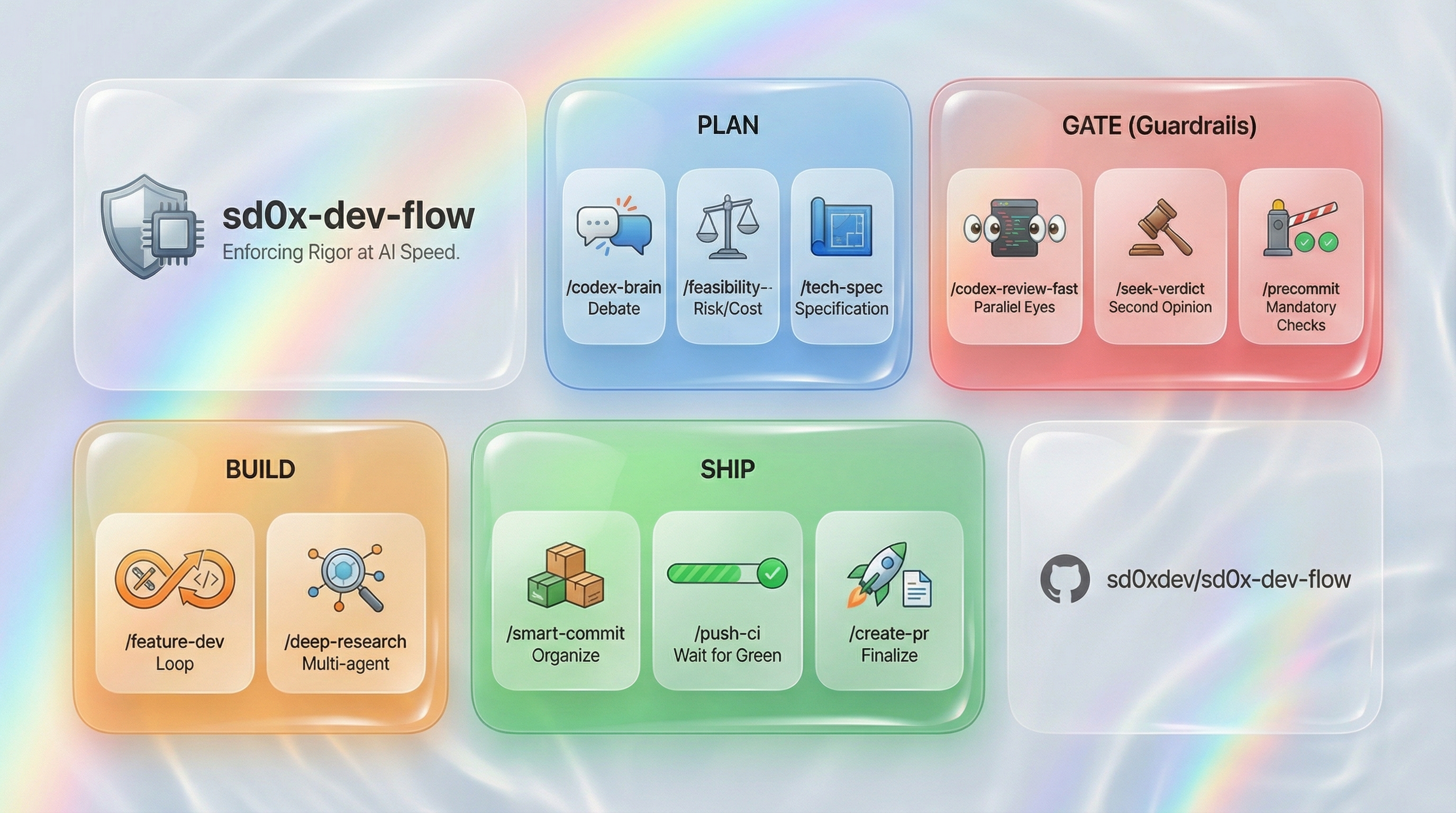
**Language**: English | [繁體中文](README.zh-TW.md) | [简体中文](README.zh-CN.md) | [日本語](README.ja.md) | [한국어](README.ko.md) | [Español](README.es.md)
> The harness layer for Claude Code.
**Let the model choose the path. Keep "done" verifiable.**
v4 gives Claude discretion inside a closed, test-pinned anchor set; hooks preserve gate receipts across compaction, and Codex reviews independently.
Full control plane on Claude Code. Skills-only distribution for Codex CLI and other compatible agents.
98 bundled · 98 public skills · 15 agents — ~4% of Claude's context window
[](LICENSE) [](https://www.npmjs.com/package/skills)
## Quick Start
```bash
# Claude Code — full control plane
/plugin marketplace add sd0xdev/sd0x-dev-flow
/plugin install sd0x-dev-flow@sd0xdev-marketplace
# Configure your project
/project-setup
```
One command auto-detects framework, package manager, database, entrypoints, and scripts. Installs a subset of rules and hooks; the full plugin bundles 15 rules + 8 hooks. Use `--lite` to only configure CLAUDE.md (skip rules/hooks).
```bash
# Codex CLI / Cursor / Windsurf / Aider — skills only
npx skills add sd0xdev/sd0x-dev-flow
# Generate AGENTS.md + install git hooks (run inside Claude Code)
/codex-setup init
```
| Method | Tools | Coverage |
|--------|-------|----------|
| Plugin install | Claude Code | Full (98 bundled skills, hooks, rules, auto-loop) |
| `npx skills add` | Codex CLI, Cursor, Windsurf, Aider | Skills only (98 public skills) |
| `/codex-setup init` | Codex CLI | AGENTS.md kernel + git hooks |
**Requirements**: Claude Code 2.1+ | [Codex MCP](https://github.com/openai/codex) (optional to install the plugin, required for the `/codex-*` review gates — Codex *is* the single reviewer, so without it a review emits `⛔ Blocked` + `⚠️ Need Human` rather than degrading)
## Why v4
Frontier models can plan, batch, and recover from structured state — they no longer need the harness to dictate every next command. v4 moves from **choreography to contracts**: the harness stopped scripting the model's moves and started defining what must be true when the work is declared done, without relaxing a single safety or review anchor.
| Dimension | v3 (choreography) | v4 (contracts) |
|-----------|-------------------|----------------|
| Hook role | Emit the next command to run | Publish `[AUTO_LOOP_STATE]` facts — change class, gate receipts, round/cap, tier |
| Completion | Scripted step sequence ("fix → immediately re-review") | Terminal completion invariant: every gate the change class requires has passed after the last edit |
| Rule force | Uniform — every rule reads as mandatory | Three tiers: **Anchor** (never), **Default** (deviate with a stated signal), **Guidance** (advisory) |
| Review depth | Maximum by default | Risk-scaled tiers (`fast` / `standard` / `thorough`); security and data integrity always escalate |
| Round cap hit | Hand off to the human | First hit: structured self-diagnosis + one bounded adjustment, then resume — unless a cap-specific human exit applies (security/data-integrity, architecture-level change, requirement ambiguity); the same change hitting the cap again after its diagnosis: always human |
The non-negotiable core lives in a **closed Anchor Register** (`rules/discretion.md`) that no project override can downgrade — resolution is Anchor-first, and a test suite fails by design if a Register entry is removed. Inside that boundary, ownership is explicit:
| Owner | Owns |
|-------|------|
| **Model** | Batching, timing, review depth escalation, Default-tier deviations (stated, then keep working) |
| **Harness** | Gate freshness, receipts across compaction, strict-mode blocking, the closed anchor set |
| **Human** | Irreversible approvals (push, commit, merge) and the enumerated exit points |
The model owns the path. The harness owns the evidence and non-negotiable boundaries. The human retains irreversible authority.
## What This Harness Does
> [Harness engineering](https://martinfowler.com/articles/exploring-gen-ai/harness-engineering.html) is the discipline of engineering everything around the LLM — tool loops, context management, hooks, state machines, safety layers — as opposed to training the model itself. Mitchell Hashimoto coined the term in Feb 2026; [Anthropic engineering](https://www.anthropic.com/engineering/effective-harnesses-for-long-running-agents) and [Martin Fowler](https://martinfowler.com/articles/exploring-gen-ai/harness-engineering.html) have published on it; [arXiv 2603.05344](https://arxiv.org/html/2603.05344v1) formalizes it.
sd0x-dev-flow is a reference implementation. Each row below maps a canonical harness sub-problem to concrete code you can study:
| # | Harness sub-problem | sd0x-dev-flow implementation | Code evidence |
|---|---------------------|------------------------------|---------------|
| 1 | **Tool loop control** | Terminal completion invariant — every gate a change class requires must pass after the last edit; the model chooses when and how to run them | [`rules/auto-loop.md`](rules/auto-loop.md) + [`hooks/post-tool-review-state.sh`](hooks/post-tool-review-state.sh) |
| 2 | **Sentinel-driven state machine** | `✅ Ready` / `⛔ Blocked` / `## Overall: ✅ PASS` gate sentinels parsed into their respective durable state planes; opt-in dual review additionally aggregates via a machine-facing `REVIEW_GATE=` marker | [`hooks/post-tool-review-state.sh`](hooks/post-tool-review-state.sh) (sentinel parser) + [`scripts/emit-review-gate.sh`](scripts/emit-review-gate.sh) (dual-review `REVIEW_GATE=` producer) |
| 3 | **Context recovery across compaction** | `[AUTO_LOOP_RESUME]` stdout injection after SessionStart(compact) | [`hooks/post-compact-auto-loop.sh`](hooks/post-compact-auto-loop.sh) |
| 4 | **Lifecycle interceptors** | 5 hook event types dispatched to 8 scripts: PreToolUse / PostToolUse / Stop / SessionStart / UserPromptSubmit | [`hooks/`](hooks/) (8 scripts) + [`.claude/settings.json`](.claude/settings.json) |
| 5 | **Capability-based tool gating** | Skill frontmatter `allowed-tools` — e.g., `/ask` has no Edit/Write | 89 of 98 public skills declare `allowed-tools` |
| 6 | **Defense-in-depth safety** | 5 layers: pre-edit-guard → commit-msg-guard → pre-push-gate → stop-guard → sidecar fail-closed marker | [`scripts/pre-push-gate.sh`](scripts/pre-push-gate.sh) + [`scripts/commit-msg-guard.sh`](scripts/commit-msg-guard.sh) + [`hooks/stop-guard.sh`](hooks/stop-guard.sh) |
| 7 | **Generator-evaluator split** | Codex reviews what Claude wrote, researching the repo independently — never handed a conclusion to confirm | [`rules/codex-invocation.md`](rules/codex-invocation.md) + [`rules/auto-loop.md`](rules/auto-loop.md) (Review Dispatch) |
| 8 | **Incremental progress tracking** | Per-tier round budget (default 3 / 5 / 30, overridable 3–50) + cap diagnostic: first cap hit triggers a structured stall classification and one bounded adjustment, with enumerated human exits | [`rules/auto-loop.md`](rules/auto-loop.md) (§ Cap Diagnostic Protocol) |
| 9 | **Human-in-the-loop safety gates** | `AskUserQuestion` approval before every `/push-ci` push; `/dev/tty` pre-push confirmation is the terminal credential for protected-branch pushes (plus non-fast-forward detection) | [`scripts/pre-push-gate.sh`](scripts/pre-push-gate.sh) + [`skills/push-ci/SKILL.md`](skills/push-ci/SKILL.md) |
| 10 | **Self-improvement loop** | Correction → record lesson → promote to rule after 3+ recurrences | [`rules/self-improvement.md`](rules/self-improvement.md) |
Most harness projects cover 2–4 of these. sd0x-dev-flow covers all 10 — which makes the code useful as a study target, not just a tool.
## How It Works
```mermaid
flowchart LR
P["🎯 Plan"] --> B["🔨 Build"]
B --> G["🛡️ Gate"]
G --> S["🚀 Ship"]
P -.- P1["/codex-brainstorm /feasibility-study /tech-spec"]
B -.- B1["/feature-dev /bug-fix /codex-implement"]
G -.- G1["/codex-review-fast /precommit /codex-test-review"]
S -.- S1["/smart-commit /push-ci /create-pr /pr-review"]
```
Everything orbits one rule — the **terminal completion invariant**: work on a change may be declared complete only when every gate its change class requires has passed *after the last edit in that class*. Code edits require an independent Codex review then `/precommit`; `.md` docs require `/codex-review-doc`. When to run them, how to batch edits, and how deep to review are the model's calls — the invariant constrains the end state, not the choreography.
Hooks report **facts, not orders**: they emit `[AUTO_LOOP_STATE]` blocks (change class, gate receipts, round/cap, tier) and the model owns the decision. What blocks comes from the tier (`fast` P0 · `standard` P0/P1 · `thorough` P0/P1/P2); findings below that line are logged and the loop proceeds rather than opening another round. Hitting the round cap triggers a structured self-diagnosis (architecture problem? doc too long? attention diffusion?) and one bounded adjustment before the loop resumes — rather than an automatic hand-off, though the cap-specific human exits stay in force (security and data-integrity changes skip the diagnosis entirely; a stall diagnosed as architecture-level or requirement ambiguity goes to the human).
Enforcement has two modes:
| Mode | Open gate at stop | Enforced by |
|------|-------------------|-------------|
| `warn` (plugin-runtime fallback) | Warning emitted; closing the gate stays the model's obligation | Behavior layer |
| `strict` (default when installed via `/project-setup`) | Stop is blocked until the gate passes — fail-closed | Hook |
A second reviewer is available via `/codex-review-branch --dual` and is off by default. See [docs/hooks.md](docs/hooks.md) for mode and dependency details.
Detailed: Review Loop Sequence Diagram
```mermaid
sequenceDiagram
participant D as Developer
participant C as Claude
participant X as Codex MCP
participant H as Hooks
D->>C: Edit code
H->>H: Track file change
C->>X: Codex review (sandbox, researches repo itself)
X-->>C: Findings + gate sentinel
H->>H: Parse sentinel into code_review.passed
C->>C: Gate on the tier's blocking severity
alt Blocking findings
C->>C: Fix them (sub-threshold: log and move on)
C->>X: --continue threadId
X-->>C: Re-verify
end
C->>C: /precommit (auto)
C-->>D: ✅ All gates passed
Note over H: Strict mode: incomplete gate → blocked
```
## Feature Spotlight: Tiered Review
One reviewer — Codex — runs everywhere by default. The **tier** decides how much rigour a change gets, and what a reviewer finding has to be before it re-opens the loop:
| Tier | Use for | Blocks on | Round cap |
|------|---------|-----------|-----------|
| `fast` | Docs, config, small low-risk edits | P0 | 3 |
| `standard` **(default)** | Ordinary features and bug fixes | P0, P1 | 5 |
| `thorough` | Security, data integrity, releases, public API | P0, P1, P2 | 30 |
The configured tier is a baseline, not a ceiling — the model escalates when the change warrants it, and security or data-integrity changes are always reviewed at `thorough` whatever is configured.
**80 is a passing grade.** Findings below the tier's blocking severity are logged (`[NIT_DEFERRED]`, persisted with a TTL so they are not re-raised next session) and the loop proceeds to `/precommit` — no extra fix pass, no extra review round. `/codex-review-branch` picks them up when the change is next reviewed at depth.
The round caps above are the tier defaults — a project `## Max Rounds` override (3–50) takes precedence. Hitting the cap is a diagnosis point, not an automatic hand-off: the model classifies the stall (architecture, doc too long, attention diffusion, unverified claims, tier mismatch, requirement ambiguity), makes one bounded adjustment, and resumes. The cap-specific human exits stay binding: security/data-integrity changes skip the diagnosis and go straight to the human, a stall classified as architecture-level or requirement ambiguity exits to the human, and the same change hitting the cap a second time after its diagnosis always does. (Architecture-level changes, feature removal, or a user request to stop exit to the human at any point — cap or no cap.)
A second reviewer is available via `/codex-review-branch --dual` and is **off unless the flag is passed** — worth its doubled token and wall-clock cost on a release or a security review, not on a typical fix. Under `--dual`, findings are severity-normalized, deduplicated (file + issue key, ±5 line tolerance) and source-attributed.
Gate: `✅ Ready` or `⛔ Blocked` — in strict mode, incomplete gate = blocked.
## When to Use
| Good Fit | Not Ideal |
|----------|-----------|
| Solo or small-team projects with Claude Code | Teams not using Claude Code |
| Projects needing automated review gates | One-off scripts with no CI |
| Codex CLI / Cursor / Windsurf users (skills subset) | Projects requiring custom LLM providers |
| Repos where quality gates prevent regressions | Repos with no test infrastructure |
## Workflow Tracks
| Workflow | Commands | Gate | Receipts |
|----------|----------|------|----------|
| Feature | `/feature-dev` → `/verify` → `/codex-review-fast` → `/precommit` | ✅/⛔ | Hook-tracked (blocks in strict mode) |
| Bug Fix | `/issue-analyze` → `/bug-fix` → `/verify` → `/precommit` | ✅/⛔ | Hook-tracked (blocks in strict mode) |
| Auto-Loop | Code edit → `/codex-review-fast` → `/precommit` | ✅/⛔ | Hook-tracked (blocks in strict mode) |
| Doc Review | `.md` edit → `/codex-review-doc` | ✅/⛔ | Hook-tracked (blocks in strict mode) |
| Planning | `/codex-brainstorm` → `/feasibility-study` → `/tech-spec` | — | — |
| Onboarding | `/project-setup` → `/repo-intake` | — | — |
Visual: Workflow Flowcharts
```mermaid
flowchart TD
subgraph feat ["🔨 Feature Development"]
F1["/feature-dev"] --> F2["Code + Tests"]
F2 --> F3["/verify"]
F3 --> F4["/codex-review-fast"]
F4 --> F5["/precommit"]
F5 --> F6["/update-docs"]
end
subgraph fix ["🐛 Bug Fix"]
B1["/issue-analyze"] --> B2["/bug-fix"]
B2 --> B3["Fix + Regression test"]
B3 --> B4["/verify"]
B4 --> B5["/codex-review-fast"]
B5 --> B6["/precommit"]
end
subgraph docs ["📝 Docs Only"]
D1["Edit .md"] --> D2["/codex-review-doc"]
D2 --> D3["Done"]
end
subgraph plan ["🎯 Planning"]
P1["/codex-brainstorm"] --> P2["/feasibility-study"]
P2 --> P3["/tech-spec"]
P3 --> P4["/codex-architect"]
P4 --> P5["Implementation ready"]
end
subgraph ops ["⚙️ Operations"]
O1["/project-setup"] --> O2["/repo-intake"]
O2 --> O3["Develop"]
O3 --> O4["/project-audit"]
O3 --> O7["/best-practices"]
O3 --> O5["/risk-assess"]
O4 --> O6["/next-step --go"]
O5 --> O6
O7 --> O6
end
```
## Cookbook
Real-world scenarios showing which skills to combine and in what order.
| Scenario | Flow | Docs |
|----------|------|------|
| First day in a repo | `/project-setup` → `/repo-intake` → `/next-step` | [→](docs/cookbook/first-day.md) |
| Implement a new feature | `/feature-dev` → `/verify` → `/codex-test-review` → `/codex-review-fast` → `/precommit` | [→](docs/cookbook/new-feature.md) |
| Resolve PR review comments | `/load-pr-review` → fix → `/codex-review-fast` → `/push-ci` | [→](docs/cookbook/pr-review-comments.md) |
| Security pre-merge pass | `/codex-security` → `/dep-audit` → `/risk-assess` → `/pre-pr-audit` | [→](docs/cookbook/security-pre-merge.md) |
| **Showcase:** Validate direction | `/deep-research` → `/best-practices` → `/feasibility-study` → `/codex-brainstorm` | [→](docs/cookbook/validate-direction.md) |
| **Showcase:** Adversarial design | `/codex-brainstorm` (Nash equilibrium debate) → `/codex-architect` | [→](docs/cookbook/adversarial-design.md) |
[All 10 scenarios →](docs/cookbook/)
## What's Included
| Category | Count | Examples |
|----------|-------|---------|
| Skills | 98 public (98 bundled) | `/project-setup`, `/codex-review-fast`, `/verify`, `/smart-commit`, `/deep-research` |
| Agents | 15 | strict-reviewer, verify-app, coverage-analyst, architecture-designer |
| Hooks | 8 | pre-edit-guard, auto-format, review state tracking, stop guard, post-compact-auto-loop, post-skill-auto-loop, user-prompt-review-guard, session-init |
| Rules | 15 | auto-loop, auto-loop-project, codex-invocation, security, testing, git-workflow, self-improvement, context-management |
| Scripts | 18 | precommit runner, verify runner, dep audit, namespace hint, skill runner, commit-msg guard, pre-push gate, emit-review-gate, emit-plan-gate, build-codex-artifacts, resolve-feature (CLI + shell), classify-docs, detect-scope, migration-audit, security-redact, readme-catalog |
### Minimal Context Footprint
~4% of Claude's 200k context window — 96% remains for your code.
| Component | Tokens | % of 200k |
|-----------|--------|-----------|
| Rules (always loaded) | 5.1k | 2.6% |
| Skills (on-demand) | 1.9k | 1.0% |
| Agents | 791 | 0.4% |
| **Total** | **~8k** | **~4%** |
Skills load on-demand. Idle skills cost zero tokens.
## Skill Reference
| Skill | Use when |
|-------|----------|
| `/project-setup` | First-time project configuration |
| `/bug-fix` | Fixing bugs and resolving issues |
| `/feature-dev` | Implementing new features end-to-end |
| `/smart-commit` | Committing changes with smart grouping |
| `/push-ci` | Pushing code and monitoring CI |
| `/create-pr` | Creating GitHub pull requests |
| `/codex-review-fast` | Quick code review (diff only) |
| `/codex-review-doc` | Reviewing documentation changes |
| `/codex-security` | OWASP Top 10 security audit |
| `/verify` | Running full test verification chain |
| `/precommit` | Pre-commit quality gate (lint + build + test) |
| `/precommit-fast` | Quick pre-commit (lint + test, no build) |
| `/codex-brainstorm` | Adversarial brainstorming (Nash equilibrium) |
| `/tech-spec` | Writing technical specifications |
| `/pr-review` | PR self-review before merge |
All 98 public skills
### Development (33)
| Skill | Description |
|-------|-------------|
| `/ask` | Context-aware Q&A with auto context gathering. |
| `/bug-fix` | Bug fix workflow. |
| `/bump-version` | Bump package and plugin version in sync. |
| `/code-explore` | Pure Claude code investigation. |
| `/code-investigate` | Dual-perspective code investigation. |
| `/codex-architect` | Codex architecture consulting. |
| `/codex-implement` | Implement features via Codex MCP. |
| `/codex-setup` | Initialize sd0x-dev-flow infrastructure for Codex CLI and other non-Claude agents. |
| `/create-pr` | Create or update GitHub PR with gh CLI. |
| `/debug` | Interactive debugging workflow with hypothesis-driven probe loop. |
| `/deep-explore` | Multi-wave parallel code exploration orchestrator. |
| `/epic-merge` | Sequential squash-merge of stacked PR chains into an epic branch. |
| `/feature-dev` | Feature development workflow. |
| `/feature-verify` | Feature verification (READ-ONLY, P0-P5). |
| `/git-investigate` | Git history investigation. |
| `/git-profile` | Git identity and GPG signing profile manager. |
| `/install-hooks` | Install plugin hooks into project .claude/ for persistent use without plugin loaded |
| `/install-rules` | Install plugin rules into project .claude/rules/ for persistent use without plugin loaded |
| `/install-scripts` | Install plugin runner scripts into project .claude/scripts/ for persistent use without plugin loaded |
| `/issue-analyze` | GitHub Issue and PR review thread deep analysis with Codex blind verdict. |
| `/jira` | Jira integration — view issues, generate branches, create tickets, transition status. |
| `/load-pr-review` | Load GitHub PR review comments into AI session — analyze, triage, plan. |
| `/merge-prep` | Pre-merge analysis and preparation. |
| `/next-step` | Change-aware next step advisor. |
| `/post-dev-test` | Post-development test completion. |
| `/pr-comment` | Post friendly review comments to a GitHub PR — prepare locally, preview, then submit as atomic review. |
| `/project-setup` | Project configuration initialization. |
| `/push-ci` | Push to remote and monitor CI. |
| `/remind` | Lightweight model correction with context-aware rule loading. |
| `/repo-intake` | Project initialization inventory (one-time). |
| `/smart-commit` | Smart batch commit. |
| `/smart-rebase` | Smart partial rebase for squash-merge repositories. |
| `/watch-ci` | Monitor GitHub Actions CI runs until completion. |
### Review (Codex MCP) (15)
| Skill | Description | Loop Support |
|-------|-------------|--------------|
| `/codex-cli-review` | Code review via Codex CLI with full disk access. | - |
| `/codex-code-review` | Code review using Codex MCP. | - |
| `/codex-explain` | Explain complex code via Codex MCP. | - |
| `/codex-review` | Full second-opinion using Codex MCP (with lint:fix + build). | `--continue ` |
| `/codex-review-branch` | Fully automated review of an entire feature branch using Codex MCP | - |
| `/codex-review-doc` | Review documents using Codex MCP. | `--continue ` |
| `/codex-review-fast` | Quick second-opinion using Codex MCP (diff only, no tests). | `--continue ` |
| `/codex-security` | OWASP Top 10 security review using Codex MCP. | `--continue ` |
| `/codex-test-gen` | Generate unit tests for specified functions using Codex MCP | - |
| `/codex-test-review` | Review test case sufficiency using Codex MCP, suggest additional edge cases. | `--continue ` |
| `/doc-review` | Document review via Codex MCP. | - |
| `/plan-review` | Pre-ExitPlanMode adversarial plan review loop via Codex MCP. | - |
| `/security-review` | Security review via Codex MCP. | - |
| `/seek-verdict` | Independent second-opinion verification for any finding. | - |
| `/test-review` | Test coverage review via Codex MCP. | - |
### Verification (13)
| Skill | Description |
|-------|-------------|
| `/best-practices` | Industry best practices conformance audit with mandatory adversarial debate. |
| `/check-coverage` | Comprehensive assessment of Unit / Integration / E2E three-layer test coverage, identify gaps and provide actionable ... |
| `/dep-audit` | Audit dependency security risks |
| `/dev-security-audit` | Comprehensive developer workstation security audit — scans for exposed credentials, compromised application data, per... |
| `/necessity-audit` | Necessity audit for over-designed spec elements. |
| `/pre-pr-audit` | Pre-PR confidence audit with 5-dimension scoring. |
| `/precommit` | Pre-commit checks — lint:fix -> build -> test |
| `/precommit-fast` | Quick pre-commit checks — lint:fix -> test |
| `/project-audit` | Project health audit with deterministic scoring. |
| `/risk-assess` | Uncommitted code risk assessment with breaking change detection, blast radius analysis, and scope metrics. |
| `/test-deep` | Context-aware test orchestration. |
| `/test-health` | Holistic test coverage measurement. |
| `/verify` | Verification loop — lint -> typecheck -> unit -> integration -> e2e |
### Planning (17)
| Skill | Description |
|-------|-------------|
| `/architecture` | Architecture design and documentation. |
| `/codex-brainstorm` | Adversarial brainstorming via Claude+Codex debate. |
| `/deep-analyze` | Deep-dive analysis of an initial proposal — research code implementation, produce an actionable roadmap and alternatives |
| `/deep-research` | Universal multi-source research orchestration. |
| `/feasibility-study` | Feasibility analysis from first principles. |
| `/fp-brief` | First-principles briefing from technical documents. |
| `/orchestrate` | Agent-driven workflow orchestration (v1 report-only). |
| `/post-dev-recap` | Post-development recap wrapper. |
| `/project-brief` | Convert a technical spec into a PM/CTO-readable executive summary. |
| `/recap-ask` | Interactive Q&A over an existing recap document. |
| `/recap-doc` | Post-development recap document generator. |
| `/req-analyze` | Requirements analysis — problem decomposition, stakeholder scan, requirement structuring. |
| `/request-tracking` | Request tracking knowledge base. |
| `/review-spec` | Review technical spec documents from completeness, feasibility, risk, and code consistency perspectives. |
| `/tech-brief` | Technical briefing for developer sharing. |
| `/tech-spec` | Tech spec generation and review. |
| `/ui-first-principles` | First-principles UI/IA reasoning: turns a `` + API field set into JTBD analysis, principle-anchored field-p... |
### Documentation & Tooling (20)
| Skill | Description |
|-------|-------------|
| `/claude-health` | Claude Code config health check + plugin sync. |
| `/contract-decode` | EVM contract error and calldata decoder. |
| `/create-request` | Create, update, or scan per-task request tickets for progress tracking. |
| `/de-ai-flavor` | Remove AI artifacts from documents. |
| `/doc-refactor` | Refactor documents — simplify without losing information, visualize flows with sequenceDiagram. |
| `/generate-runner` | Generate a customized precommit runner for any ecosystem. |
| `/obsidian-cli` | Obsidian vault integration via official CLI. |
| `/op-session` | Initialize 1Password CLI session for Claude Code. |
| `/portfolio` | Portfolio system knowledge base. |
| `/pr-review` | PR self-review — review changes, produce checklist, update rules |
| `/pr-summary` | List open PRs, filter automation PRs, group by ticket ID, format as Markdown. |
| `/refactor` | Multi-target refactoring orchestrator. |
| `/runbook` | Generate/update feature release runbook |
| `/safe-remove` | Safely remove plugin assets (skill/agent/rule/script/hook) with dependency detection and reference cleanup. |
| `/sharingan` | Replicate knowledge from any source as sd0x-dev-flow skill definition. |
| `/simplify` | Wrap-up refactoring — simplify code, eliminate duplication, preserve behavior |
| `/skill-health-check` | Validate skill quality against routing, progressive loading, and verification criteria. |
| `/statusline-config` | Customize Claude Code statusline. |
| `/update-docs` | Research current code state then update corresponding docs, ensuring docs stay in sync with code. |
| `/zh-tw` | Rewrite the previous reply in Traditional Chinese |
## Rules & Hooks
15 rules + 8 hooks. The rules are tiered contracts: `discretion.md` resolves every instruction in the 12 plugin-managed rule files to exactly one of Anchor / Default / Guidance, and the 2 user-owned override files resolve Anchor-first under their parent rules. The hooks are fact publishers and guardrails: they record gate receipts and re-inject state after compaction; stop-guard blocks incomplete-review stops in strict mode, while pre-edit-guard rejects sensitive-path edits in any mode.
> **Customization**: Edit `auto-loop-project.md` to override auto-loop behavior per project. Plugin updates won't conflict — see [Rule Override Pattern](docs/features/rule-override-pattern/2-tech-spec.md).
For full rules, hooks, and environment variable reference, see [docs/rules.md](docs/rules.md) and [docs/hooks.md](docs/hooks.md).
## Customization
Run `/project-setup` to auto-detect and configure all placeholders, or manually edit `.claude/CLAUDE.md`:
| Placeholder | Description | Example |
|-------------|-------------|---------|
| `{PROJECT_NAME}` | Your project name | my-app |
| `{FRAMEWORK}` | Your framework | MidwayJS 3.x, NestJS, Express |
| `{CONFIG_FILE}` | Main config file | src/configuration.ts |
| `{BOOTSTRAP_FILE}` | Bootstrap entry | bootstrap.js, main.ts |
| `{DATABASE}` | Database | MongoDB, PostgreSQL |
| `{TEST_COMMAND}` | Test command | yarn test:unit |
| `{LINT_FIX_COMMAND}` | Lint auto-fix | yarn lint:fix |
| `{BUILD_COMMAND}` | Build command | yarn build |
| `{TYPECHECK_COMMAND}` | Type checking | yarn typecheck |
Overrides resolve **Anchor-first**: user-owned override files (`auto-loop-project.md`, `testing-project.md`) customize Default- and Guidance-tier behavior only — no project override can downgrade an entry in the Anchor Register, and an attempt is reported as a conflict rather than honoured.
## Showcase: Multi-Agent Research
Run `/deep-research` to orchestrate 2-3 parallel researcher agents across web sources, codebase, and community knowledge — with claim registry synthesis and conditional adversarial debate.
| Feature | Details |
|---------|---------|
| Agents | 2-3 parallel (web + code + community) |
| Synthesis | Claim registry with consensus detection |
| Validation | Conditional /codex-brainstorm debate |
| Scoring | 4-signal completeness model |
[Full documentation](docs/features/deep-research/)
## Architecture
Six layers, each owning one concern:
| Layer | Owns |
|-------|------|
| **Skills** | Capabilities loaded on demand — the verbs (`/feature-dev`, `/codex-review-fast`, …) |
| **Model** | The route: batching, timing, review depth escalation, Default-tier deviations |
| **Rules** | Tiered contracts (Anchor / Default / Guidance) loaded every session |
| **Hooks + state** | `[AUTO_LOOP_STATE]` facts, durable gate receipts, recovery across compaction |
| **Codex** | Independent review — researches the repo itself, never handed a conclusion |
| **Scripts + agents** | Deterministic checks (precommit, guards) and isolated subagents |
For advanced architecture details (agentic control stack, control loop theory, sandbox rules), see [docs/architecture.md](docs/architecture.md) — note that parts of it predate v4 and still describe the v3 choreography; `rules/auto-loop.md` and `rules/discretion.md` are the current source of truth.
## Contributing
PRs welcome. Please:
1. Follow existing naming conventions (kebab-case)
2. Include `When to Use` / `When NOT to Use` in skills
3. Add `disable-model-invocation: true` for dangerous operations
4. Test with Claude Code before submitting
## License
MIT
## Star History