# _`FastKoko`_
[](./CHANGELOG.md) []()
[]()
[](https://github.com/hexgrad/kokoro)
[](https://github.com/hexgrad/misaki)
[](https://huggingface.co/hexgrad/Kokoro-82M/commit/9901c2b79161b6e898b7ea857ae5298f47b8b0d6)
[](https://huggingface.co/spaces/Remsky/FastKoko) [](https://github.com/remsky?tab=packages&repo_name=Kokoro-FastAPI)
Dockerized FastAPI wrapper for [Kokoro-82M](https://huggingface.co/hexgrad/Kokoro-82M) text-to-speech model
- OpenAI-compatible Speech endpoint, multi-language support
- English (US/GB), Spanish, French, Hindi, Italian, Japanese, Brazilian Portuguese, Mandarin Chinese
- Per-word timestamped caption generation, voice mixing with weighted combinations
- Phoneme endpoints: generate phonemes from text, or generate audio from phonemes
- Prebuilt multiplatform images
- CPU and NVIDIA GPU (CUDA): linux/amd64 + linux/arm64
- AMD GPU (ROCm, experimental): linux/amd64 only
- Apple Silicon (MPS) supported when running directly via UV (no image)
### Integration Guides
[](https://deepwiki.com/remsky/Kokoro-FastAPI) [](https://codewiki.google/github.com/remsky/kokoro-fastapi)
[](https://github.com/remsky/Kokoro-FastAPI/wiki/Setup-Kubernetes) [](https://github.com/remsky/Kokoro-FastAPI/wiki/Integrations-DigitalOcean) [](https://github.com/remsky/Kokoro-FastAPI/wiki/Integrations-SillyTavern)
[](https://github.com/remsky/Kokoro-FastAPI/wiki/Integrations-OpenWebUi)
## Get Started
Quickest Start (docker run)
Pre-built multi-arch images with models baked in.
`:latest` is available, but please pin to a release tag for stable usage.
| Your hardware | Image |
|---|---|
| No GPU (any laptop, VPS, CPU-only server) | `kokoro-fastapi-cpu:latest` |
| Apple Silicon (M1/M2/M3) | `kokoro-fastapi-cpu:latest` in Docker, or `./start-gpu_mac.sh` natively for MPS |
| NVIDIA GTX 9xx, 10xx, 20xx, 30xx, 40xx (x86_64) | `kokoro-fastapi-gpu:latest-cu126` or `kokoro-fastapi-gpu:latest` |
| NVIDIA RTX 50-series / Blackwell (x86_64) | `kokoro-fastapi-gpu:latest-cu128` |
| NVIDIA on arm64 (Jetson, GH200) | `kokoro-fastapi-gpu:latest` (ships cu129, no cu126 arm64 wheels upstream) |
| AMD GPU | `kokoro-fastapi-rocm:latest` (experimental, x86_64 only) |
```bash
docker run -p 8880:8880 ghcr.io/remsky/kokoro-fastapi-cpu:latest # CPU
docker run --gpus all -p 8880:8880 ghcr.io/remsky/kokoro-fastapi-gpu:latest # NVIDIA (x86_64 or arm64)
docker run --gpus all -p 8880:8880 ghcr.io/remsky/kokoro-fastapi-gpu:latest-cu128 # NVIDIA Blackwell / RTX 50-series
docker run --device=/dev/kfd --device=/dev/dri -p 8880:8880 ghcr.io/remsky/kokoro-fastapi-rocm:latest # AMD
```
Configuration via environment variables, see `core/config.py`. The `:latest` and `:latest-cu126` tags resolve to the same multi-arch image.
Quick Start (docker compose)
1. Install prerequisites, and start the service using Docker Compose (Full setup including UI):
- Install [Docker](https://www.docker.com/products/docker-desktop/)
- Clone the repository:
```bash
git clone https://github.com/remsky/Kokoro-FastAPI.git
cd Kokoro-FastAPI
cd docker/gpu # For NVIDIA GPU support
# or cd docker/cpu # For CPU support
# or cd docker/rocm # For AMD GPU (ROCm, experimental, amd64 only)
docker compose up --build
# *Note for Apple Silicon (M1/M2/M3) users:
# The Docker GPU image is CUDA-only and won't run on Apple Silicon. With Docker, use `docker/cpu`.
# For native MPS (Apple GPU) acceleration, run directly via UV with `./start-gpu_mac.sh`.
cd ../.. # back to repo root for the paths below
# Models will auto-download, but if needed you can manually download:
python docker/scripts/download_model.py --output api/src/models/v1_0
# Or run directly via UV:
./start-gpu.sh # For GPU support
./start-cpu.sh # For CPU support
```
Direct Run (via uv)
1. Install prerequisites ():
- Install [astral-uv](https://docs.astral.sh/uv/)
- Install [espeak-ng](https://github.com/espeak-ng/espeak-ng) in your system if you want it available as a fallback for unknown words/sounds. The upstream libraries may attempt to handle this, but results have varied.
- Clone the repository:
```bash
git clone https://github.com/remsky/Kokoro-FastAPI.git
cd Kokoro-FastAPI
```
Run the [model download script](https://github.com/remsky/Kokoro-FastAPI/blob/master/docker/scripts/download_model.py) if you haven't already
Start directly via UV (with hot-reload)
Linux and macOS
```bash
./start-cpu.sh OR
./start-gpu.sh
```
Windows
```powershell
.\start-cpu.ps1 OR
.\start-gpu.ps1
```
Up and Running?
Run locally as an OpenAI-Compatible Speech Endpoint
```python
from openai import OpenAI
client = OpenAI(
base_url="http://localhost:8880/v1", api_key="not-needed"
)
with client.audio.speech.with_streaming_response.create(
model="kokoro",
voice="af_sky+af_bella", #single or multiple voicepack combo
input="Hello world!"
) as response:
response.stream_to_file("output.mp3")
```
- The API will be available at http://localhost:8880
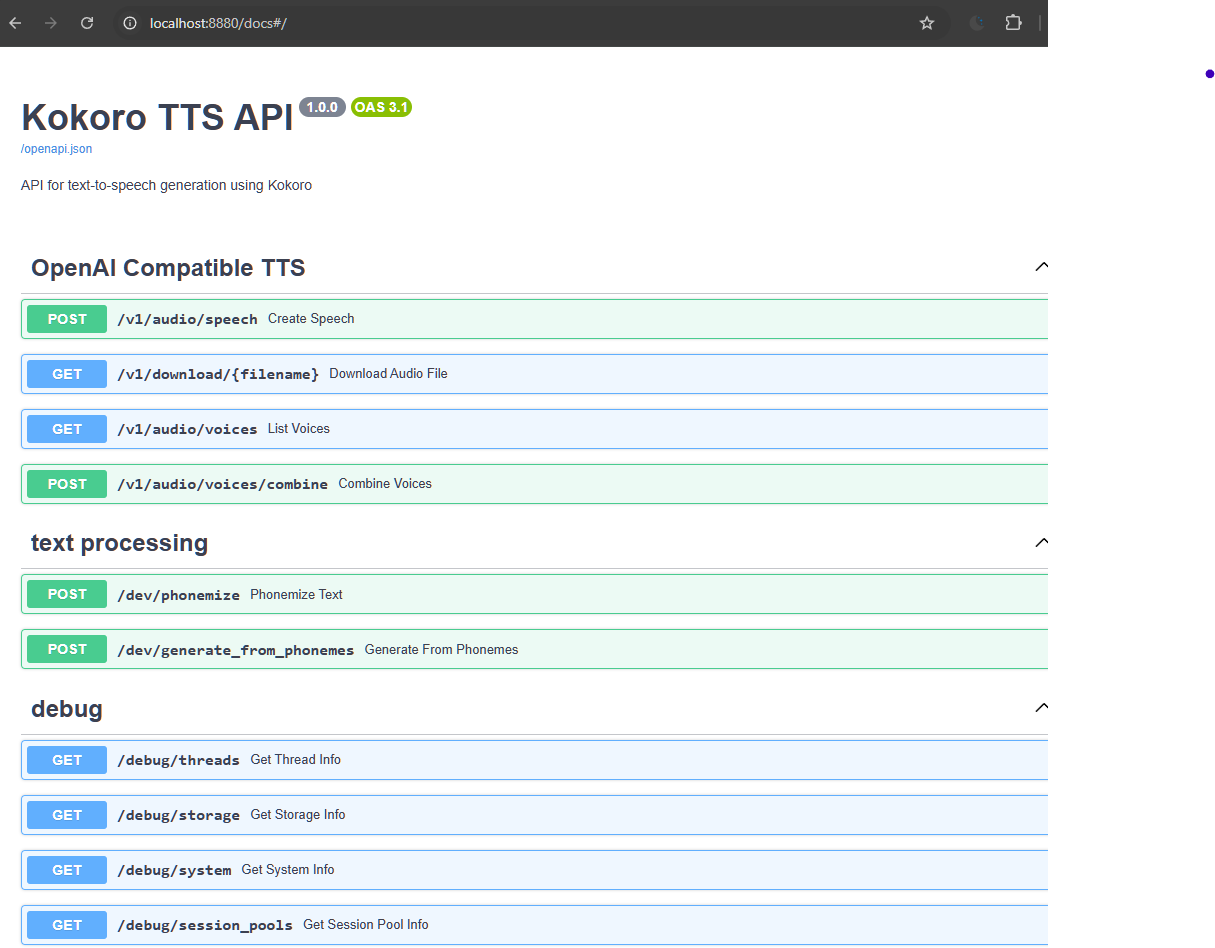
- API Documentation: http://localhost:8880/docs
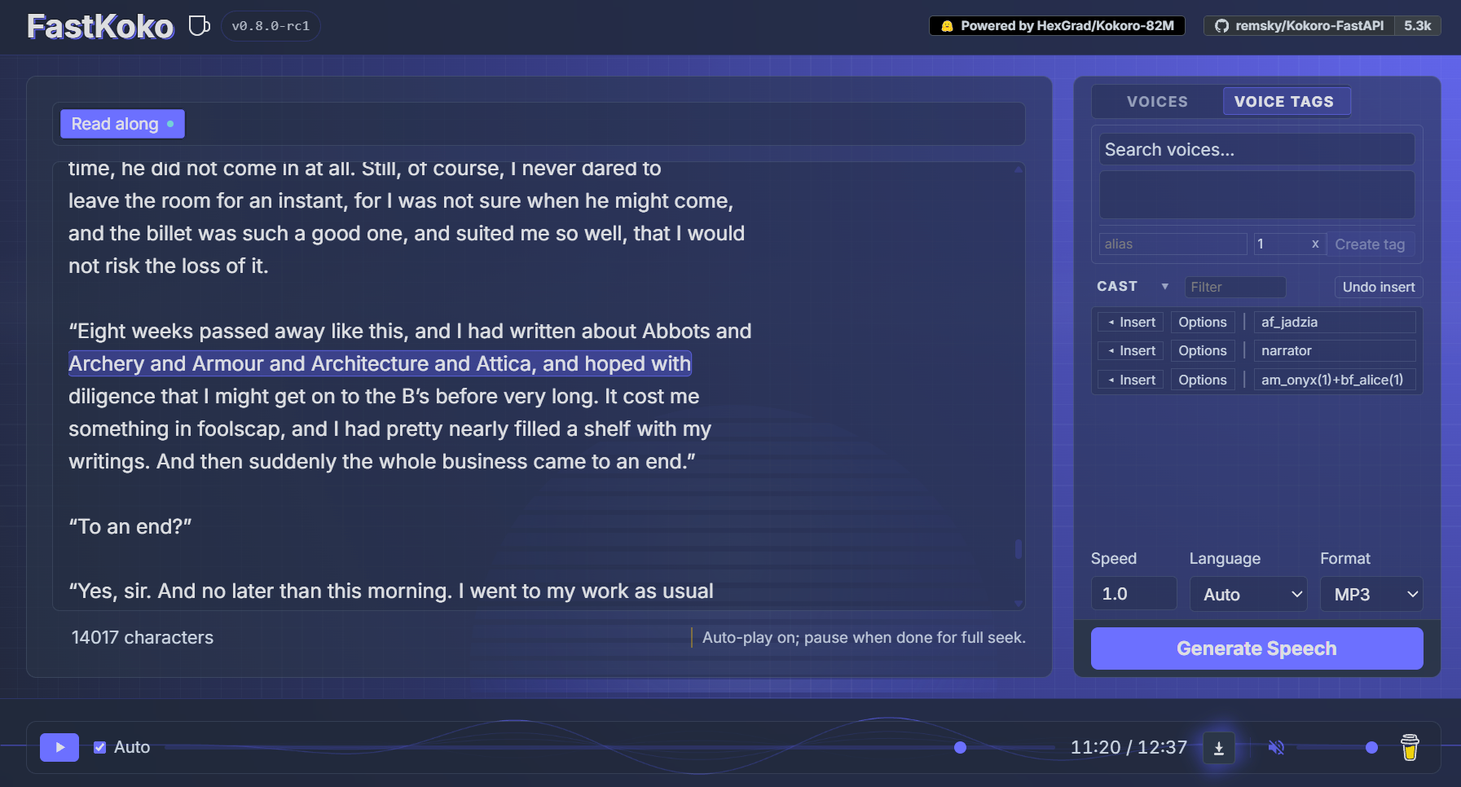
- Web Interface: http://localhost:8880/web
## Features
OpenAI-Compatible Speech Endpoint
```python
# Using OpenAI's Python library
from openai import OpenAI
client = OpenAI(base_url="http://localhost:8880/v1", api_key="not-needed")
response = client.audio.speech.create(
model="kokoro",
voice="af_bella+af_sky", # see /api/src/core/openai_mappings.json to customize
input="Hello world!",
response_format="mp3"
)
response.stream_to_file("output.mp3")
```
Or Via Requests:
```python
import requests
response = requests.get("http://localhost:8880/v1/audio/voices")
voices = [v["id"] for v in response.json()["voices"]]
# Generate audio
response = requests.post(
"http://localhost:8880/v1/audio/speech",
json={
"model": "kokoro",
"input": "Hello world!",
"voice": "af_bella",
"response_format": "mp3", # Supported: mp3, wav, opus, flac
"speed": 1.0
}
)
# Save audio
with open("output.mp3", "wb") as f:
f.write(response.content)
```
Quick tests (run from another terminal):
```bash
python examples/assorted_checks/test_openai/test_openai_tts.py # Test OpenAI Compatibility
python examples/assorted_checks/test_voices/test_all_voices.py # Test all available voices
```
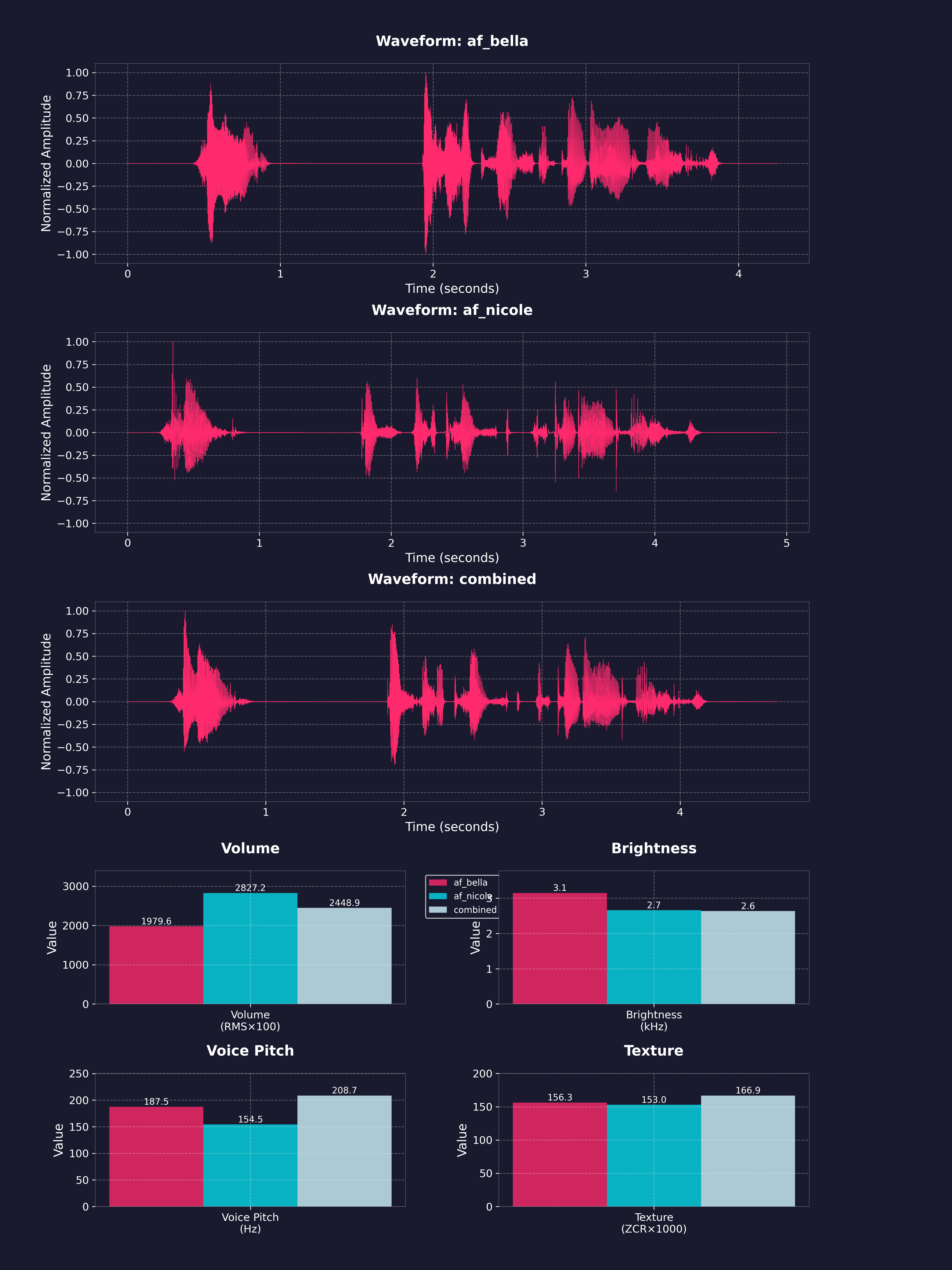
Voice Combination
- Weighted voice combinations using ratios (e.g., "af_bella(2)+af_heart(1)" for 67%/33% mix)
- Ratios are automatically normalized to sum to 100%
- Available through any endpoint by adding weights in parentheses
- Saves generated voicepacks for future use
Combine voices and generate audio:
```python
import requests
response = requests.get("http://localhost:8880/v1/audio/voices")
voices = [v["id"] for v in response.json()["voices"]]
# Example 1: Simple voice combination (50%/50% mix)
response = requests.post(
"http://localhost:8880/v1/audio/speech",
json={
"input": "Hello world!",
"voice": "af_bella+af_sky", # Equal weights
"response_format": "mp3"
}
)
# Example 2: Weighted voice combination (67%/33% mix)
response = requests.post(
"http://localhost:8880/v1/audio/speech",
json={
"input": "Hello world!",
"voice": "af_bella(2)+af_sky(1)", # 2:1 ratio = 67%/33%
"response_format": "mp3"
}
)
# Example 3: Download combined voice as .pt file
response = requests.post(
"http://localhost:8880/v1/audio/voices/combine",
json="af_bella(2)+af_sky(1)" # 2:1 ratio = 67%/33%
)
# Save the .pt file
with open("combined_voice.pt", "wb") as f:
f.write(response.content)
# Use the downloaded voice file
response = requests.post(
"http://localhost:8880/v1/audio/speech",
json={
"input": "Hello world!",
"voice": "combined_voice", # Use the saved voice file
"response_format": "mp3"
}
)
```
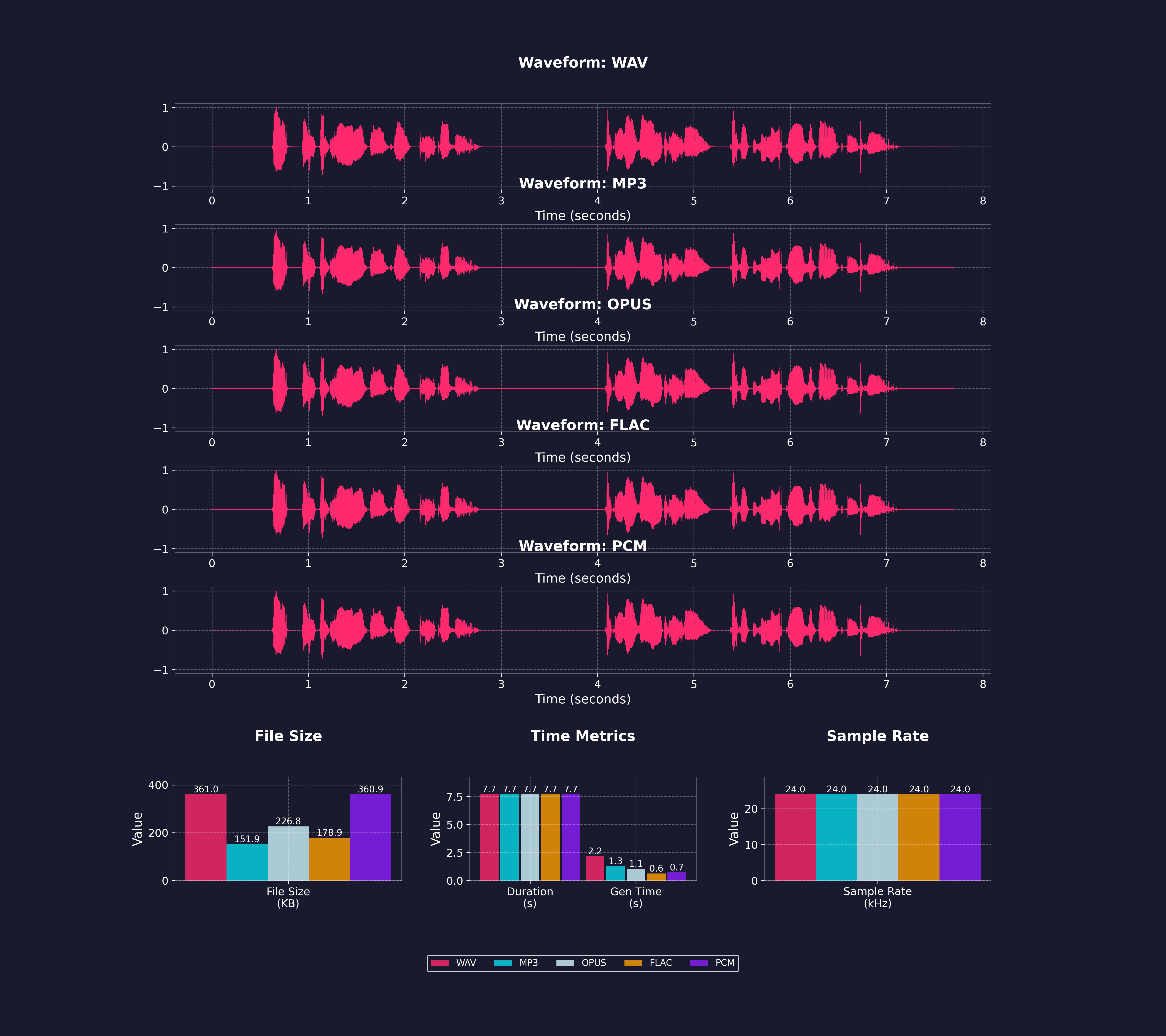
Multiple Output Audio Formats
- mp3
- wav
- opus
- flac
- m4a
- pcm
Streaming Support
```python
# OpenAI-compatible streaming
from openai import OpenAI
client = OpenAI(
base_url="http://localhost:8880/v1", api_key="not-needed")
# Stream to file
with client.audio.speech.with_streaming_response.create(
model="kokoro",
voice="af_bella",
input="Hello world!"
) as response:
response.stream_to_file("output.mp3")
# Stream to speakers (requires PyAudio)
import pyaudio
player = pyaudio.PyAudio().open(
format=pyaudio.paInt16,
channels=1,
rate=24000,
output=True
)
with client.audio.speech.with_streaming_response.create(
model="kokoro",
voice="af_bella",
response_format="pcm",
input="Hello world!"
) as response:
for chunk in response.iter_bytes(chunk_size=1024):
player.write(chunk)
```
Or via requests:
```python
import requests
response = requests.post(
"http://localhost:8880/v1/audio/speech",
json={
"input": "Hello world!",
"voice": "af_bella",
"response_format": "pcm"
},
stream=True
)
for chunk in response.iter_content(chunk_size=1024):
if chunk:
# Process streaming chunks
pass
```
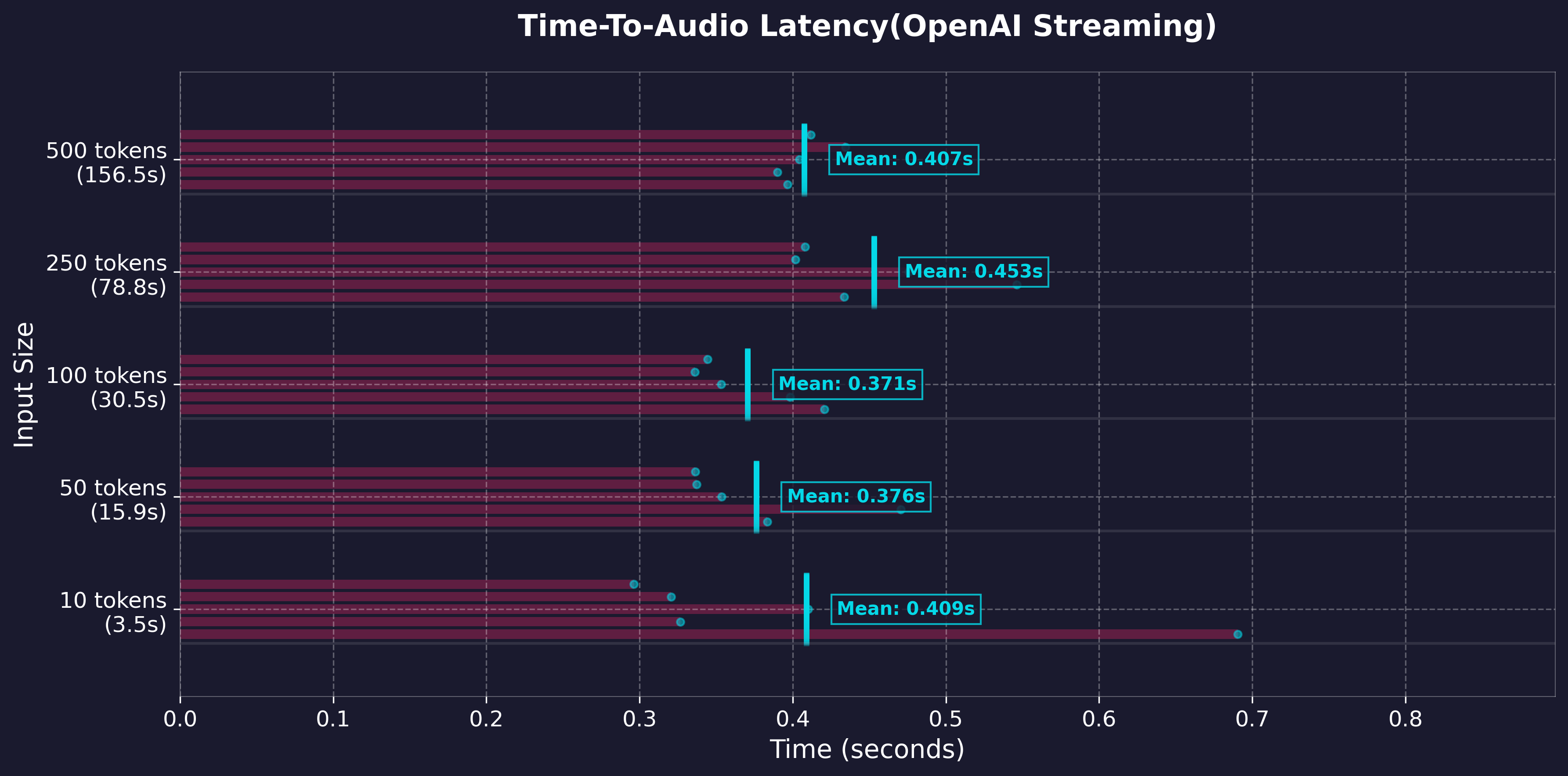
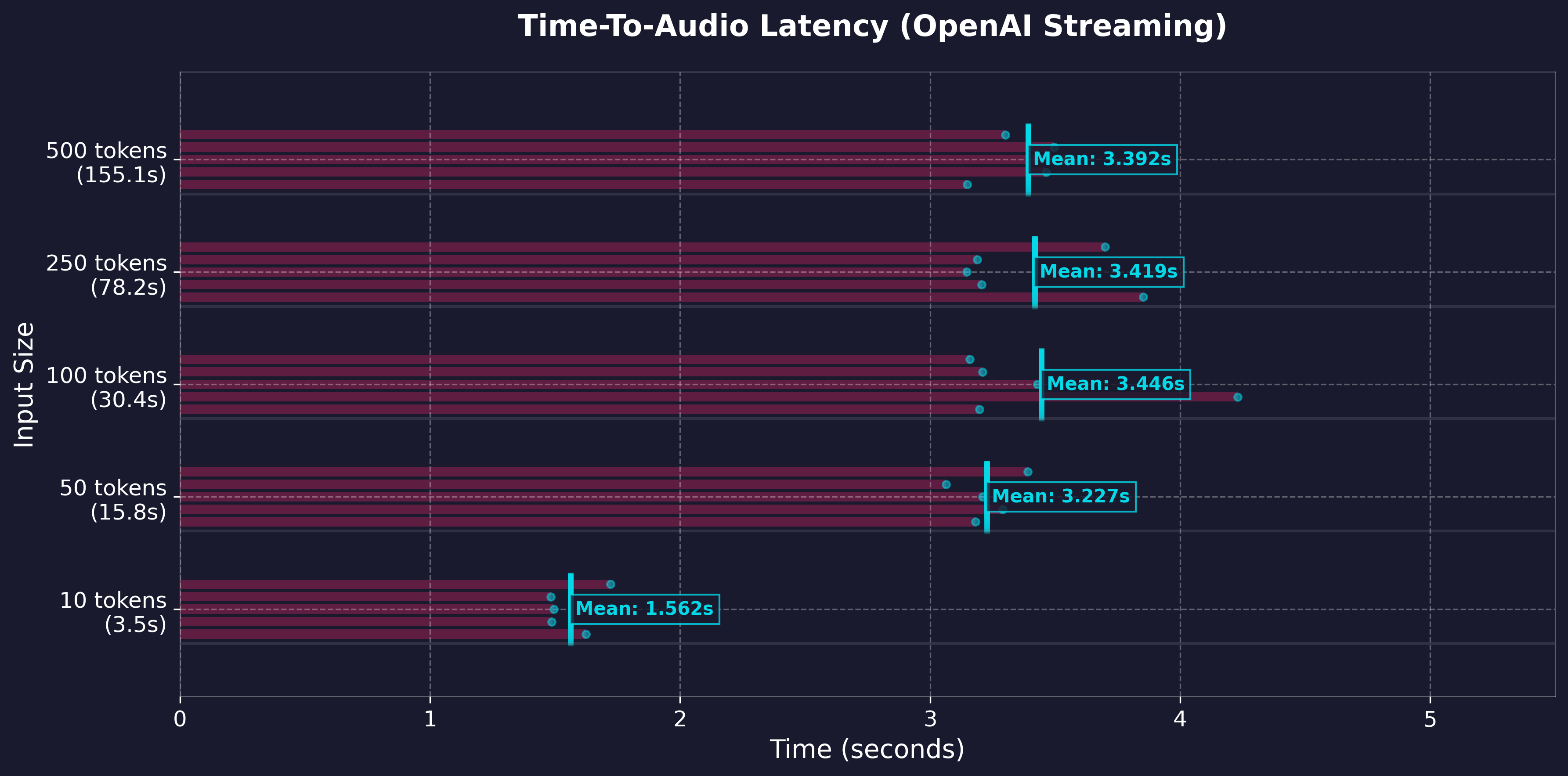
Key Streaming Metrics:
- First token latency @ chunksize
- ~300ms (GPU) @ 400
- ~3500ms (CPU) @ 200 (older i7)
- ~<1s (CPU) @ 200 (M3 Pro)
- Adjustable chunking settings for real-time playback
*Note: Artifacts in intonation can increase with smaller chunks*
## Processing Details
Performance & Benchmarks
### Hardware variants
```bash
# GPU: Requires NVIDIA driver with CUDA 12.6+ support (~35x-100x realtime speed)
cd docker/gpu
docker compose up --build
# CPU: PyTorch CPU inference
cd docker/cpu
docker compose up --build
# AMD GPU: ROCm 6.4 (experimental, amd64 only)
cd docker/rocm
docker compose up --build
```
### Throughput
Benchmarking was performed on generation via the local API using text lengths up to feature-length books (~1.5 hours output), measuring processing time and realtime factor. Tests were run on:
- Windows 11 Home w/ WSL2
- NVIDIA 4060Ti 16gb GPU @ CUDA 12.1
- 11th Gen i7-11700 @ 2.5GHz
- 64gb RAM
- WAV native output
- H.G. Wells - The Time Machine (full text)
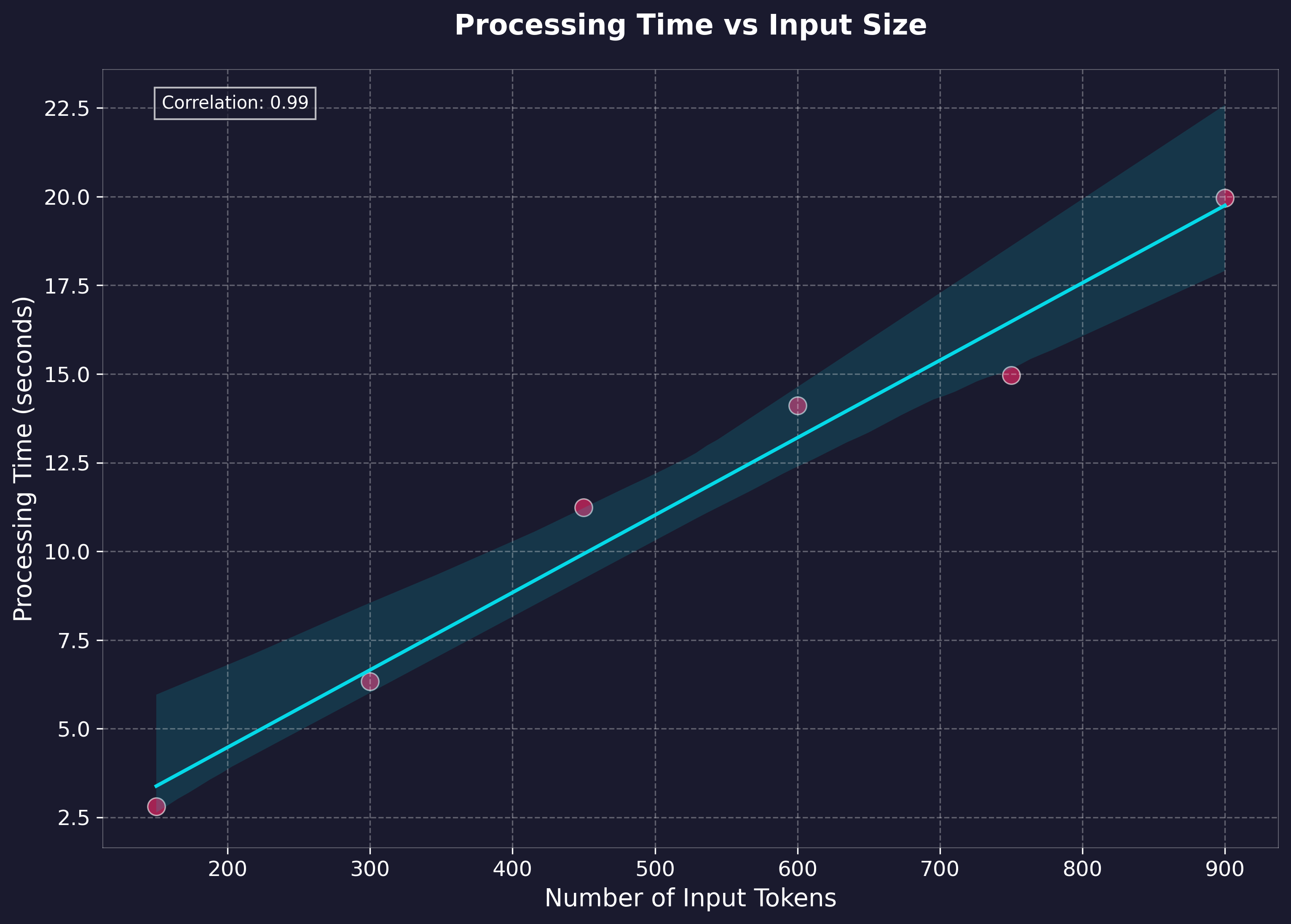
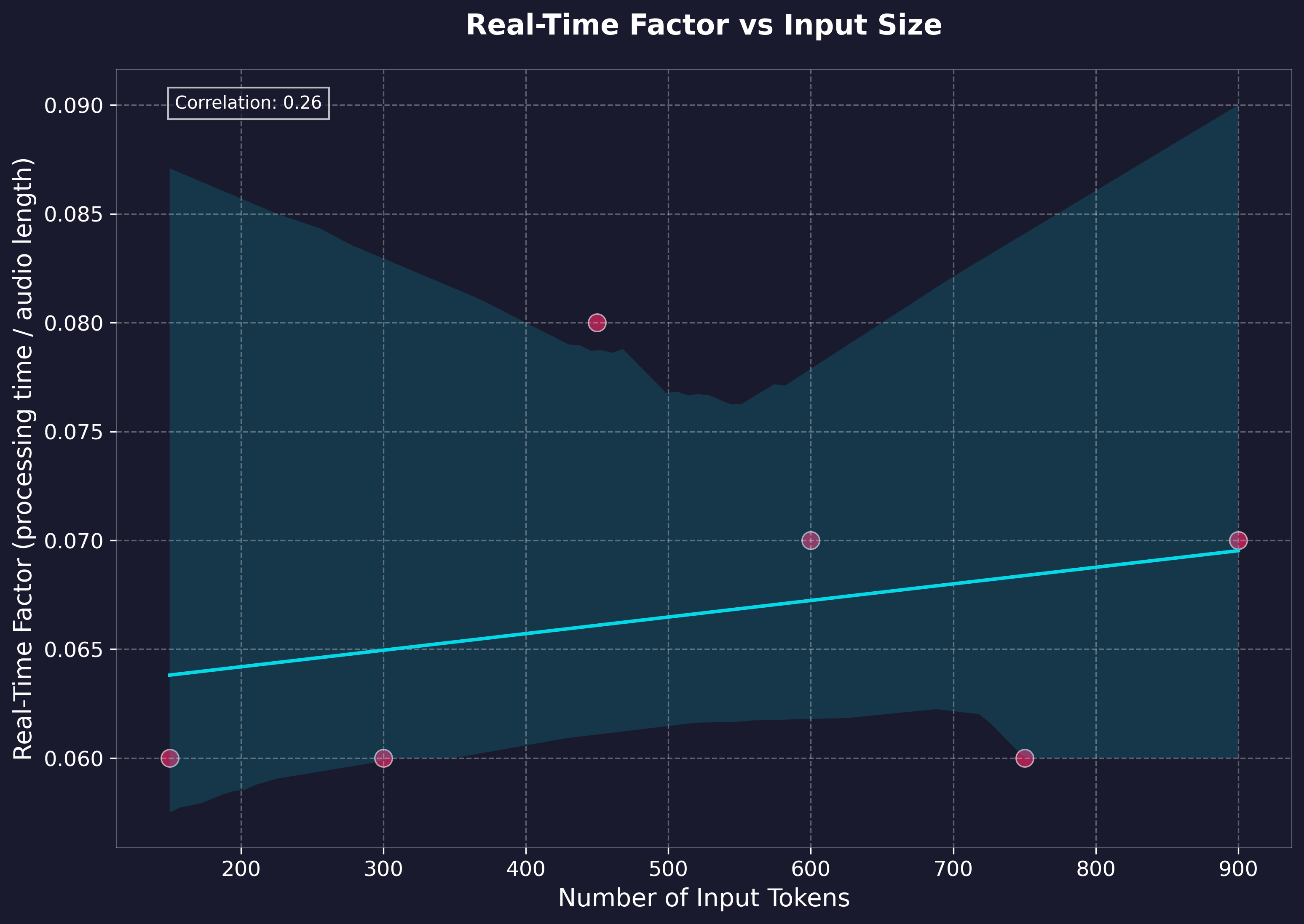
Key Performance Metrics:
- Realtime Speed: Ranges between 35x-100x (generation time to output audio length)
- Average Processing Rate: 137.67 tokens/second (cl100k_base)
### Model Unload / VRAM Reclaim
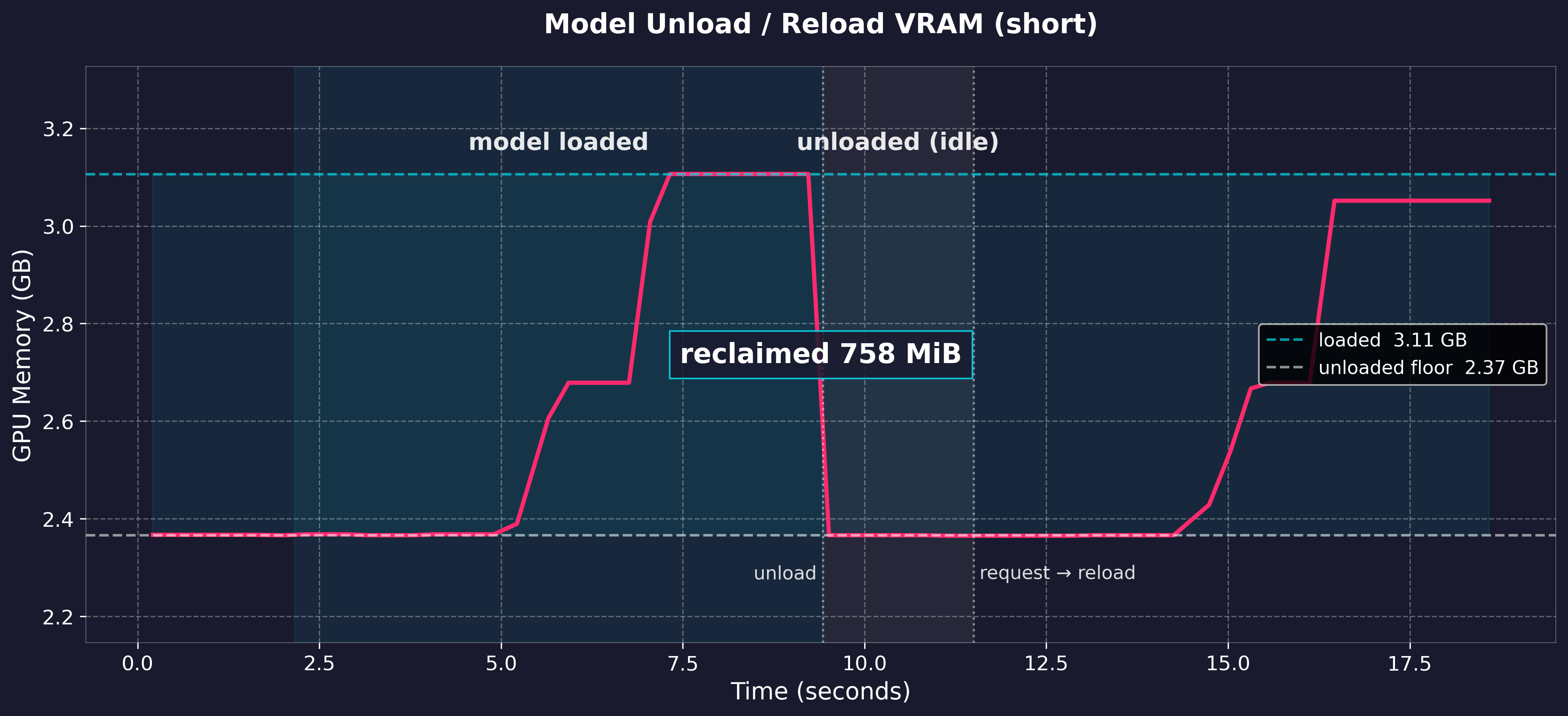
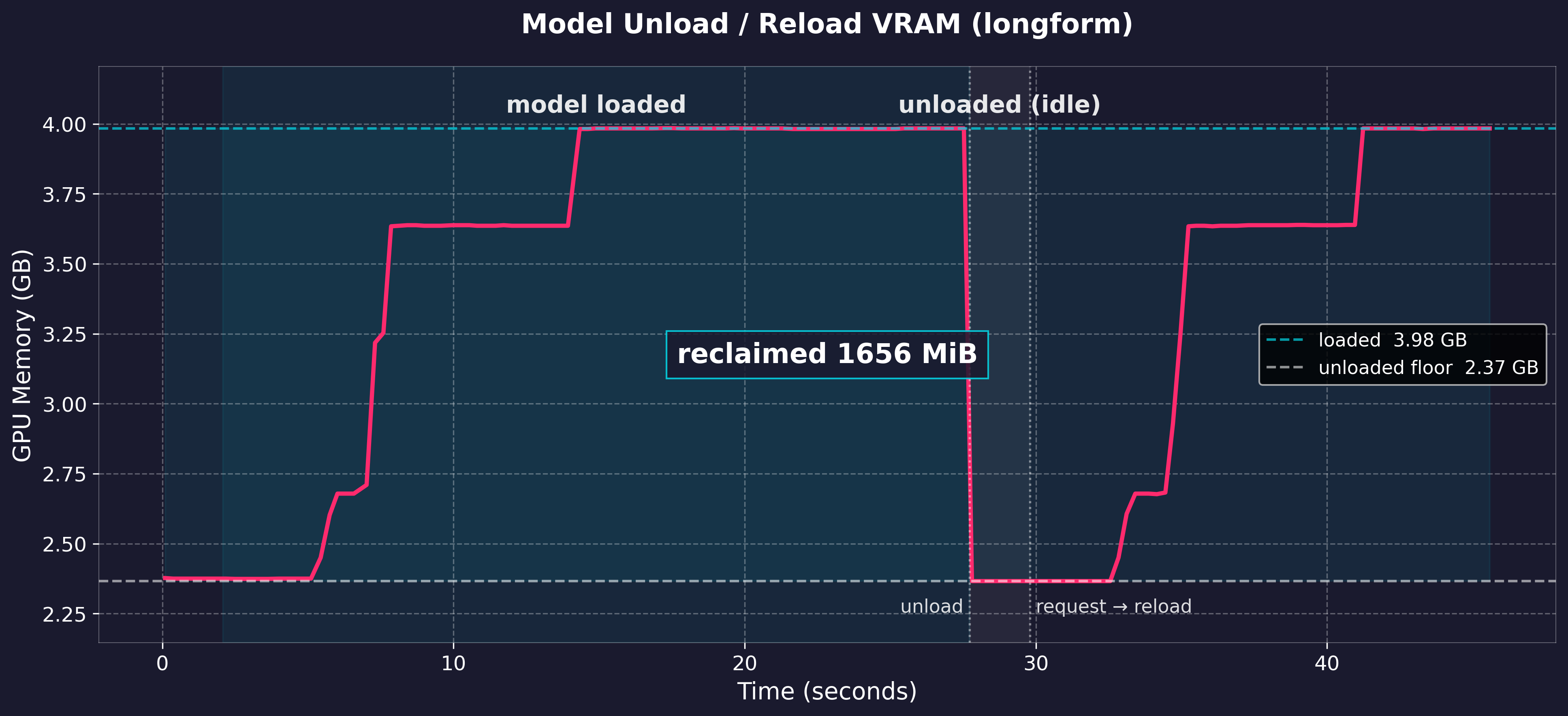
`POST /dev/unload` frees the model from VRAM and reloads lazily on the next request. Reclaim scales with load (the activation pool, not just weights) but plateaus: chunks cap at 450 tokens. Long-form = ~30 paragraphs. Same setup as above.
| Workload | Loaded | Floor | Reclaimed | Reload |
| --- | --- | --- | --- | --- |
| Short (6s audio) | 3.11 GB | 2.37 GB | 758 MiB | +4.9s |
| Long-form (7.5m) | 3.98 GB | 2.37 GB | 1,656 MiB | +5.1s |
Floor is host + CUDA context. Reproduce with `uv run --extra benchmarks assorted_checks/benchmarks/benchmark_model_unload.py` from `examples/`.
### Transcription roundtrip (WER/CER)
End-to-end roundtrip: synthesize with Kokoro, transcribe the result back with [`faster-whisper`](https://github.com/SYSTRAN/faster-whisper), compare to the source text. Scripts and data live under `examples/assorted_checks/test_transcription/`.
**Long-form English** (full book, *A Journey to the Centre of the Earth*, Project Gutenberg, voice `af_heart`, `base.en` Whisper on CUDA float16, baseline captured on cu126 GPU build):
| Run | Input chars | Audio length | Synth speedup | Transcribe speedup | WER |
| --- | --- | --- | --- | --- | --- |
| Short (~ch.7) | 64,996 | 66m 06s | 36.4x rt | 62.4x rt | **0.047** |
| Full book | 502,766 | 507m 52s | 45.7x rt | 65.1x rt | **0.033** |
See `examples/assorted_checks/test_transcription/BASELINE.md` for the full regression bands.
**Per-language check** (single-sentence per voice, multilingual Whisper `small`. WER for Latin scripts, CER for ja/zh/hi):
| Language | Voice | Metric | Score |
| --- | --- | --- | --- |
| English | `af_heart` | WER | 0.000 |
| English (UK) | `bf_emma` | WER | 0.111 |
| Spanish | `ef_dora` | WER | 0.000 |
| French | `ff_siwis` | WER | 0.000 |
| Italian | `if_sara` | WER | 0.000 |
| Portuguese | `pf_dora` | WER | 0.000 |
| Hindi | `hf_alpha` | CER | 0.059 |
| Japanese | `jf_alpha` | CER | 0.000 |
| Chinese | `zf_xiaobei` | CER | 0.143 |
*Caveat: these are single short sentences, not a comprehensive per-language quality benchmark. They confirm each voice produces transcribable audio in its target language; deeper quality evaluation per language is open work.*
To reproduce, see `examples/assorted_checks/test_transcription/README.md`.
Natural Boundary Detection
- Automatically splits and stitches at sentence boundaries
- Helps to reduce artifacts and allow long form processing as the base model is only currently configured for approximately 30s output
The model is capable of processing up to a 510 phonemized token chunk at a time, however, this can often lead to 'rushed' speech or other artifacts. An additional layer of chunking is applied in the server, that creates flexible chunks with a `TARGET_MIN_TOKENS` , `TARGET_MAX_TOKENS`, and `ABSOLUTE_MAX_TOKENS` which are configurable via environment variables, and set to 175, 250, 450 by default
Timestamped Captions & Phonemes
Generate audio with word-level timestamps without streaming:
```python
import requests
import base64
import json
response = requests.post(
"http://localhost:8880/dev/captioned_speech",
json={
"model": "kokoro",
"input": "Hello world!",
"voice": "af_bella",
"speed": 1.0,
"response_format": "mp3",
"stream": False,
},
stream=False
)
with open("output.mp3","wb") as f:
audio_json=json.loads(response.content)
# Decode base 64 stream to bytes
chunk_audio=base64.b64decode(audio_json["audio"].encode("utf-8"))
# Process streaming chunks
f.write(chunk_audio)
# Print word level timestamps
print(audio_json["timestamps"])
```
Generate audio with word-level timestamps with streaming:
```python
import requests
import base64
import json
response = requests.post(
"http://localhost:8880/dev/captioned_speech",
json={
"model": "kokoro",
"input": "Hello world!",
"voice": "af_bella",
"speed": 1.0,
"response_format": "mp3",
"stream": True,
},
stream=True
)
f=open("output.mp3","wb")
for chunk in response.iter_lines(decode_unicode=True):
if chunk:
chunk_json=json.loads(chunk)
# Decode base 64 stream to bytes
chunk_audio=base64.b64decode(chunk_json["audio"].encode("utf-8"))
# Process streaming chunks
f.write(chunk_audio)
# Print word level timestamps
print(chunk_json["timestamps"])
```
Phoneme & Token Routes
Convert text to phonemes and/or generate audio directly from phonemes:
```python
import requests
def get_phonemes(text: str, language: str = "a"):
"""Get phonemes and tokens for input text"""
response = requests.post(
"http://localhost:8880/dev/phonemize",
json={"text": text, "language": language} # "a" for American English
)
response.raise_for_status()
result = response.json()
return result["phonemes"], result["tokens"]
def generate_audio_from_phonemes(phonemes: str, voice: str = "af_bella"):
"""Generate audio from phonemes"""
response = requests.post(
"http://localhost:8880/dev/generate_from_phonemes",
json={"phonemes": phonemes, "voice": voice},
headers={"Accept": "audio/wav"}
)
if response.status_code != 200:
print(f"Error: {response.text}")
return None
return response.content
# Example usage
text = "Hello world!"
try:
# Convert text to phonemes
phonemes, tokens = get_phonemes(text)
print(f"Phonemes: {phonemes}") # e.g. ðɪs ɪz ˈoʊnli ɐ tˈɛst
print(f"Tokens: {tokens}") # Token IDs including start/end tokens
# Generate and save audio
if audio_bytes := generate_audio_from_phonemes(phonemes):
with open("speech.wav", "wb") as f:
f.write(audio_bytes)
print(f"Generated {len(audio_bytes)} bytes of audio")
except Exception as e:
print(f"Error: {e}")
```
See `examples/phoneme_examples/generate_phonemes.py` for a sample script.
Inline Control Tokens
Two tokens can be embedded in the `input` text and are parsed server-side (API, WebUI, or any client):
- **Pause**: `[pause:1.5s]` inserts that much silence. Must be exactly this form (colon, trailing `s`, case-insensitive). `[pause=1.5]`, `[PAUSE 1.0]`, and SSML `` are not recognized and get read aloud.
- **Pronunciation**: `[Worcester](/wˈʊstər/)` speaks the IPA between the slashes instead of the word. English only; use `/dev/phonemize` to find the IPA.
```text
The city of [Worcester](/wˈʊstər/) is easy. [pause:1s] See?
```
Debug Endpoints
Monitor system state and resource usage with these endpoints:
- `/debug/threads` - Get thread information and stack traces
- `/debug/storage` - Monitor temp file and output directory usage
- `/debug/system` - Get system information (CPU, memory, GPU)
- `POST /dev/unload` - Release model from VRAM; reloads lazily on next request
Useful for debugging resource exhaustion or performance issues.
Logging
Global API [loguru logging level](https://loguru.readthedocs.io/en/stable/api/logger.html#levels) can be set using the `API_LOG_LEVEL` environment variable. Defaults to `DEBUG`.
**Docker**
Modify the appropriate compose `yml` or append to command line.
```bash
docker run --env 'API_LOG_LEVEL=WARNING' ...
```
**Direct via UV**
Linux and macOS
```bash
export API_LOG_LEVEL=WARNING
./start-cpu.sh OR
./start-gpu.sh
```
Windows
```powershell
$env:API_LOG_LEVEL = 'WARNING'
.\start-cpu.ps1 OR
.\start-gpu.ps1
```
## Known Issues & Troubleshooting
Missing words & Missing some timestamps
The api will automatically do text normalization on input text which may incorrectly remove or change some phrases. This can be disabled by adding `"normalization_options":{"normalize": false}` to your request json:
```python
import requests
response = requests.post(
"http://localhost:8880/v1/audio/speech",
json={
"input": "Hello world!",
"voice": "af_heart",
"response_format": "pcm",
"normalization_options":
{
"normalize": False
}
},
stream=True
)
for chunk in response.iter_content(chunk_size=1024):
if chunk:
# Process streaming chunks
pass
```
Linux GPU Permissions
Some Linux users may encounter GPU permission issues when running as non-root.
Can't guarantee anything, but here are some common solutions, consider your security requirements carefully
### Option 1: Container Groups (Likely the best option)
```yaml
services:
kokoro-tts:
# ... existing config ...
group_add:
- "video"
- "render"
```
### Option 2: Host System Groups
```yaml
services:
kokoro-tts:
# ... existing config ...
user: "${UID}:${GID}"
group_add:
- "video"
```
Note: May require adding host user to groups: `sudo usermod -aG docker,video $USER` and system restart.
### Option 3: Device Permissions (Use with caution)
```yaml
services:
kokoro-tts:
# ... existing config ...
devices:
- /dev/nvidia0:/dev/nvidia0
- /dev/nvidiactl:/dev/nvidiactl
- /dev/nvidia-uvm:/dev/nvidia-uvm
```
⚠️ Warning: Reduces system security. Use only in development environments.
Prerequisites: NVIDIA GPU, drivers, and container toolkit must be properly configured.
Visit [NVIDIA Container Toolkit installation](https://docs.nvidia.com/datacenter/cloud-native/container-toolkit/latest/install-guide.html) for more detailed information
WAV duration reported as nonsense in some readers
WAV responses ship with streaming-sentinel (`0xFFFFFFFF`) size fields in the header. Most readers (`soundfile`, `pydub`/ffmpeg, browsers, OS players) handle this fine. Python's stdlib `wave` does not, and reports a bogus duration. Use `soundfile.info(path).duration` or `ffprobe` for exact length.
## Project
Versioning & Development
**Branching Strategy:**
* **`release` branch:** Contains the latest stable build, recommended for production use. Docker images tagged with specific versions are built from this branch.
* **`master` branch:** Used for active development. It may contain experimental features, ongoing changes, or fixes not yet in a stable release. Use this branch if you want the absolute latest code, but be aware it might be less stable. The `latest` Docker tag often points to builds from this branch.
Note: This is a *development* focused project at its core.
If you run into trouble, you may have to roll back a version on the release tags if something comes up, or build up from source and/or troubleshoot + submit a PR.
Free and open source is a community effort, and there's only really so many hours in a day. If you'd like to support the work, feel free to open a PR, buy me a coffee, or report any bugs/features/etc you find during use.

Model
This API uses the [Kokoro-82M](https://huggingface.co/hexgrad/Kokoro-82M) model from HuggingFace.
Visit the model page for more details about training, architecture, and capabilities. I have no affiliation with any of their work, and produced this wrapper for ease of use and personal projects.
License
This project is licensed under the Apache License 2.0 - see below for details:
- The Kokoro model weights are licensed under Apache 2.0 (see [model page](https://huggingface.co/hexgrad/Kokoro-82M))
- The FastAPI wrapper code in this repository is licensed under Apache 2.0 to match
- The inference code adapted from StyleTTS2 is MIT licensed
The full Apache 2.0 license text can be found at: https://www.apache.org/licenses/LICENSE-2.0
## Contributor Stats
 Made with [contrib.rocks](https://contrib.rocks).