<div align="center">

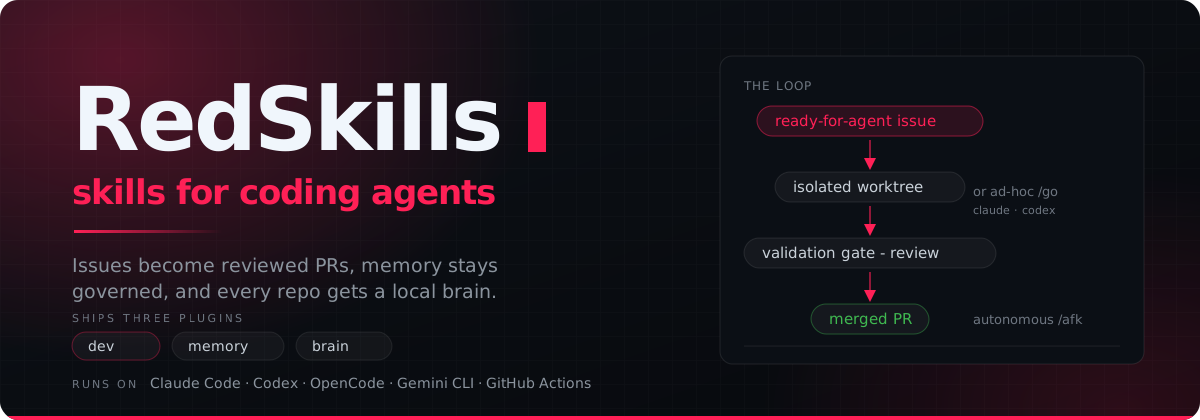
<img src="docs/hero.svg" alt="RedSkills - agent workflow, governed Memory, and Brain knowledge for serious engineering agents" width="100%" />

<p>
  <a href="https://www.npmjs.com/package/@reddb-io/red-skills"><img src="https://img.shields.io/npm/v/%40reddb-io%2Fred-skills?style=for-the-badge&label=npm&color=ff2056&labelColor=0d1117" alt="npm version"></a>
  <a href="https://github.com/reddb-io/red-skills/actions/workflows/red-workspace-ci.yml"><img src="https://img.shields.io/github/actions/workflow/status/reddb-io/red-skills/red-workspace-ci.yml?branch=main&style=for-the-badge&label=CI&labelColor=0d1117" alt="CI"></a>
  <a href="LICENSE"><img src="https://img.shields.io/badge/license-Apache--2.0-blue?style=for-the-badge&labelColor=0d1117" alt="License"></a>
  <a href=".claude-plugin/marketplace.json"><img src="https://img.shields.io/badge/marketplace-dev%20%7C%20memory%20%7C%20brain-ff2056?style=for-the-badge&label=plugins&labelColor=0d1117" alt="Plugins"></a>
</p>

<strong>The operating system for agentic engineering work.</strong><br>
RedSkills turns GitHub issues into reviewed PRs, remembers the operational
evidence that prevents repeated mistakes, and gives every repo a local knowledge
surface for Claude Code, Codex, OpenCode, Gemini CLI, Pi, and GitHub Actions.

</div>

---

RedSkills is reddb.io's plugin suite for serious code-agent workflows. It
started as a reddb.io adaptation of
[`mattpocock/skills`](https://github.com/mattpocock/skills): small `SKILL.md`
files that teach agents concrete behaviors. RedSkills keeps that core and adds
the pieces teams need when agents are doing real engineering work: issue
automation, isolated worktrees, autonomous execution, governed Memory, Brain,
MCP servers, release bundles, status signals, and guardrails.

One piece shapes everything else: a **host-scoped daemon** that owns every
agent process on the machine. Read
[The Execution Model](#the-execution-model) first — the rest of this document
assumes it.

Attribution is preserved in [NOTICE](./NOTICE).

## Contents

**Start here**

- [Core And Complementary](#core-and-complementary) — the one distinction the rest of this document obeys

**Core**

- [The Execution Model](#the-execution-model) — the host-scoped `redskilled` daemon
- [The Loop](#the-loop) — issue to reviewed PR
- [What Ships](#what-ships) — the `dev`, `memory`, and `brain` plugins

**Installing and using it**

- [Install](#install) — the universal installer
- [Quick Start](#quick-start) — bootstrap a repo and move work
- [Host Support](#host-support) — which agent host gets which surface

**Complementary**

- [Surfaces Over The Daemon](#surfaces-over-the-daemon) — herdr, VSCode, the statusline
- [Token-Efficient Terminal Work](#token-efficient-terminal-work) — `rsp`
- [GitHub Actions Lane](#github-actions-lane) — one autonomous attempt in CI
- [Container Lane](#container-lane) — AFK in a stateless Docker image

**Reference**

- [TOON And TOONL](#toon-and-toonl) — the serialization mandate and the repo-wide invariants
- [Configuration](#configuration) — `.red/config.yaml`
- [Repo Layout](#repo-layout) — what lives where
- [Skill Map](#skill-map) — every shipped skill
- [Development In This Repo](#development-in-this-repo) — building and testing RedSkills itself
- [License](#license)

## Core And Complementary

RedSkills has a **core** and a **complementary layer**, and telling them apart is
the fastest way to read this repository. The core is what makes an agent move
work: the plugins that teach it, the daemon that runs it, and the issue-to-PR
loop that governs it. Everything else is an **accelerator over that core** —
useful, independently installable, and never load-bearing for the loop itself.

**Core — remove any of these and work stops moving.**

| Piece | What it is | Where |
| --- | --- | --- |
| `dev`, `memory`, `brain` | The three marketplace plugins. Dev moves work, Memory improves agent execution, Brain preserves human-facing knowledge. | [What Ships](#what-ships) |
| `redskilled` | The host-scoped execution daemon. It owns the processes that do the work. | [The Execution Model](#the-execution-model) |
| The issue-to-PR loop | GitHub Issues as the work queue, isolated worktrees, gates, and review-gated landing. | [The Loop](#the-loop) |

**Complementary — remove any of these and the loop still runs, more slowly or
less visibly.**

| Piece | What it is | Where |
| --- | --- | --- |
| [`rsp`](./apps/rsp/README.md) | Token-efficient terminal wrappers over a reversible elision store, plus `rsp wait`. | [Token-Efficient Terminal Work](#token-efficient-terminal-work) |
| [`herdr-plugin`](./apps/herdr-plugin-red-skills/README.md) | A [herdr](https://herdr.dev) plugin pane reading the daemon: Workers, logs, events, PRs. | [Surfaces Over The Daemon](#surfaces-over-the-daemon) |
| [`vscode-extension-red-skills`](./apps/vscode-extension-red-skills/README.md) | A VSCode extension reading the same daemon from inside the editor. | [Surfaces Over The Daemon](#surfaces-over-the-daemon) |
| The statusline | The daemon's own one-line answer, rendered by the daemon and printed by the host. | [Surfaces Over The Daemon](#surfaces-over-the-daemon) |
| The Actions lane | One autonomous attempt per issue, from GitHub Actions, without a local daemon. | [GitHub Actions Lane](#github-actions-lane) |
| [`afk-container`](./apps/afk-container/README.md) | The same drain in a stateless Docker image. | [Container Lane](#container-lane) |
| [`code-nav`](./apps/code-nav/README.md) | The LSP-backed `navigator` MCP server used by `dev` for codebase orientation. | [Repo Layout](#repo-layout) |
| [`red-browser`](./apps/red-browser) | Browser CLI and CDP driver for ground-truth verification of live apps. | [Repo Layout](#repo-layout) |

Two properties are neither core nor complementary — they are **house rules the
whole repo obeys**: structured data is TOON everywhere (files *and* wires), and
agent work happens in disposable worktrees while the primary checkout's branch
stays under human control. Both are enforced as ratchets, not conventions; see
[TOON And TOONL](#toon-and-toonl) and [Configuration](#configuration).

## The Execution Model

Without a shared host, every checkout ran its own execution plane. Each one sized itself
against the machine independently, so N repositories draining work at once spent
the same host budget N times and nothing on the machine knew the total.
[ADR 0130](./.red/adr/0130-redskilled-host-scoped-execution-daemon.md) replaced
that with one process.

**`redskilled` is the host-scoped execution daemon: exactly one singleton per
machine, behind a unix socket.** It owns Worker processes across every project
on that machine — birth, death, limits, and placement — while each project's
bundle keeps owning the work. A second OS user on the same machine is refused by
name rather than served from the first user's daemon (Amendment 3).

### The demand loop

There are exactly **two players**, and the loop belongs to the one that outlives
the session (Amendment 4):

```text
registration  ->  tracker poll  ->  admission  ->  birth
(project MCP)     (daemon)         (daemon)       (daemon)
```

| Step | Who | What actually happens |
| --- | --- | --- |
| **Registration** | The project's MCP, alive in a user's session | Hands over an opaque work selector, a launch template (argv + env), and a target. Renewed while the session lives, survives that session's end, lapses after a stated interval, and deregisters itself when the queue drains. |
| **Tracker poll** | The daemon | Reads queue depth for every registered project on one shared credential. GitHub quota is per token, so one aliased request for N projects is the saving that splitting the poller across N processes cannot make. |
| **Admission** | The daemon | Only it sees every project at once, so only it can decide how many Workers the host affords. A project asks; a smaller grant is an ordinary answer, recorded with the host's own reason. |
| **Birth** | The daemon | Launches the Worker into a resource unit of its own — a transient init-system unit, not a daemon child — substituting the four per-birth facts it owns (`{{worker_id}}`, slot, workspace, log path) into the launch template it was handed. |

The launch is **restated, not frozen** (Amendment 5): a tick that swapped the
runner sends the new argv/env pair on the renewal its session already sends, and
the daemon holds it as the launch for the *next* Worker. That is what lets a
drain start on `claude`, meet repeated deaths, and swap to `codex` without a new
op or a window where the host holds no record of a project that is still working.

### What the daemon refuses to know

Its contract is minimal and frozen: **argv, placement target, budget, opaque
project label — never repository layout.** It does not know what an Issue, a
label, a Spec, a gate or a Landing is. A selector is a string it carries, never a
sentence it reads. That refusal is load-bearing: it is what lets one daemon serve
checkouts pinned to different bundle versions, which dissolves bundle-version
skew rather than managing it.

Three properties follow, and they are the ones worth trusting:

- **It fails closed.** No daemon, no Worker. A launcher that cannot reach the
  daemon throws; there is no quiet local fallback, because a Worker a project
  starts itself is one no admission verdict judged — outside the host budget,
  absent from the host event lane, reported by no surface. The repo enforces this
  as a CI ratchet: a per-project module that can create a process fails
  `invariants:host-owns-birth`.
- **A restart costs none of it.** Workers are init-system units, so the daemon
  re-attaches by unit name and rehydrates identity and budget from its own
  append-only TOONL event lane. A stop is a restart, not an evacuation, and
  `redskilled stop` prints exactly what survives it.
- **Reach is asymmetric.** A session reads *every* project's Workers — diagnosing
  contention from wherever you happen to be is the problem the daemon exists to
  solve — and writes only its own. A refusal never distinguishes "no such Worker"
  from "not your Worker", so a session cannot map another project by guessing.

### The MCP is the interface

The `castle` MCP server is the canonical **complete** interface to every
execution capability — project registration and status, worker dispatch, runner
steering, the gate, landing and cascade, claims, the worktree pool, hygiene,
observability, and the queue ([ADR 0120](./.red/adr/0120-red-castle-is-the-afk-mcp.md),
consolidated by [ADR 0123](./.red/adr/0123-boundary-consolidation-mcp-first-skills-and-pruned-castle.md)).
The CLI, `/afk`, `/go`, and every UI over the daemon are **clients of it**, never
owners of a capability the MCP lacks. Every tool wraps a value-returning
primitive rather than the print-and-exit command layer and returns TOON, so one
core answers both transports; mutating tools carry a `MUTATING:` prefix and are
announced before use.

### Provisioning

A daemon starts on first use, so the floor is auto-spawn and supervision is
optional. One command establishes both halves and prints the audit; it is what
`/red-setup` runs:

```bash
redskilled provision                  # start the daemon, print the audit
redskilled provision --check          # the read-only half — creates nothing, starts nothing
redskilled provision --install-unit   # also write the optional supervising user unit
redskilled statusline global          # every project's Workers, each showing its owner
redskilled stop                       # stop the daemon; print what survives it
```

The operator-scoped home `~/.red/redskilled/` has exactly one creator —
`provisionRedskilledHome` (Amendment 2) — and is created only when a declared
workspace target reads it. It is *not* the checkout's `.red/`, whose sole
creator remains `/red-setup`; ADR 0067's authority is repository-scoped.
`/red-doctor` reports the same four checks (`home`, `daemon-entry`, `reach`,
`supervisor-unit`) read-only, probing the socket without ever spawning the daemon
it reports on.

Full detail: [apps/redskilled](./apps/redskilled/README.md).

## The Loop

**Issue to PR is the product.** RedSkills treats GitHub Issues as the work queue,
not a side note. `/triage`, `/to-spec`, `/to-tickets`, `/afk`, `/go`, `/hitl`, and
`/retake` all speak the same issue-state vocabulary, and **agents work in
disposable worktrees** so the primary checkout stays under human branch control.

```text
Plan -> Spec -> sliced issues -> ready-for-agent -> isolated worktree
  -> validation -> PR -> review/checks -> merge -> Memory evidence
```

The issue lifecycle is intentionally boring:

```text
needs-triage -> /triage -> ready-for-agent -> /afk -> PR/merge -> closed
                                |
                                +---- blocked/spec/validation/etc.
                                      -> ready-for-human -> /hitl or /retake
```

Important states:

| State | Meaning |
| --- | --- |
| `ready-for-agent` | The only issue state autonomous drainage consumes. |
| `running` | Timeline state while a Worker owns the issue. Live state is the daemon's. |
| `ready-for-human` | A human decision is needed before delegation is safe. |
| `blocked:dependency` | Waits on `req:N` labels and should not page a human. |
| `blocked:validation` / `blocked:spec` | Can be requeued only after retry guidance is already decided. |
| `blocked:ci` | The branch is pushed and the pull request is real, but the queue handed it back. |

### Landing in the merge-queue era

**The merge command exiting 0 is not the merge.** Under a merge queue — the
forge's own, or `--auto` — exit 0 means *enqueued*, so landing ends by asking the
pull request itself and treats only `state: MERGED` as landed. A queue that hands
the PR back parks `blocked:ci` with the issue open and the branch on origin;
nothing closes, relabels, deletes, or cascades before that confirmation.

CI is queue-aware on the other side of the same seam: a merge queue tests each
candidate on a temporary `gh-readonly-queue/*` branch and reports through the
`merge_group` event, so
[`red-workspace-ci.yml`](./.github/workflows/red-workspace-ci.yml) subscribes to
it. Without that trigger the required checks never report for a queued entry and
the queue accepts pull requests and then holds them forever.

## What Ships

Three plugins install from one marketplace. **One source tree, several hosts:**
Claude Code, Codex, Gemini CLI, OpenCode, Pi, GitHub Actions, MCP servers, and
the herdr dashboard are generated from or read the same plugin definitions and
runtime apps.

| Plugin | Job | Use it when |
| --- | --- | --- |
| [`dev`](./plugins/dev/.claude-plugin/plugin.json) | Engineering workflow: issue triage, autonomous execution, worktree safety, review-gated landing, process dashboards, runner policy, and codebase orientation. | You want an agent to plan, execute, review, or ship code work. |
| [`memory`](./plugins/memory/README.md) | Governed operational memory: decisions, validations, reasoning attempts, stale-claim checks, context packs, and skill telemetry evidence. | You want agents to stop repeating old mistakes after context resets. |
| [`brain`](./plugins/brain/README.md) | Project-local knowledge: typed artifacts, personal/project facts, sources, graph connections, search, cited answers, and dashboards. | You want durable knowledge the human may ask about later. |

Maintainer-only plugin:

| Plugin | Job | Use it when |
| --- | --- | --- |
| [`internal`](./plugins/internal/README.md) | Maintainer-only skills for operating this repository. Installable through the normal marketplace flow, but active only when `plugins.internal.enabled: true` is present. | You maintain `red-skills` itself. |

### Dev
<img src="docs/plugin-dev.svg" alt="dev plugin - issue pipeline, autonomous execution, landing, and codebase orientation" width="100%" />

`dev` owns the engineering workflow: issue pipeline, autonomous execution,
interactive landing, process visibility, setup/adoption checks, codebase
orientation, and three MCP servers — [`castle`](./plugins/dev/skills/engineering/afk/MCP.md),
[`navigator`](./apps/code-nav/README.md), and [`rsp`](./apps/rsp/README.md).

Core responsibilities:

- Bootstrap RedSkills with [`red-setup`](./plugins/dev/skills/engineering/red-setup/SKILL.md).
- Maintain issue state with [`triage`](./plugins/dev/skills/engineering/triage/SKILL.md), [`to-spec`](./plugins/dev/skills/engineering/to-spec/SKILL.md), and [`to-tickets`](./plugins/dev/skills/engineering/to-tickets/SKILL.md).
- Execute delegable work with [`afk`](./plugins/dev/skills/engineering/afk/SKILL.md), or dispatch one concrete demand with [`go`](./plugins/dev/skills/engineering/go/SKILL.md).
- Land a hand-worked branch with [`retake`](./plugins/dev/skills/engineering/retake/SKILL.md) (the retired `ship` migrated there — ADR 0081).
- Resolve human gates with [`hitl`](./plugins/dev/skills/engineering/hitl/SKILL.md) or safe retries with [`retake`](./plugins/dev/skills/engineering/retake/SKILL.md).

Dev guard rails:

- When `plugins.dev.enabled: true`, the dev PreToolUse proxy enforces the
  worktree boundary for agent shell commands: `git worktree add` must target a
  registered lane under `.red/tmp/`, and branch-moving commands in the primary checkout
  (`git switch`, `git checkout <branch>`, `git checkout -b`, `git switch -c`,

  `gh pr checkout`) are blocked. Create branches through
  `git worktree add .red/tmp/worktrees/manual/<slug> -b <branch> ...` instead.
- `plugins.dev.lock.primary-branch` remains the explicit branch-lock workflow
  flag that setup writes for compatibility and base-pinning integrations.
- The dev shell-command guard is controlled by `command_guard` in
  `.red/config.yaml`. It runs from the agent `PreToolUse` hook, stays inert
  unless `plugins.dev.enabled: true`, and blocks matching shell commands before
  execution. These repo-defined rules are **additional** to the built-in
  `.red/tmp` worktree boundary above. `global` rules apply everywhere, `main`
  rules apply in the primary session scope (not specifically the Git branch
  named `main`), and `worktree` rules apply in `/afk` and `/go` worktrees
  under `.red/tmp/`. Deny rules
  support `regex:<pattern>`, `prefix:<literal>`, `suffix:<literal>`,
  `exact:<literal>`, and `glob:<pattern>`. Bare entries with `*`, `?`, or `[`
  are Bash globs; other bare entries match the exact command, a command prefix,
  or a command suffix at a shell-command boundary. `command_guard.deny` remains
  a legacy alias for `command_guard.global`.

Example policy, not a default:

```yaml
command_guard:
  global:
    - "rm -Rf /*"
    - "git stash"
    - sudo
    - 'regex:(^|[;&|[:space:]])curl[[:space:]].*\|[[:space:]]*sh'
  main:
    - "git rebase"
    - "git checkout -b"
  worktree:
    - "git clean"

plugins:
  dev:
    enabled: true
```

### Memory

<img src="docs/plugin-memory.svg" alt="memory plugin - governed evidence that makes the next agent safer and faster" width="100%" />

`memory` is governed operational memory for code agents. **Memory is evidence,
not vibes.** It stores work evidence that can make future agents safer and
faster: decisions, root causes, validation evidence, reasoning attempts,
stale-claim checks, readiness, handoffs, and skill telemetry evidence — so a
future agent can verify an old claim before acting on it.

Memory modes:

| Mode | Storage | Best for |
| --- | --- | --- |
| `markdown-only` | Plain notes under `.red/memory/notes/`. | Low-risk rollout with explicit store/recall only. |
| `graph` | Project-local RedDB store at `.red/memory/graph.rdb`. | Governed recall, provenance, supersession, readiness, context packs, Workbench, MCP/HTTP, and Skill telemetry. |

Memory is not the Personal-fact store. Personal facts belong in Brain, not Memory.
Broad human-facing project knowledge belongs in Brain too.

Start with [plugins/memory/README.md](./plugins/memory/README.md).

### Brain

<img src="docs/plugin-brain.svg" alt="brain plugin - project-local knowledge, cited synthesis, and a local dashboard" width="100%" />

`brain` is a project-local knowledge repository under `.red/brain/*`. It stores
typed artifacts and graph connections for later search and cited synthesis.

Use Brain for:

- Personal facts, durable preferences, identity context, and relationship notes.
- Project notes, decisions, ideas, questions, sources, bookmarks, and meeting
  residue.
- `brain think` cited answers with confidence and missing-evidence signals.
- `brain dashboard` local summaries and KPI-style views.
- Optional outbound channel actions through the Brain channel bridge.

Start with [plugins/brain/README.md](./plugins/brain/README.md).

## Install

The fastest route on Claude Code is the plugin marketplace, straight from the
session:

```
/plugin marketplace add reddb-io/red-skills
/plugin install dev@red-skills
/plugin install memory@red-skills
/plugin install brain@red-skills
```

Codex and Gemini have the same marketplace flow through their own CLIs — the
exact commands live in [docs/INSTALL.md](./docs/INSTALL.md).

For every other host, and for machine-wide installs and upgrades, use the
universal installer:

```bash
curl -fsSL https://raw.githubusercontent.com/reddb-io/red-skills/v3/scripts/install.sh | bash
```

The installer resolves the latest GitHub Release, stores it under
`~/.red-skills/versions/<tag>`, updates `~/.red-skills/current`, detects which
supported CLIs are present (`claude`, `codex`, `opencode`, `pi`), then installs
the right surface for each host:

| Host | What the installer does |
| --- | --- |
| Claude Code | Registers the RedSkills marketplace and installs `dev`, `memory`, and `brain`. |
| Codex CLI | Registers the RedSkills marketplace and installs `dev`, `memory`, and `brain`. |
| Gemini CLI | Registers the RedSkills marketplace and installs `dev`, `memory`, and `brain`. |
| OpenCode | Generates and installs OpenCode plugin modules, skills, MCP config, provider config, and TUI attention config. |
| Pi | Registers one Pi package per plugin via `pi install`, exposes the same skill buckets through the standard agent skills protocol. |

OpenCode installs use the published `opencode-host.bundle.min.mjs` asset when
available, so normal installs need `node` but do not need a local workspace
build. If that asset is unavailable for a pinned older release, the installer
falls back to building from source with `pnpm`.

Useful options:

```bash
# inspect without writing
curl -fsSL https://raw.githubusercontent.com/reddb-io/red-skills/v3/scripts/install.sh | bash -s -- --dry-run

# install only one host
curl -fsSL https://raw.githubusercontent.com/reddb-io/red-skills/v3/scripts/install.sh | bash -s -- --only opencode
curl -fsSL https://raw.githubusercontent.com/reddb-io/red-skills/v3/scripts/install.sh | bash -s -- --only pi

# pin a release
curl -fsSL https://raw.githubusercontent.com/reddb-io/red-skills/v3/scripts/install.sh | bash -s -- --version v3.1.2

# force plugin reinstall where the host supports removal
curl -fsSL https://raw.githubusercontent.com/reddb-io/red-skills/v3/scripts/install.sh | bash -s -- --force

# uninstall from every detected host
curl -fsSL https://raw.githubusercontent.com/reddb-io/red-skills/v3/scripts/install.sh | bash -s -- --uninstall

# uninstall and remove the ~/.red-skills release cache
curl -fsSL https://raw.githubusercontent.com/reddb-io/red-skills/v3/scripts/install.sh | bash -s -- --uninstall --purge
```

After installing, restart any already-open CLI sessions so they reload plugin
manifests. Then run `/red-setup` in a project from Claude Code or
OpenCode, or `$dev:red-setup` in Codex when the client exposes
namespace-qualified skills.

**Installing a single host by hand, or from a checkout?** The per-host manual
walkthroughs (Claude Code, Codex CLI, Gemini CLI, OpenCode, Pi), the no-marketplace
symlink path, the generated-manifest maintenance commands, and the runner doctor
live in [docs/INSTALL.md](./docs/INSTALL.md).

## Quick Start

### 1. Bootstrap A Repo

Run this inside a target repository:

```text
/red-setup
```

It creates and wires the RedSkills operating surface:

- `.red/config.yaml` with explicit `plugins.<name>.enabled: true` flags.
- GitHub issue labels such as `needs-triage`, `ready-for-agent`,
  `ready-for-human`, `running`, `blocked:*`, `blocked:dependency`, and `req:N`.
- Domain docs under `.red/CONTEXT-MAP.md`, `.red/contexts/*/CONTEXT.md`, and
  ADRs under `.red/adr/`.
- `AGENTS.md` / `CLAUDE.md` blocks for agent skills and the development
  workflow.
- RedSkills workflows such as `red-issues-needs-triage.yml`.
- A reachable `redskilled` daemon, by calling `redskilled provision` (Section E3)
  and offering the optional supervising user unit.
- Optional statusline wiring and primary-checkout branch guardrails.

Re-run `/red-setup` when adoption drifts. Run `/red-doctor` to inspect drift
and operational probes without changing anything, or `/red-doctor --fix` for the
approved, per-finding gated repair path.

### 2. Move Work Through Issues

```text
/start                  # sharpen a plan against domain language and ADRs
/wayfinder              # map work too large for one agent session
/to-spec                 # publish the plan as a Spec issue
/to-tickets <spec>        # cut vertical implementation slices
/triage                 # make an issue delegable
/afk                    # drain ready-for-agent work in isolated worktrees
```

Shortcuts:

- Already have a delegable issue? Use `/afk --issues N`.
- Already have a spec? Use `/to-tickets` or `/triage`.
- Hit a bug? Use `/report-bug`, then `/triage`.
- One genuinely untracked, one-off demand? Use `/go "<demand>"` — it mints a
  disposable `lane:go` issue, works in an isolated worktree, runs the shared
  gate, and brings back a PR. Tracked backlog work belongs to `/afk`.
- Something is urgent? Label the issue `priority:urgent`; the `/afk` queue
  promotes it ahead of every `--spec` / `--issues` filter.

### 3. Use Memory And Brain Deliberately

```text
$init                 # Memory setup: markdown-only or graph
$store Decision: ...
$recall topic
$capture Long-lived project or personal context...
$search topic
$think question
```

Use Memory for operational evidence that helps future agents act. Use Brain for
knowledge the human wants preserved, searched, and cited later.

## Host Support

| Host | Surface | Notes |
| --- | --- | --- |
| Claude Code | Marketplace plugins, slash commands, skills, hooks, MCP servers | Primary interactive host. |
| Codex CLI | Marketplace plugins, `$skill` invocation, MCP servers, footer integration | Namespace-qualified skill names may appear depending on client version. |
| Gemini CLI | Marketplace plugins, skills, hooks, MCP servers | Fully natively supported via generated manifests. |
| OpenCode | Generated `.opencode/skills`, plugin modules, MCP config, provider config, TUI attention config | Installed through `scripts/install-opencode.sh`. |
| Pi | One npm-published package per plugin (`@reddb-io/red-skills-<plugin>` on npm, staged under `packaging/pi/<name>/`) carrying the shared skill buckets | Installed through `pi install npm:@reddb-io/red-skills-<plugin>`, or via `scripts/install-pi.sh` for repo-scoped installs and the `--source-dir` dev path. |
| GitHub Actions | Reusable attempt workflow and composable action | Runs one autonomous attempt per issue in adopter repos — see [GitHub Actions Lane](#github-actions-lane). |

## Surfaces Over The Daemon

Because the daemon answers one question — *what is this machine currently
doing* — every surface over it is a **reader**, and the readers stay honest by
construction: the payload dates itself, so staleness is rendered rather than
re-derived, and an absence is never a zero. **No agent host renders anything:**
the daemon renders from the very payload the structured op returns, and a test
proves the two agree.

### herdr plugin

[`apps/herdr-plugin-red-skills/`](./apps/herdr-plugin-red-skills/README.md) is a
[herdr](https://herdr.dev) plugin, vendored into this repo by
[ADR 0131](./.red/adr/0131-herdr-plugin-is-vendored-in-this-repo.md). It answers
the daemon's question in one pane:

- **Workers** — every live Worker across every project, with its state, uptime,
  measured RSS against its declared budget, whether it got a unit of its own, and
  the last line it published.
- **Logs** — a Worker's own log tailed from the path the daemon was handed at
  spawn, plus the host event lane: birth, death, budget-kill.
- **Pull requests** — each registered project's open PRs, open issues, and
  recently closed work, polled once per interval for the whole host.
- **Notifications** — raised on a *transition*, never a state: a Worker ended, one
  was killed over budget, the daemon went away or came back, a project's open PR
  count rose, an upgrade is waiting.

```bash
pnpm install                    # from the repo root, once
herdr plugin link apps/herdr-plugin-red-skills
```

It holds itself to the daemon's own rules. **It reads and never writes** —
`worker-start`, `worker-command`, `project-register` and `shutdown` are never
sent, and a test asserts it. **It never spawns the daemon**, because a pane
opening on session restore must not be what starts a machine-wide singleton.
**The status line is the daemon's**, asked for rather than redrawn.

Why it lives here: it read `redskilled` from its own repository, so a contract
change here silently aged the client there — the wire became TOON and the plugin
still wrote a line of JSON, kept working only because the daemon answers in the
dialect it was addressed in. The repo-wide invariants stopped at the repo
boundary too. Absorbed at `apps/herdr-plugin-red-skills/` on the ADR 0124 precedent — a real
directory, an `.upstream` marker recording the absorbed commit, every later
change an ordinary one-PR change here — its `check-manifest.py` and `node --test`
suite now run under the shared gate. Its bin is `red-skills-herdr`, because
`red-skills` is the name `@reddb-io/red-skills` already ships under.

The same entry runs outside herdr, which is what makes it debuggable:

```bash
node bin/red-skills-herdr.mjs doctor     # why this plugin sees what it sees
node bin/red-skills-herdr.mjs status     # the daemon's own status line
node bin/red-skills-herdr.mjs dashboard  # the pane, in this terminal
node bin/red-skills-herdr.mjs logs --events
```

### VSCode extension

[`apps/vscode-extension-red-skills/`](./apps/vscode-extension-red-skills/README.md) is the same
reader inside the editor. It contributes three tree views and a log channel:

| View | Reads | Answers |
| --- | --- | --- |
| **Workers** | `statusline-payload` | What is running now — RSS against the declared ceiling, uptime, isolation, the last line each Worker logged. |
| **Host events** | the TOONL event lane beside the socket | What *happened* — births, deaths with their exit status, budget kills, the daemon's own stop. |
| **Pull requests** | `statusline-payload` | Each registered project's open PR and issue counts, as the host polled them. |
| **Worker log** | the Worker's own `log_path` | The tail of one Worker's log, followed as it grows. |

The socket answers "what is running NOW" and the lane answers "what happened",
and both are read every tick: a Worker that vanished between two reads tells you
it is gone, and only the lane tells you whether it exited 0, was killed over its
ceiling, or took a signal.

It obeys the same two refusals as the herdr plugin — **it sends only `ping`,
`host-state` and `statusline-payload`**, and it **never starts the daemon**,
because a tree view restoring with a window must not be what births a
machine-wide singleton. An absent daemon is reported as absent, with the socket
path and the rule that produced it in the tooltip. Notifications fire on a
*transition*, never a state; the first read of a session is deliberately silent,
and `redskilled.notifications.workerBirth` is off by default.

The `.vsix` is **never published** — build and install it from the checkout:

```bash
pnpm -C apps/vscode-extension-red-skills build      # typecheck + bundle out/extension.cjs
pnpm -C apps/vscode-extension-red-skills package    # write dist/reddb-io.vscode-extension-red-skills-<version>.vsix
code --install-extension apps/vscode-extension-red-skills/dist/reddb-io.vscode-extension-red-skills-0.1.0.vsix
```

### Statusline

`redskilled statusline` is the agent-host surface. The default mode is the local
project; `global` is the whole machine, naming the owner of each Worker.
`--verbose` adds each Worker's last logged line — published on its heartbeat as
an opaque string the daemon stores and returns without parsing, so the whole
global verbose view is still one read and opens no project's files. A crowded
machine **degrades rather than overflows**: one entry per project, then the host
total, with the loss stated rather than left to be detected by re-parsing.

## Token-Efficient Terminal Work

`rsp` ([`apps/rsp/`](./apps/rsp/README.md), ADR 0095) wraps the noisy development
commands and keeps their full output in a **reversible elision store**, so an
agent reads a compact summary and can recover the original bytes on demand.
**Terminal output is elided, not truncated.**

```bash
rsp git status          rsp gh pr view        rsp vitest run
rsp git diff --brief    rsp gh issue list     rsp cargo test
rsp git log --terse     rsp gh run view       rsp cat <file>
rsp show el:<id>        # the original bytes, verbatim
```

Three properties make it safe to leave on:

- **Elision is reversible, never truncation.** Lossy output mints an `el:<id>`
  handle and `rsp show el:<id>` writes the original bytes back to stdout. An
  expired handle prints the exact command to reproduce it rather than pretending.
- **Failure passes through.** A disabled wrapper, a missing store, or an
  unreachable resident costs the elision and never the command: raw stdout,
  stderr, and exit status arrive intact.
- **The resident is the core** (ADR 0126). The CLI, the wrappers, the pre-exec
  hook, the proxy, and the MCP server are peer clients of one process behind a
  unix socket, so a host with no MCP server connected is fully supported.

`rsp wait` is the standard waiting primitive — for PR checks, Actions runs,
releases, and local async commands. Run it in a background shell and treat
process exit as the signal; never hand-write a sleep-polling loop.

```bash
rsp wait pr 123 --reason "before merge"
rsp wait run --branch feature/x --latest
rsp wait cmd -- "pnpm -C apps/rsp build"
```

Exit codes are the verdict: `0` success, `1` failure, `2` timeout or
indeterminate. Every wait emits an `rsp.wait.result` envelope, sealed to disk
*before* any wake, so a signaled process always reads a complete result.

## GitHub Actions Lane

The Actions lane runs one autonomous attempt per issue from GitHub Actions. It is
for adopter repos that want cloud execution without a local daemon.

| Layer | Artifact | Job |
| --- | --- | --- |
| Trigger + policy | [`reusable-afk-attempt.yml`](./.github/workflows/reusable-afk-attempt.yml) | `workflow_call`, manual dispatch, and trust gate. |
| Execution | [`.github/actions/afk-attempt`](./.github/actions/afk-attempt/action.yml) | Sets up Node, runner CLI, auth env, and invokes the launcher. |
| Runtime distribution | `afk.mjs` + the `@reddb-io/red-skills` npm package | Resolves the versioned `dev` bundle matching the checked-out red-skills ref via npm (ADR 0091), cache-first. |

Adoption paths:

- **Turnkey caller:** install or copy an `rs-afk-attempt.yml` caller that wires
  issue/manual triggers to
  `reddb-io/red-skills/.github/workflows/reusable-afk-attempt.yml@v3`.
- **Composable action:** use
  `reddb-io/red-skills/.github/actions/afk-attempt@v3` from your own workflow.

Pin `@v3` to track the latest compatible v3 release; the publish workflow moves
that major tag on every release. Pin a SHA when the caller needs a fully
immutable action/runtime pair.

Workflow naming convention:

| Prefix | Meaning |
| --- | --- |
| `reusable-*` | Reusable `workflow_call` workflow referenced by `uses:`; never copied into adopters. |
| `rs-*` | A caller that instantiates a `reusable-*` workflow with concrete triggers/inputs. |
| `red-*` | Standalone RedSkills workflow; internal CI or verbatim copy-installable. |

Full guide: [Actions lane](./plugins/dev/skills/engineering/afk/actions-lane.md).

## Container Lane

[`apps/afk-container/`](./apps/afk-container/README.md) is the same drain in a
self-sufficient Docker image: it picks a runner, picks the queue head, clones the
target repo into a temp directory, and hands the issue to
`red-skills-dev run --issues <N> --runner <R> --once` — the same engine path the
local daemon and the Actions lane drive. Claim comment, heartbeat, validation
gate and pull request all come from that engine; the container reimplements
nothing.

It is **stateless by construction**: no volume, no daemon, no cache to preserve.
All durable state is on GitHub — the issue with its labels and its
claim/heartbeat/park comments, plus the run branch and pull request the engine
pushes. The clone lives in a temp directory and is deleted when the run ends, on
any path, so the container can be killed at any moment.

## TOON And TOONL

RedSkills serializes structured data as [TOON](https://github.com/reddb-io/toon),
and append streams as **TOONL** — segment headers declare a schema once, rows
follow positionally, and a crash-truncated open tail is valid ("unverified",
never corrupt). Snapshots are TOON; append streams are TOONL (ADR 0097, extending
ADR 0089). Prose is never serialized.

The mandate has **two dimensions**, and the second one is the one that bit us:

- **On a file.** A `*.toon` file is written with the TOON encoder, never
  `JSON.stringify`. The decoder sniffs JSON-or-TOON and accepts both, so a
  JSON-written `.toon` looks correct locally and is wrong by policy.
- **On a wire.** A `JSON.stringify` handed to a socket write, or a `JSON.parse`
  of a framed payload read off one, fails the same way a JSON file write does.
  The guard was originally named for its own limit, which is why the daemon's
  whole request/response wire was JSON while every file it wrote was already TOON.

Both are enforced as a **repo-wide ratchet** that runs in every gate run, however
narrow the cone: new JSON I/O under `apps/` or `packages/` must be fixed or
classified in `.red/contracts/toon-json-file-io-allowlist.json`, and the failure
names the offending path, the encoder that replaces it, and the allowlist. Two
things stay green by design: quoting a value inside an error message (legibility,
not a payload) and a site reached only behind an explicit `--json` flag (the
mandate governs the default).

The other repo-wide invariants run beside it — `invariants:host-owns-birth` (only
the daemon births a Worker), `invariants:extinct-nouns` (ADR 0130's removed
concepts stay removed, including modules merely *named* for one), and
`invariants:shipped-binaries` (every shipped binary answers `--version` and
`--help` without a working machine). The declared list lives in
[`apps/dev/src/core/repo-invariants.ts`](./apps/dev/src/core/repo-invariants.ts).

## Configuration

Per-repo RedSkills config lives in `.red/config.yaml`. The canonical written
form is namespaced under `plugins.<name>.*`.

Minimal `dev` activation:

```yaml
plugins:
  dev:
    enabled: true
    lock:
      primary-branch: true
```

Activation is **strict opt-in** (ADR 0067): a plugin installs its hooks globally
but stays fully inert — no bundle fetch, no hooks — in any directory whose
`.red/config.yaml` does not set `enabled: true` for it.

Example runner/model config:

```yaml
plugins:
  dev:
    enabled: true
    afk:
      models:
        opencode:
          think:
            model: minimax/MiniMax-M3
```

Model defaults and escalation rules are documented in
[`model-tier-policy`](./plugins/dev/skills/engineering/model-tier-policy/SKILL.md).
The runtime source of truth is `CONFIG_DEFAULTS` in
[`apps/dev/src/core/config.ts`](./apps/dev/src/core/config.ts).

Operator-declared pre-merge checks (backpressure):

```yaml
plugins:
  dev:
    afk:
      backpressure:
        - pnpm lint
        - cargo fmt --check
```

`afk.backpressure` is an ordered list of shell commands run in the worker-branch
worktree after the implicit feedback gate (test/typecheck/lint/build) passes on
the DONE path. Any non-zero command blocks the merge and parks the issue exactly
like a feedback failure. When the list is non-empty, every executed check — pass
and fail alike — is also rendered as a single aggregated, non-blocking `COMMENT`
PR review, so the PR carries a legible evidence ledger without adding a new gate.

House rules:

- Labels are kebab-case or `prefix:value`: `needs-triage`, `ready-for-agent`,
  `ready-for-human`, `priority:urgent`, `blocked:dependency`, `spec:42`.
- RedSkills-managed workflows use role prefixes: `red-*`, `reusable-*`, or
  `rs-*`.
- Issues and Specs live on GitHub Issues.
- Project artifacts live under `.red/`: tracked knowledge in
  `.red/{config.yaml,adr/,contexts/,contracts/,hooks/}`, durable machine state
  under `.red/state/`, and 100% disposable scratch under `.red/tmp/` in a named
  lane (ADR 0098).
- Use SSH git remotes for autonomously managed repositories.
- Do task work in isolated worktrees; the primary checkout's branch is for the
  human to control.

## Repo Layout

| Path | Purpose |
| --- | --- |
| [`plugins/dev`](./plugins/dev) | Plugin definition, skills, hooks, scripts, MCP config, and docs for engineering workflow. |
| [`plugins/memory`](./plugins/memory) | Plugin definition and skills for governed operational memory. Runtime source lives in `apps/memory`. |
| [`plugins/brain`](./plugins/brain) | Plugin definition and skills for Brain. Runtime source lives in `apps/brain`. |
| [`plugins/internal`](./plugins/internal) | Maintainer-only plugin definition and skills for operating this repository. |
| [`apps/redskilled`](./apps/redskilled) | The host-scoped execution daemon (ADR 0130): socket, lease, wire contract, placement, birth, event lane, statusline, provisioning, reclaim. |
| [`apps/herdr-plugin-red-skills`](./apps/herdr-plugin-red-skills) | Vendored herdr plugin that reads the daemon (ADR 0131): Workers, logs, event lane, pull requests, notifications. `.upstream` records the absorbed commit. |
| [`apps/vscode-extension-red-skills`](./apps/vscode-extension-red-skills) | VSCode extension that reads the daemon from inside the editor: Workers, host events, pull requests, per-Worker log channel, transition notifications. |
| [`apps/rsp`](./apps/rsp) | Token-efficient terminal wrappers, the elision store and resident, the interception hook and proxy, `rsp wait`, and the rsp MCP server. |
| [`apps/dev`](./apps/dev) | Issue pipeline, execution, landing, dashboard, triage, runner, release/channel, repo invariants, and workflow runtime code. |
| [`apps/memory`](./apps/memory) | Memory CLI, graph operations, Workbench, MCP/HTTP surfaces, evals, and diagnostics. |
| [`apps/brain`](./apps/brain) | Brain CLI, store, MCP server, dashboard, channel bridge, and artifact logic. |
| [`apps/code-nav`](./apps/code-nav) | LSP-backed `navigator` MCP server used by the `dev` plugin. |
| [`apps/opencode-host`](./apps/opencode-host) | Adapter that emits OpenCode config, skills, hooks, MCP passthrough, and statusline/toast integration. |
| [`apps/red-browser`](./apps/red-browser) | Browser CLI: opens a local annotation bridge for HTML artifacts, long-polls human feedback, and enforces the layout-audit gate. |
| [`apps/afk-container`](./apps/afk-container) | Stateless Docker image that drains `ready-for-agent` issues one ephemeral run at a time through the existing engine. |
| [`packages/shared`](./packages/shared) | Shared runtime helpers: plugin gate, bundle fetching, args, logging, channels, the resident core and wire, and the daemon-home namer. |
| [`packages/browser-bridge`](./packages/browser-bridge) | Local CLI-to-browser annotation bridge: injects an annotation SDK into HTML artifacts and long-polls for human feedback and layout-audit results. |
| [`packages/cdp-driver`](./packages/cdp-driver) | CDP-based live-app driver for `red-browser`: connects to Chrome via DevTools Protocol, captures a11y-tree snapshots, and streams console/network events. |
| [`packages/build-info`](./packages/build-info) | Shared runtime build metadata helpers consumed by bundled apps and by plain-ESM binaries. |
| [`packages/red-castle`](./packages/red-castle) | Execution substrate vendored in-repo (`@reddb-io/red-castle`): worktree isolation, agent spawning, and signal detection. |
| [`packaging/npm`](./packaging/npm) | The publishable `@reddb-io/red-skills` npm package (outside the pnpm workspace): built bundles plus the shipped bin shims. The client transport (ADR 0091). |
| [`docs`](./docs) | The hero and section artwork, the [install walkthroughs](./docs/INSTALL.md), and the [release flow](./docs/RELEASING.md). |
| [`.red`](./.red) | RedSkills' own project configuration: context map, glossaries, ADRs, contracts, issue-tracker docs, and agent rules. |
| [`.github/workflows`](./.github/workflows) | Release, CI, upstream watch, issue automation, PR review, and reusable attempt workflows. |

Installed plugin trees are definitions and launchers. Runtime bundles are built
from `apps/*` and shipped inside the [`@reddb-io/red-skills`](./packaging/npm)
npm package (ADR 0091) — one tarball carrying the `dev`, `memory`, `brain`,
`redskilled`, `code-nav`, `castle-mcp`, and `rsp` bundles plus their bin shims
(`red-skills-dev`, `red-skills-memory`, `red-skills-brain`,
`red-skills-redskilled`, `red-skills-castle-mcp`, `red-skills-code-nav`, `rsp`).
Session-start launchers resolve the version-pinned package via npm, cache-first,
and integrity is npm's own tarball shasum — no GitHub-release download and no
client-side signature step. The canonical dispatch form is
`npx -y -p @reddb-io/red-skills@<version> red-skills-dev <subcommand>`; a bare
shim invocation resolves against whatever else is installed. The Memory/Brain
native `red` engine binary is the one per-platform artifact that cannot ride in
the tarball; those plugins resolve it separately at runtime.

## Skill Map

This is a map, not a replacement for the skill files. Open the linked
`SKILL.md` before using a skill in a new context.

| Area | Skills |
| --- | --- |
| Dev setup and issue flow | [`ask-red`](./plugins/dev/skills/engineering/ask-red/SKILL.md), [`red-setup`](./plugins/dev/skills/engineering/red-setup/SKILL.md), [`red-doctor`](./plugins/dev/skills/engineering/red-doctor/SKILL.md), [`start`](./plugins/dev/skills/engineering/start/SKILL.md), [`wayfinder`](./plugins/dev/skills/engineering/wayfinder/SKILL.md), [`to-spec`](./plugins/dev/skills/engineering/to-spec/SKILL.md), [`to-tickets`](./plugins/dev/skills/engineering/to-tickets/SKILL.md), [`triage`](./plugins/dev/skills/engineering/triage/SKILL.md), [`report-bug`](./plugins/dev/skills/engineering/report-bug/SKILL.md) |
| Dev execution and landing | [`afk`](./plugins/dev/skills/engineering/afk/SKILL.md), [`go`](./plugins/dev/skills/engineering/go/SKILL.md), [`manager`](./plugins/dev/skills/engineering/manager/SKILL.md), [`implement`](./plugins/dev/skills/engineering/implement/SKILL.md), [`tdd`](./plugins/dev/skills/engineering/tdd/SKILL.md), [`verify`](./plugins/dev/skills/engineering/verify/SKILL.md), [`ground-truth`](./plugins/dev/skills/engineering/ground-truth/SKILL.md), [`diagnose`](./plugins/dev/skills/engineering/diagnose/SKILL.md), [`hitl`](./plugins/dev/skills/engineering/hitl/SKILL.md), [`retake`](./plugins/dev/skills/engineering/retake/SKILL.md), [`resolving-merge-conflicts`](./plugins/dev/skills/engineering/resolving-merge-conflicts/SKILL.md) |
| Dev operations and understanding | [`dashboard`](./plugins/dev/skills/engineering/dashboard/SKILL.md), [`audit-skills`](./plugins/dev/skills/engineering/audit-skills/SKILL.md), [`daily-review`](./plugins/dev/skills/engineering/daily-review/SKILL.md), [`red-gains`](./plugins/dev/skills/engineering/red-gains/SKILL.md), [`context`](./plugins/dev/skills/engineering/context/SKILL.md), [`zoom-out`](./plugins/dev/skills/engineering/zoom-out/SKILL.md), [`improve-codebase-architecture`](./plugins/dev/skills/engineering/improve-codebase-architecture/SKILL.md), [`adr-editor`](./plugins/dev/skills/engineering/adr-editor/SKILL.md), [`model-tier-policy`](./plugins/dev/skills/engineering/model-tier-policy/SKILL.md), [`red-statusline`](./plugins/dev/skills/engineering/red-statusline/SKILL.md), [`prototype`](./plugins/dev/skills/engineering/prototype/SKILL.md), [`code-review`](./plugins/dev/skills/engineering/code-review/SKILL.md), [`curate`](./plugins/dev/skills/engineering/curate/SKILL.md) |
| Dev knowledge, productivity, and utilities | [`research`](./plugins/dev/skills/knowledge/research/SKILL.md), [`reflect`](./plugins/dev/skills/productivity/reflect/SKILL.md), [`ff`](./plugins/dev/skills/productivity/ff/SKILL.md), [`handoff`](./plugins/dev/skills/productivity/handoff/SKILL.md), [`write-a-skill`](./plugins/dev/skills/productivity/write-a-skill/SKILL.md), [`branch-lock`](./plugins/dev/skills/misc/branch-lock/SKILL.md), [`git-guardrails-claude-code`](./plugins/dev/skills/misc/git-guardrails-claude-code/SKILL.md), [`migrate-to-shoehorn`](./plugins/dev/skills/misc/migrate-to-shoehorn/SKILL.md), [`setup-pre-commit`](./plugins/dev/skills/misc/setup-pre-commit/SKILL.md) |
| Memory | [`init`](./plugins/memory/skills/core/init/SKILL.md), [`store`](./plugins/memory/skills/core/store/SKILL.md), [`recall`](./plugins/memory/skills/core/recall/SKILL.md), [`ingest`](./plugins/memory/skills/core/ingest/SKILL.md), [`extract`](./plugins/memory/skills/core/extract/SKILL.md), [`context-status`](./plugins/memory/skills/core/context-status/SKILL.md), [`skills-status`](./plugins/memory/skills/core/skills-status/SKILL.md), [`health`](./plugins/memory/skills/core/health/SKILL.md), [`improve-skills`](./plugins/memory/skills/core/improve-skills/SKILL.md), [`doctor`](./plugins/memory/skills/core/doctor/SKILL.md), [`export`](./plugins/memory/skills/core/export/SKILL.md), [`view`](./plugins/memory/skills/core/view/SKILL.md), [`wiki-init`](./plugins/memory/skills/core/wiki-init/SKILL.md), [`wiki`](./plugins/memory/skills/core/wiki/SKILL.md) |
| Brain | [`capture`](./plugins/brain/skills/core/capture/SKILL.md), [`search`](./plugins/brain/skills/core/search/SKILL.md), [`think`](./plugins/brain/skills/core/think/SKILL.md), [`status`](./plugins/brain/skills/core/status/SKILL.md), [`view`](./plugins/brain/skills/core/view/SKILL.md) |
| MCP servers | [`castle`](./plugins/dev/skills/engineering/afk/MCP.md), [`navigator`](./apps/code-nav/README.md), [`rsp`](./apps/rsp/README.md), [`memory-mcp`](./plugins/memory/.mcp.json), [`brain`](./plugins/brain/.mcp.json) |

## Development In This Repo

Install dependencies:

```bash
pnpm install
```

Common checks:

```bash
pnpm build
pnpm typecheck
pnpm test
pnpm bundle
./scripts/doctor-runners.sh
```

The workspace is managed by [`turbo`](./turbo.json) and
[`pnpm-workspace.yaml`](./pnpm-workspace.yaml). Root scripts intentionally cover
the runtime apps and shared packages while excluding unrelated heavy packages
where needed.

CI narrows the heavy jobs to the change's affected cone
([`scripts/ci-affected-scope.mjs`](./scripts/ci-affected-scope.mjs)) on the same
principle the pre-merge gate already uses. The narrowing is **step-level on
purpose**: a trigger-level `paths` filter or a job-level `if:` makes a required
check vanish or report "skipped", which leaves branch protection waiting forever
on a docs PR. Every job still runs on every PR and still reports a conclusion;
only the work inside it shrinks, and an unclassifiable change escalates to the
whole workspace. The repo-wide invariants run regardless of how narrow the cone
is — that is what `pnpm -C apps/dev test:invariants` is for.

Cutting a release is a maintainer flow of its own: `pnpm changeset`, the Version
Packages PR, the tag, and the publish workflow are documented in
[docs/RELEASING.md](./docs/RELEASING.md).

## License

Apache-2.0. See [LICENSE](./LICENSE). See [NOTICE](./NOTICE) for upstream MIT
attribution and bundled runtime notices.


