# metacubexd
**Mihomo Dashboard, The Official One, XD**
A modern, beautiful, and fully-featured web dashboard for [Mihomo](https://github.com/MetaCubeX/mihomo) (Clash Meta).
[](https://github.com/metacubex/metacubexd/stargazers)
[](https://github.com/metacubex/metacubexd/releases)
[](https://github.com/metacubex/metacubexd/actions)
[](./LICENSE)
[](https://github.com/metacubex/metacubexd/pulls)
[](https://github.com/metacubex/metacubexd/commits)
**[Live Demo](https://d.metacubex.one)** · **[Download Desktop App](https://github.com/metacubex/metacubexd/releases/latest)** · **[Docker Quick Start](#3-all-in-one-server-docker)**
---
## ⚡ Quick Start
**Just want to try it?** Open **https://d.metacubex.one** and enter your mihomo address + secret.
**Self-host with Docker in 30 seconds:**
```shell
docker run -d --name metacubexd -p 8080:80 ghcr.io/metacubex/metacubexd:latest
# Open http://localhost:8080
```
**Full all-in-one (UI + kernel + agent):**
```shell
curl -O https://raw.githubusercontent.com/metacubex/metacubexd/main/docs/docker-compose.yml
# Edit .env with your secrets, then:
docker compose up -d
```
---
## ✨ Features
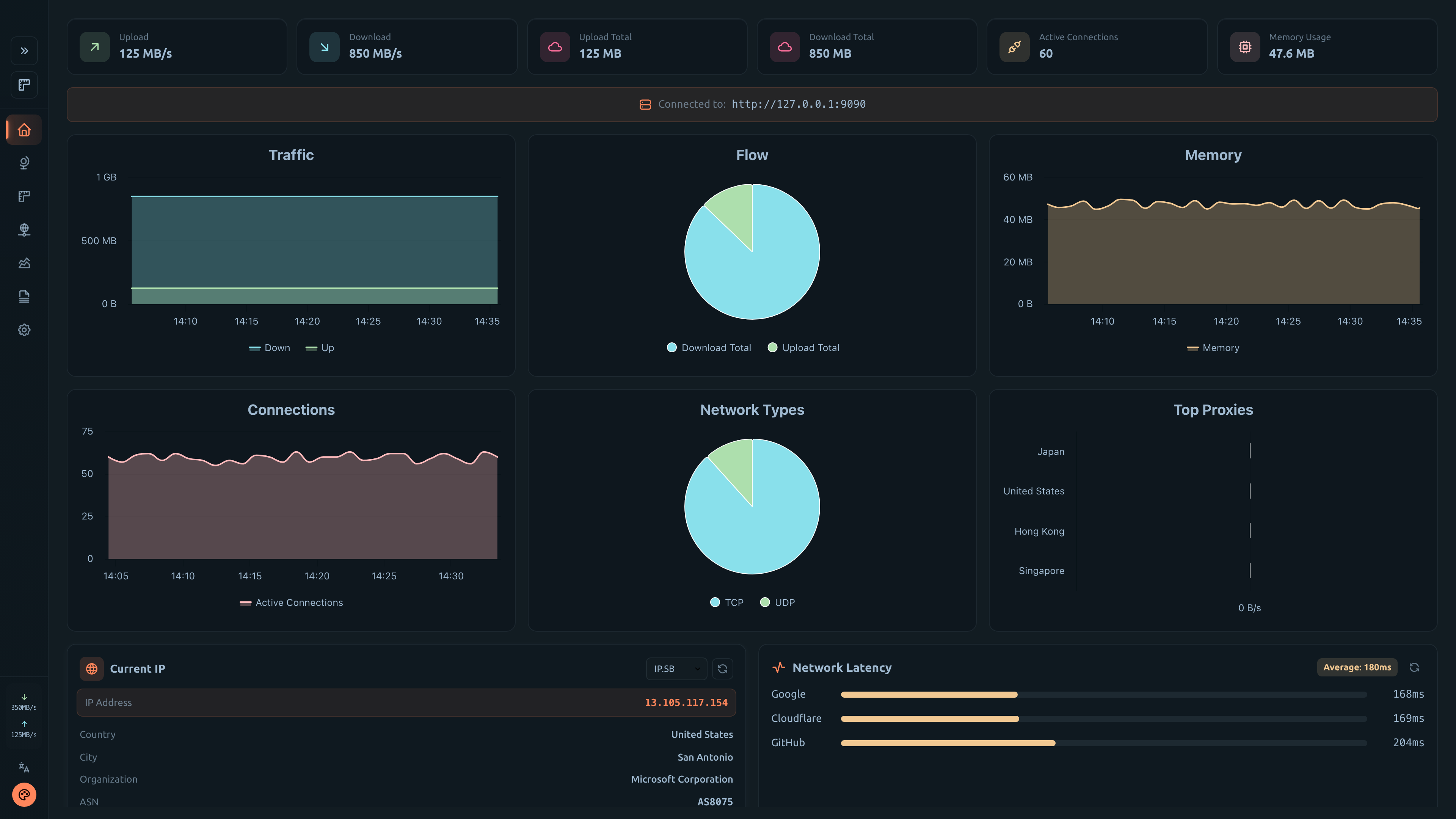
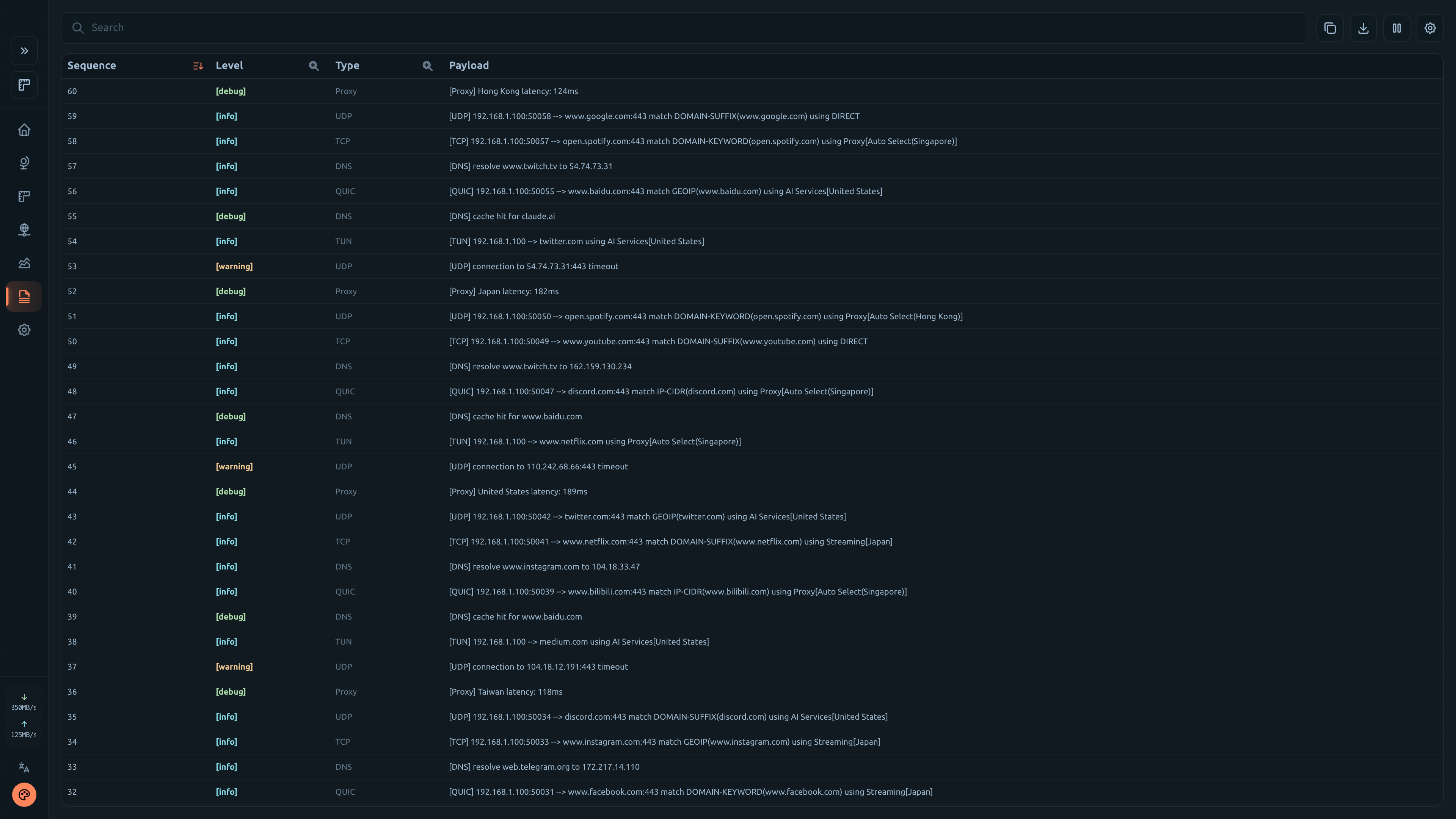
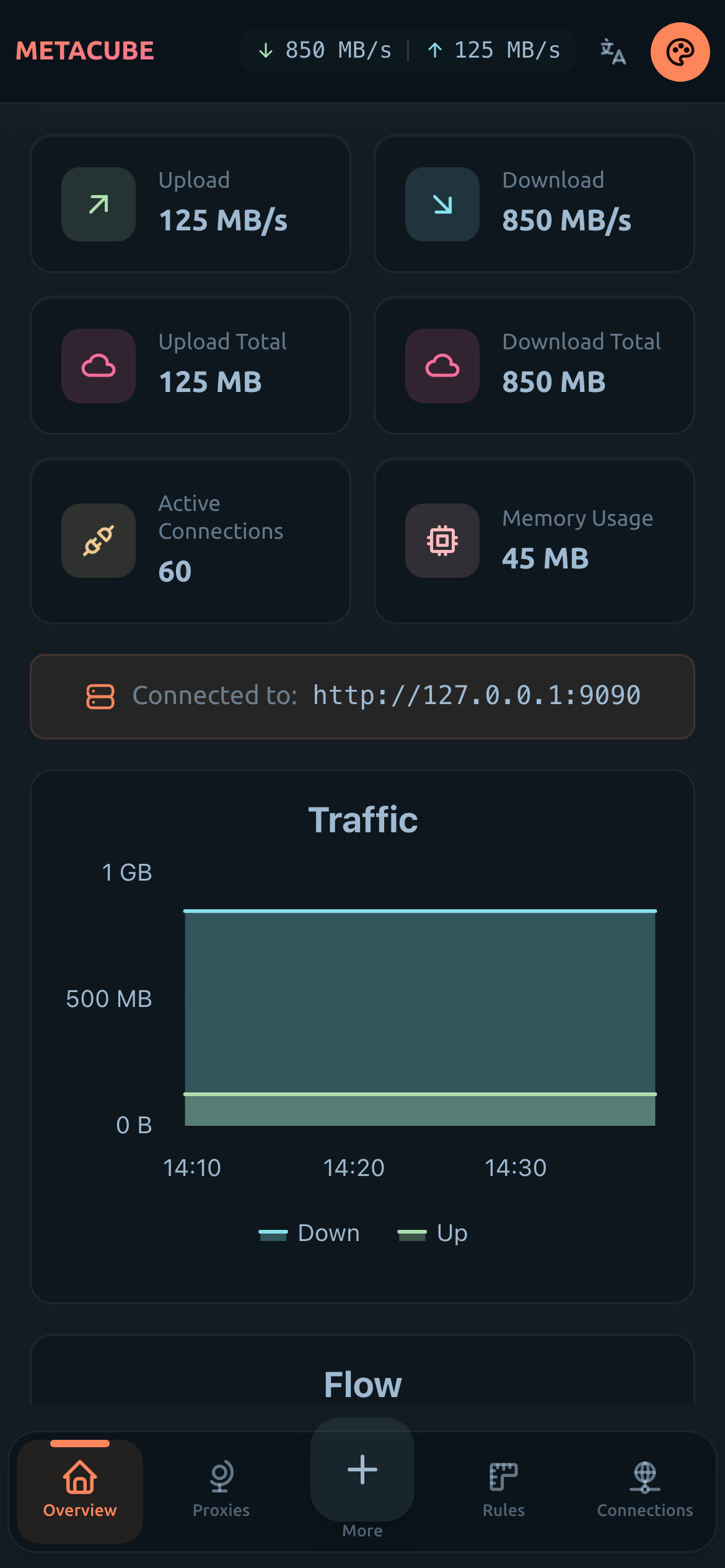
- 📊 Real-time traffic monitoring and statistics
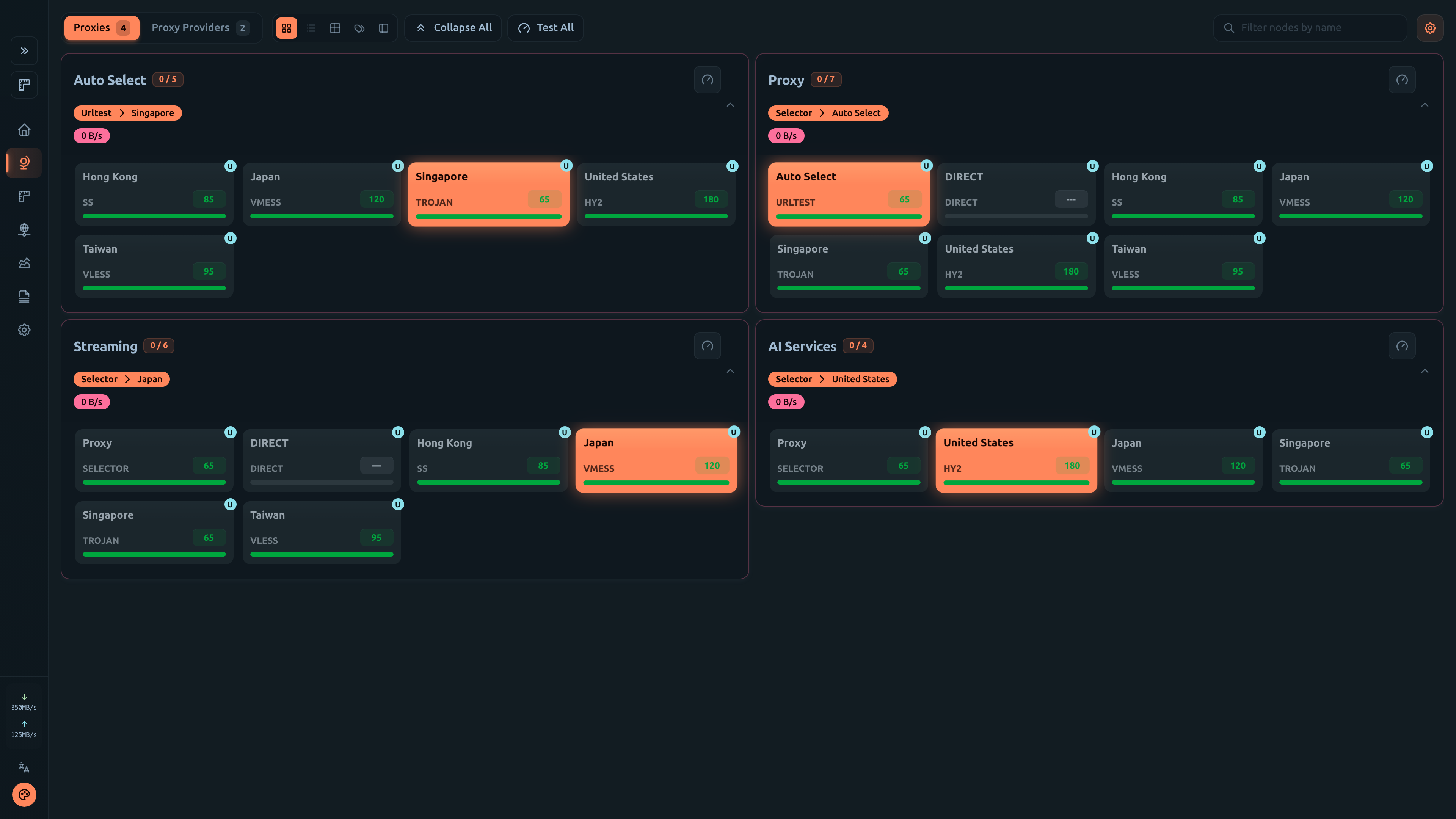
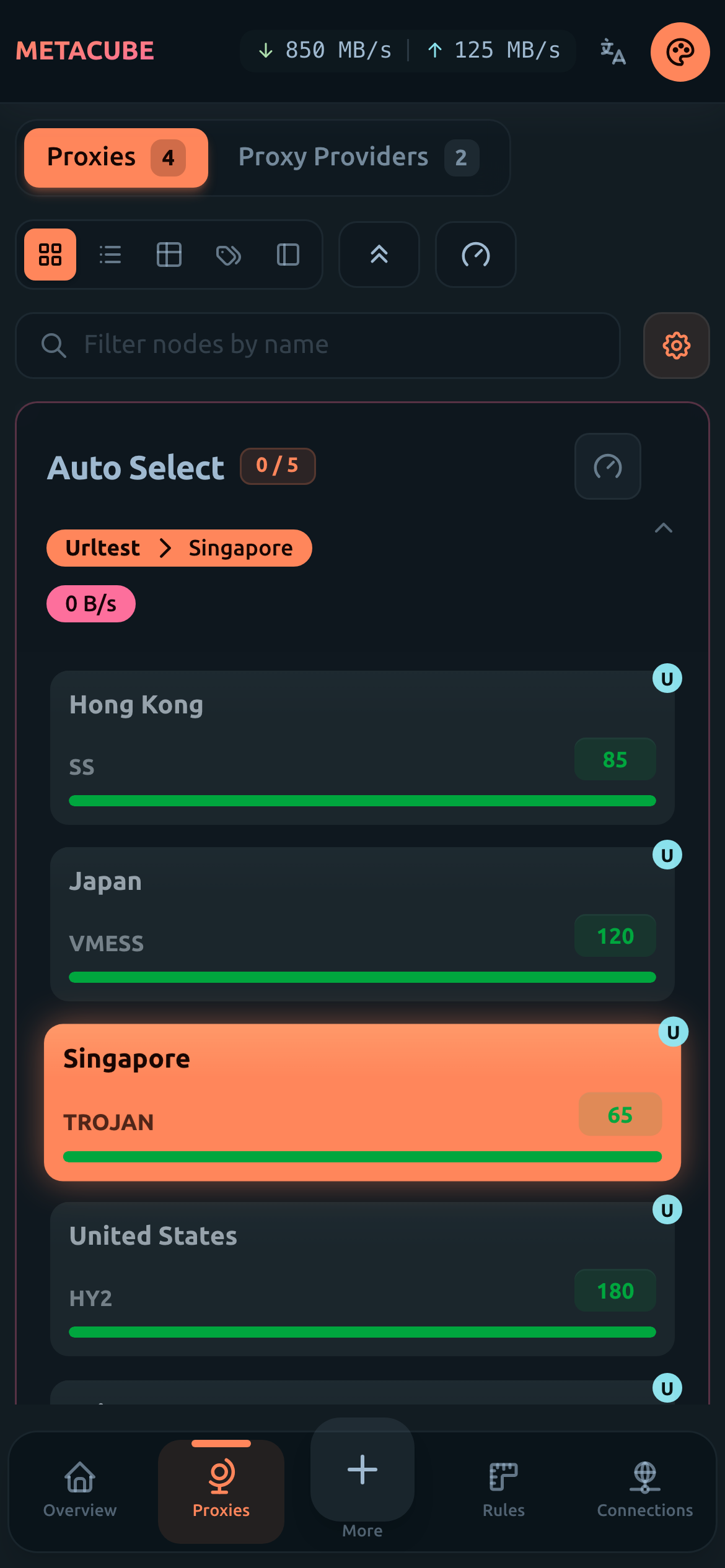
- 🔄 Proxy group management with latency testing
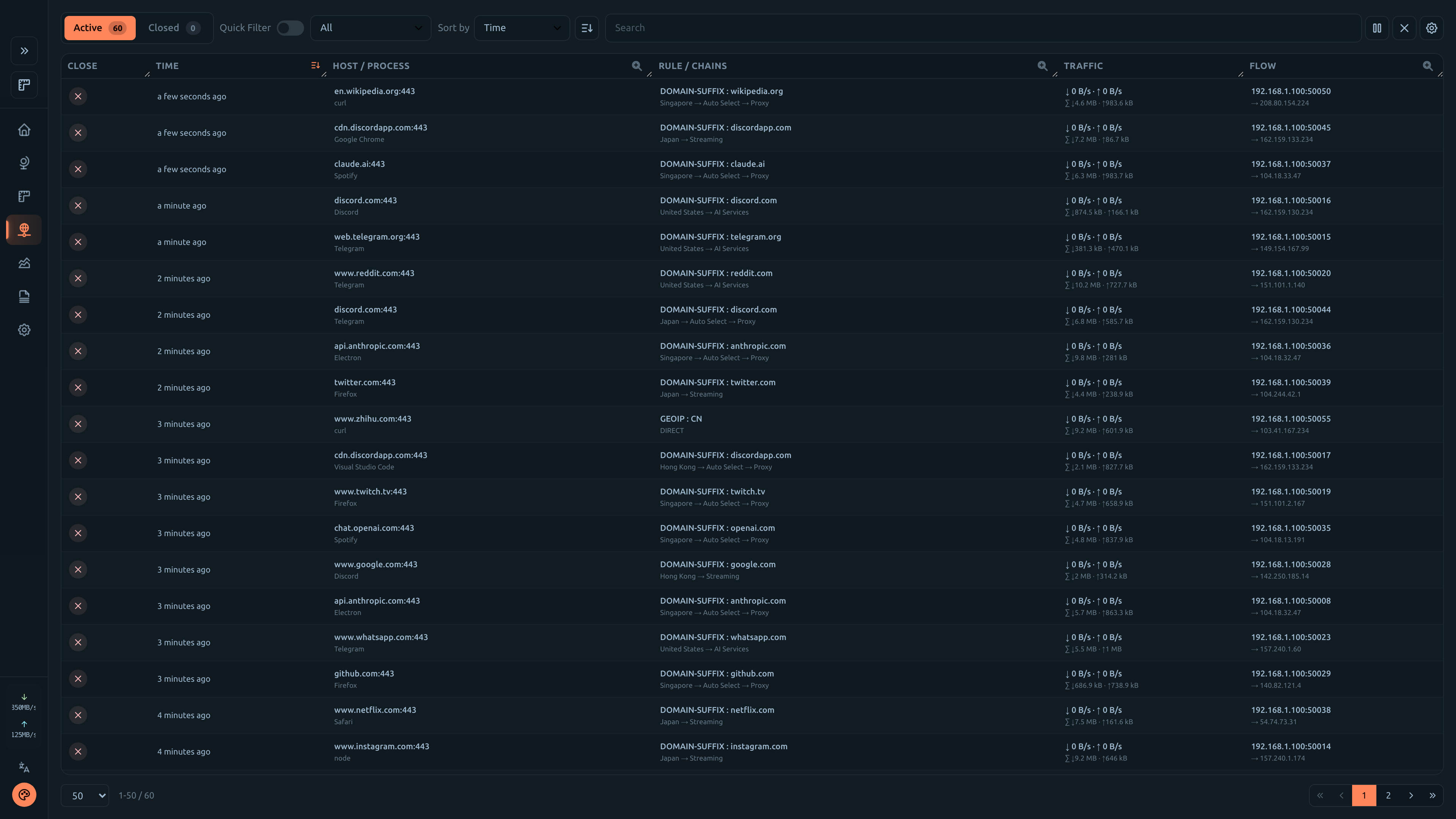
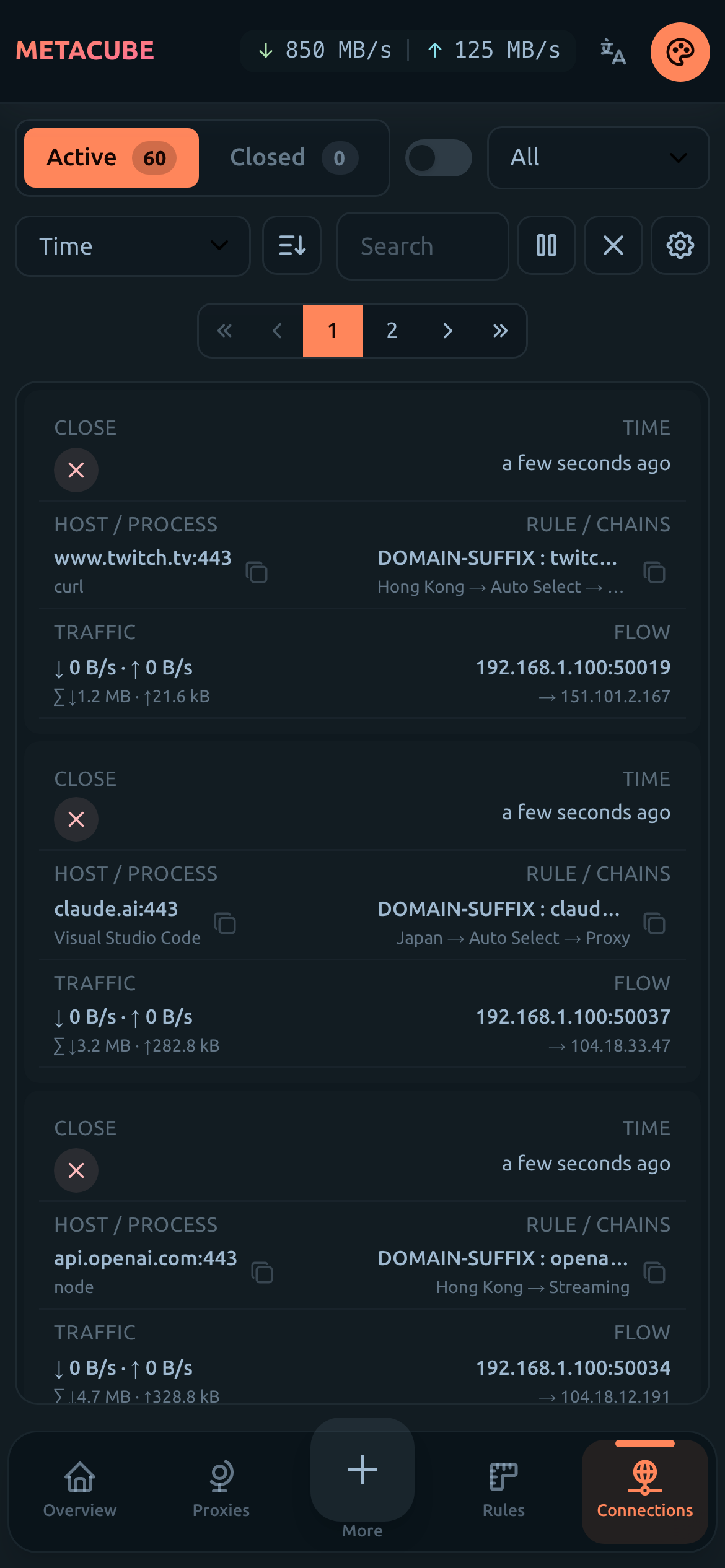
- 📡 Connection tracking and management
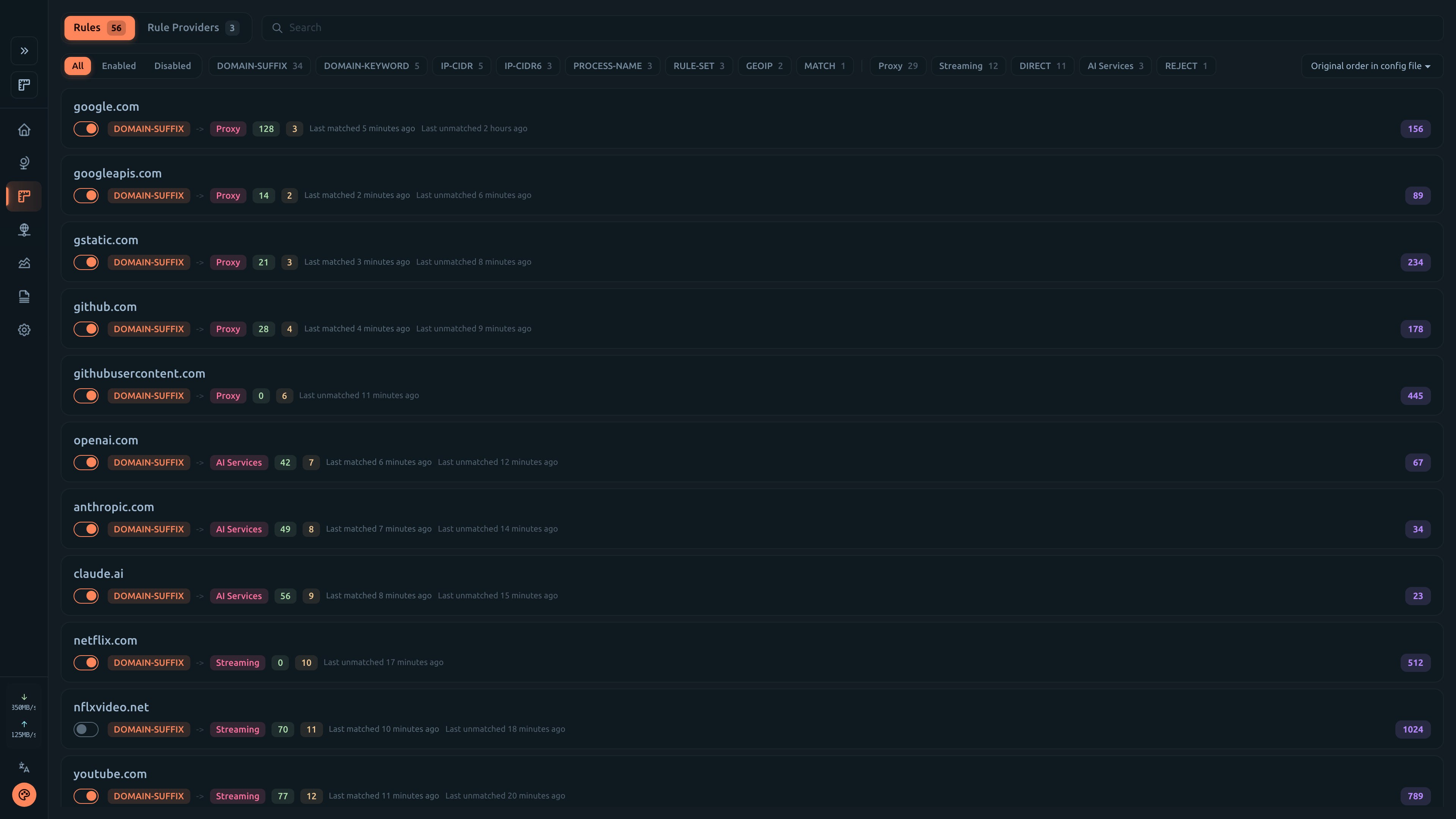
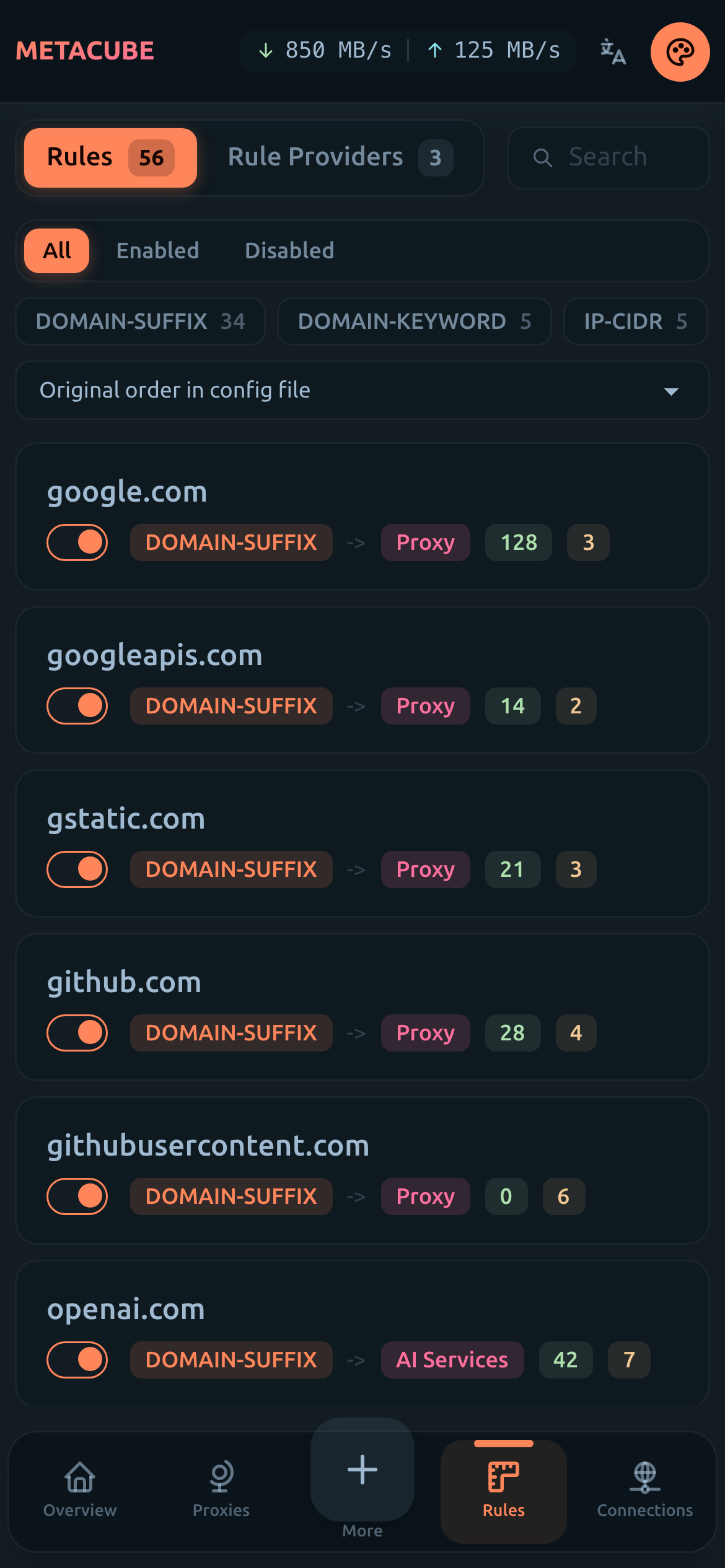
- 📋 Rule viewer with search functionality
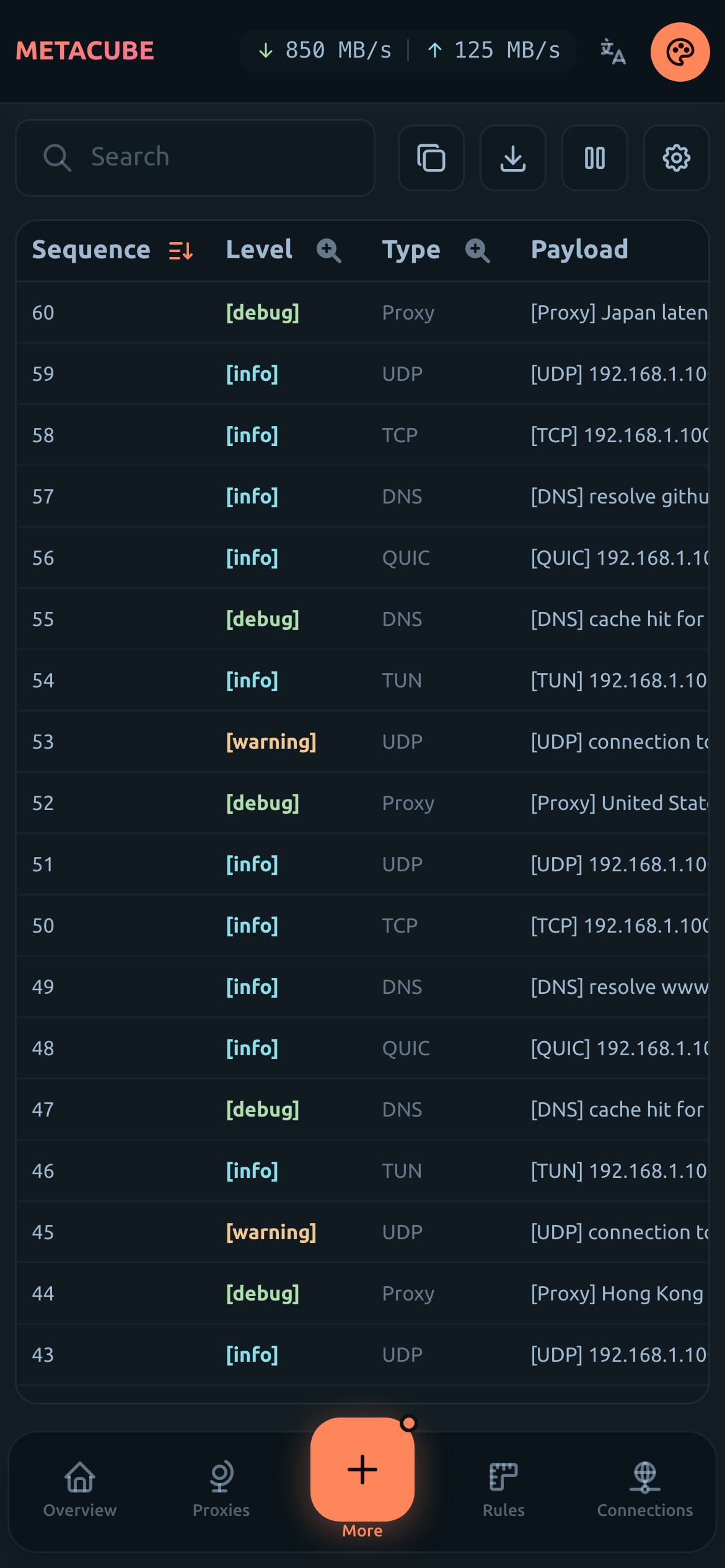
- 📝 Live log streaming
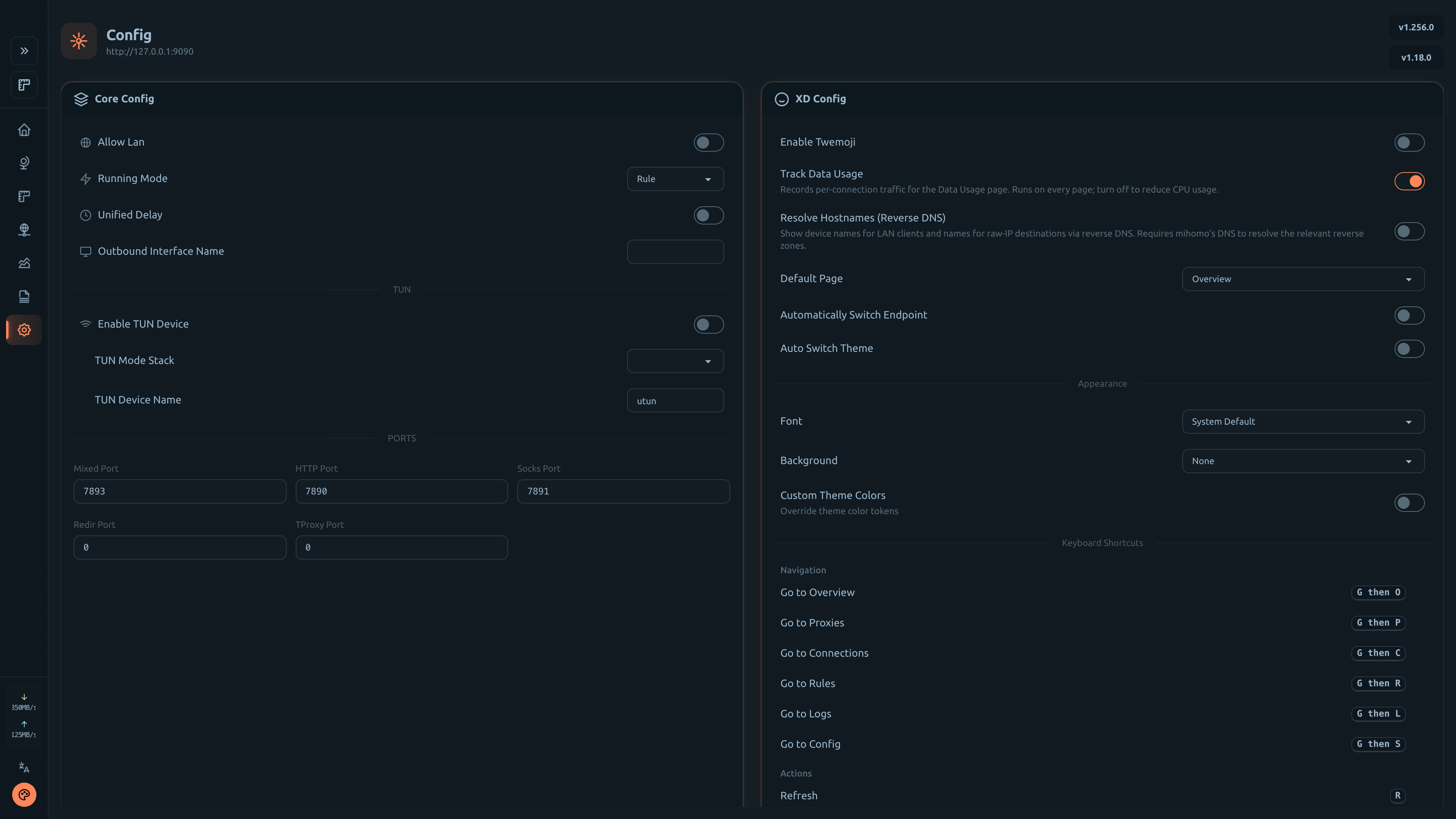
- 🎨 32 selectable themes with user color overrides
- 📱 Fully responsive design for mobile devices
- 🌐 Seven languages: English, 简体中文, Русский, 日本語, 한국어, Français, فارسی
- 🖥️ Cross-platform desktop app with bundled kernel
- 🐳 All-in-one Docker server with built-in agent
## 🖼️ Preview
Desktop Screenshots
| Overview | Proxies |
| :-----------------------------------------------------------: | :---------------------------------------------------------: |
| | |
| Connections | Rules |
| :-----------------------------------------------------------------: | :-----------------------------------------------------: |
| | |
| Logs | Config |
| :---------------------------------------------------: | :-------------------------------------------------------: |
| | |
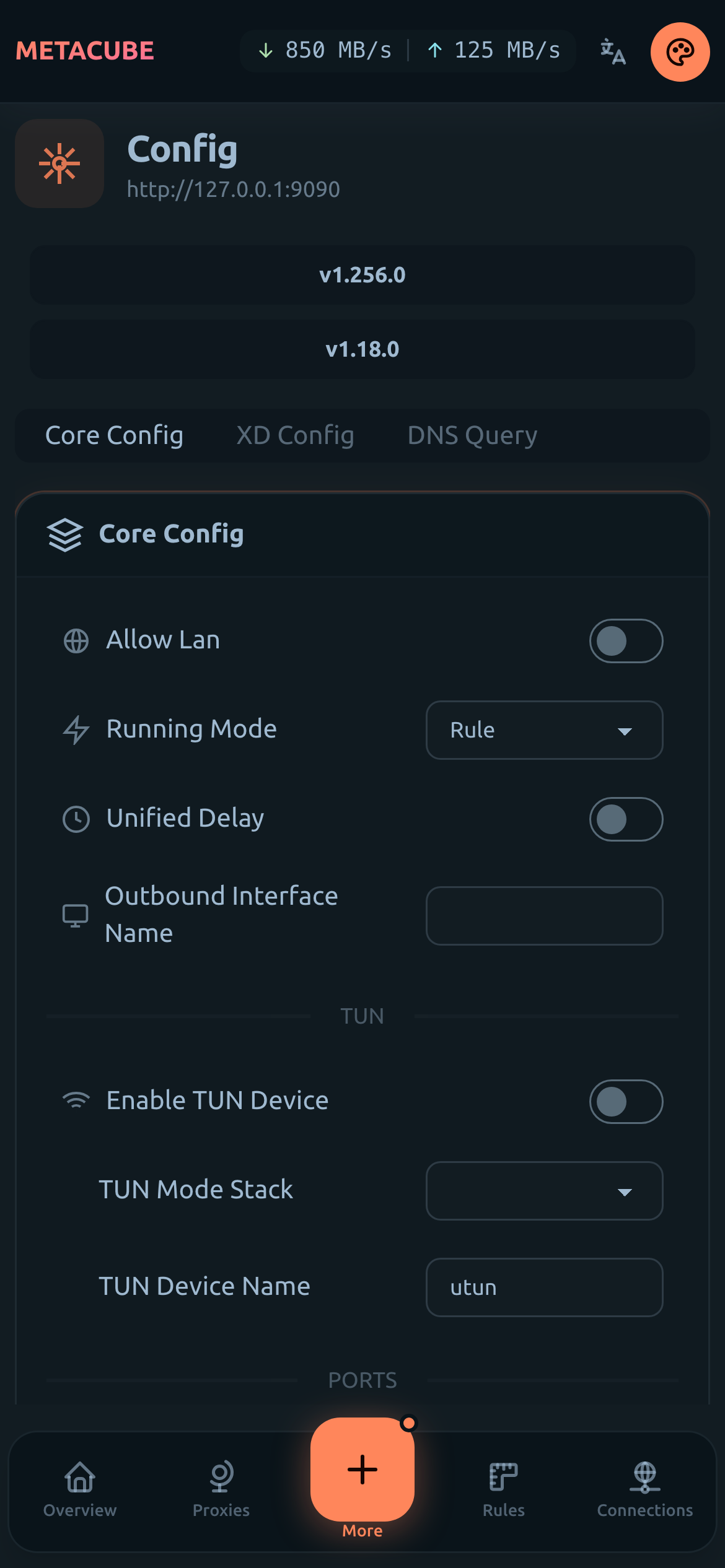
Mobile Screenshots
| Overview | Proxies | Connections |
| :---------------------------------------------------------------: | :-------------------------------------------------------------: | :---------------------------------------------------------------------: |
| | | |
| Rules | Logs | Config |
| :---------------------------------------------------------: | :-------------------------------------------------------: | :-----------------------------------------------------------: |
| | | |
## 🔗 Official Sites
Use one of these official hosted-panel deployments:
| Site | URL |
| :--------------- | :------------------------------------- |
| Primary | https://d.metacubex.one |
| GitHub Pages | https://metacubex.github.io/metacubexd |
| Cloudflare Pages | https://metacubexd.pages.dev |
## 🚀 Deployment
metacubexd ships in **three forms from one codebase**:
| Form | Who hosts the UI | Who runs the kernel | Best for |
| :------------------------- | :-------------------------------------------------------------- | :---------------------------------- | :--------------------------------------- |
| **Hosted panel** (classic) | official sites, static files, or the standalone panel container | your own remote mihomo | pointing a browser at an existing mihomo |
| **Desktop app** | the app (bundled) | the app supervises a bundled mihomo | a managed runtime on one machine |
| **All-in-one server** | the Docker image | the container's bundled mihomo | a router / NAS / VPS |
> The classic **pure-panel mode still works against any remote mihomo** — the
> kernel-control and profile features simply stay hidden when the dashboard
> isn't talking to a bundled agent.
### 1. Hosted Panel (point at your own mihomo)
Enable and protect the external controller in your mihomo `config.yaml`:
```yaml
external-controller: 0.0.0.0:9090
secret: 'replace-with-a-strong-secret'
```
Binding to `0.0.0.0` exposes the controller on every interface. Restrict it
with a firewall, use a strong secret, and configure
[`external-controller-cors`](#unable-to-connect-to-backend-when-self-hosting-cors)
for the exact dashboard origin.
Then open one of the official hosted sites listed above and enter your mihomo
`{url, secret}`, or self-host the static assets via `external-ui`:
```shell
# Clone the prebuilt gh-pages branch
git clone https://github.com/metacubex/metacubexd.git -b gh-pages /etc/mihomo/ui
# Set external-ui in your config:
# external-ui: /etc/mihomo/ui
# Update to the latest build later:
git -C /etc/mihomo/ui pull -r
```
#### Standalone hosted-panel container
**`ghcr.io/metacubex/metacubexd`** is another distribution of the hosted-panel
architecture: it serves only the dashboard over HTTP on port `80`; it does not
bundle or supervise mihomo. Point it at a mihomo instance you run separately.
One panel can manage several backends, and HTTP hosting avoids the browser's
HTTPS-to-HTTP mixed-content block when the backend is local.
```shell
docker run -d --name metacubexd -p 127.0.0.1:8080:80 \
ghcr.io/metacubex/metacubexd:latest
```
##### Pre-fill the backend address
Set `DEFAULT_BACKEND_URL` to pre-populate the connect form (and skip the
"no backend detected" prompt on first load). The container's entrypoint maps it
to the Nuxt runtime config, so it ships in every served HTML response without
rebuilding the image:
```shell
docker run -d --name metacubexd -p 127.0.0.1:8080:80 \
-e DEFAULT_BACKEND_URL=http://192.168.1.10:9090 \
ghcr.io/metacubex/metacubexd:latest
```
The URL is only a default — users can still edit it on the connect screen, and
saved endpoints take precedence on later visits.
For a safe starting point for the separately managed kernel, see the
[minimal Mihomo configuration example](./docs/config.yaml). Review its network
settings before making the controller available outside the local machine.
### 2. Desktop App
Download the installer for your platform from the
[latest release](https://github.com/metacubex/metacubexd/releases/latest):
| OS | Arch | File |
| :-------------------- | :---- | :------------------------------------------- |
| macOS (Apple Silicon) | arm64 | `MetaCubeXD--mac-arm64.dmg` |
| macOS (Intel) | x64 | `MetaCubeXD--mac-x64.dmg` |
| Windows | x64 | `MetaCubeXD--win-x64.exe` |
| Windows | arm64 | `MetaCubeXD--win-arm64.exe` |
| Debian / Ubuntu | x64 | `MetaCubeXD--linux-amd64.deb` |
| Debian / Ubuntu | arm64 | `MetaCubeXD--linux-arm64.deb` |
| Fedora / RHEL / SUSE | x64 | `MetaCubeXD--linux-x86_64.rpm` |
| Fedora / RHEL / SUSE | arm64 | `MetaCubeXD--linux-aarch64.rpm` |
| Arch Linux | x64 | `MetaCubeXD--linux-x64.pacman` |
| Arch Linux | arm64 | `MetaCubeXD--linux-aarch64.pacman` |
| Other Linux | x64 | `MetaCubeXD--linux-x86_64.AppImage` |
| Other Linux | arm64 | `MetaCubeXD--linux-arm64.AppImage` |
The desktop app **bundles its own mihomo kernel and auto-configures the local
endpoint** — you don't enter any address. Manage profiles, edit configs, and
start/stop the kernel directly inside the app.
> **These builds are unsigned.** Download them only from this repository's
> [official GitHub releases](https://github.com/metacubex/metacubexd/releases),
> verify that the URL and release tag are correct, and decide whether you trust
> the artifact before bypassing an OS warning. The project does not currently
> provide publisher identity verification through code signing.
**macOS** — Gatekeeper blocks unsigned apps ("MetaCubeXD is damaged and can't
be opened"). After dragging the app to `/Applications`, strip the quarantine
attribute:
```shell
xattr -dr com.apple.quarantine /Applications/MetaCubeXD.app
```
…or right-click the app → **Open** → **Open** in the confirmation dialog.
MetaCubeXD can also be installed through the Homebrew cask in this repository:
```shell
brew tap metacubex/metacubexd https://github.com/MetaCubeX/metacubexd.git
brew install --cask metacubexd
```
**Windows** — SmartScreen shows "Windows protected your PC". Click
**More info** → **Run anyway**.
**Linux** — install the native package for your distribution, or make the
AppImage executable and run it:
```shell
# Debian / Ubuntu
sudo apt install ./MetaCubeXD-*-linux-*.deb
# Fedora / RHEL
sudo dnf install ./MetaCubeXD-*-linux-*.rpm
# openSUSE
sudo zypper install ./MetaCubeXD-*-linux-*.rpm
# Arch Linux and derivatives
sudo pacman -U ./MetaCubeXD-*-linux-*.pacman
# Distribution-independent AppImage
chmod +x MetaCubeXD-*-linux-*.AppImage
./MetaCubeXD-*-linux-*.AppImage
```
> **System proxy and TUN are separate features.** System proxy changes the
> current user's OS proxy settings through platform tools and does not install
> the privileged helper; platform policy may still request authorization. TUN
> routes machine traffic at the network layer and requires the one-time helper
> installation described in [TUN mode (desktop)](#tun-mode-desktop).
#### TUN mode (desktop)
**TUN routes traffic at the network layer**, including applications that do not
honor per-app proxy settings (unlike the mixed proxy port, which only catches
apps you point at it). Because system-level routing needs root/admin, the
desktop app installs a small **privileged helper** the first time you enable
TUN — a background service that performs the privileged network setup on the
app's behalf. Enabling TUN therefore prompts for **administrator authorization**
the first time (the OS elevation dialog). Activate a profile before enabling
TUN. The helper persists across sessions, so later enables normally reuse it.
The app waits briefly for the helper to become ready. If an existing helper
cannot be reached or uses an incompatible protocol, the app attempts one repair;
this can request administrator authorization again. If activation fails, the
app removes the TUN settings and attempts to restart the normal proxy backend.
> The helper is installed by an unsigned app. Confirm that you downloaded the
> app from the official release page before approving its administrator prompt.
**Per-OS notes**
- **macOS** — the helper is registered as a root **LaunchDaemon**; you approve
it through the standard `osascript` "wants to make changes" administrator
prompt. The kernel binds the system's `utun` interface.
- **Windows** — the helper runs as the auto-start **`metacubexd-helper` Windows
service**, installed through a UAC prompt. Stopping the service also stops its
helper and kernel processes. The build ships **`wintun.dll`** alongside the
kernel, which mihomo's wintun backend needs — no separate download.
- **Linux** — the helper is registered as a root **systemd** unit; the elevation
prompt is **`pkexec`** (the GNOME/PolicyKit authorization dialog). On a headless
box without a Polkit agent you may need to install/enable one.
**If TUN takes down your network**
TUN reroutes default traffic, so a bad config or a stuck tunnel can drop
connectivity. Two recoveries:
- Click **"Recover network"** in the app — it tears down the TUN routing and
restores normal networking without quitting.
- **Quit the app normally** — a normal exit tears down TUN and restores routing.
If the app had to be force-quit, reopen it and use **Recover network**.
If you hit a problem, open an issue with the app version, OS and architecture,
the exact prompt or error, and whether **Recover network** restored connectivity.
Do not include secrets or subscription URLs; report security issues through the
[private security channel](./.github/SECURITY.md).
### 3. All-in-One Server (Docker)
The `metacubexd-server` image bundles the dashboard UI, the control agent, and
a per-arch mihomo kernel. One container serves the panel, supervises the
kernel, and exposes the proxy. The
[copyable Compose example](./docs/docker-compose.yml) requires secrets through
a local `.env` file; the inline version below shows the same runtime layout.
```yaml
# compose.yaml — proxy-only by default; TUN is an advanced override
services:
metacubexd:
image: ghcr.io/metacubex/metacubexd-server:latest
restart: unless-stopped
environment:
CONTROL_TOKEN: 'change-me-control'
CLASH_SECRET: 'change-me-clash'
GITHUB_TOKEN: '' # optional read-only token for Releases API checks
# optional: pre-fill the connect form's backend address
# DEFAULT_BACKEND_URL: 'http://:9090'
CONTROL_PORT: '8080'
CLASH_API_PORT: '9090'
MIXED_PORT: '7890'
TZ: 'Asia/Shanghai'
ports:
- '8080:8080' # dashboard UI + /api/control agent API
- '9090:9090' # mihomo Clash API + WebSocket (UI endpoint target)
- '7890:7890' # mixed proxy port
volumes:
- 'metacubexd-data:/data'
volumes:
metacubexd-data: {}
```
```shell
docker compose up -d
# Update
docker compose pull && docker compose up -d
```
> **Keep the control surface on a trusted network.** Docker publishes the ports
> above on all host interfaces unless you bind them to a specific address. The
> server deliberately injects `CONTROL_TOKEN` into the browser so the same-origin
> dashboard can call `/api/control`; consequently, that token is **not** access
> control for the dashboard itself. Set `CONTROL_TOKEN`, but also restrict access
> with host/network ACLs or an authenticated reverse proxy before exposing the
> dashboard beyond a trusted LAN. An optional `GITHUB_TOKEN` is also exposed to
> the browser for authenticated Releases checks, so use a narrowly scoped token.
> Protect the Clash API and mixed proxy port too.
> See [Security Policy](./.github/SECURITY.md).
Open `http://:8080` for the dashboard. The control agent unlocks the
kernel/profile UI automatically: the server injects `CONTROL_TOKEN` into the
same-origin page, so the dashboard authenticates its `/api/control` probe
without you entering the token anywhere.
**Point the UI endpoint at the kernel.** The dashboard talks to mihomo's Clash
API directly (never proxied), so set the endpoint to:
| Field | Value |
| :----- | :------------------------------- |
| URL | `http://:9090` |
| Secret | the `CLASH_SECRET` you set above |
If the UI and Clash API use different origins, allow the dashboard origin in
the active profile's
[`external-controller-cors`](#unable-to-connect-to-backend-when-self-hosting-cors)
configuration.
#### Environment variables
| Variable | Default | Purpose |
| :-------------------- | :----------------------- | :----------------------------------------------------------------------------------------------------------------------------------- |
| `CONTROL_TOKEN` | **required for control** | Bearer token for `/api/control/**`; also accepted as `?token=` for SSE. Without it, protected control routes fail closed with `503`. |
| `CLASH_SECRET` | _(none)_ | Secret for mihomo's Clash API (`external-controller`). Set one and use it as the UI endpoint's **Secret**. |
| `GITHUB_TOKEN` | _(none)_ | Optional read-only token for authenticated GitHub Releases checks. Omit it to keep anonymous requests. |
| `DEFAULT_BACKEND_URL` | _(none)_ | Optional URL that pre-fills the connect form's backend address, e.g. `http://:9090`. Saved endpoints still take precedence. |
| `CONTROL_PORT` | `8080` | Port serving the dashboard UI + control agent API. |
| `CLASH_API_PORT` | `9090` | Port for mihomo's Clash API + WebSocket. The UI endpoint targets this port. |
| `MIXED_PORT` | `7890` | mihomo mixed (HTTP + SOCKS) proxy port. |
| `DATA_DIR` | `/data` | Writable profiles, active configuration, geo data, and runtime caches. |
| `MIHOMO_BIN` | `/usr/local/bin/mihomo` | Absolute path to the mihomo executable used by the server. |
| `TZ` | _(container default)_ | Timezone for logs/scheduling, e.g. `Asia/Shanghai`. |
The named volume mounts `/data`, which holds your profiles, the active config,
and the kernel's geo / fake-ip caches. It **must be writable** — a read-only
data dir makes the kernel exit non-zero.
#### TUN mode (advanced)
TUN needs `NET_ADMIN`, the `/dev/net/tun` device, and host networking. Override
the service:
```yaml
services:
metacubexd:
image: ghcr.io/metacubex/metacubexd-server:latest
restart: unless-stopped
network_mode: host
cap_add:
- NET_ADMIN
devices:
- '/dev/net/tun:/dev/net/tun'
environment:
CONTROL_TOKEN: 'change-me-control'
CLASH_SECRET: 'change-me-clash'
volumes:
- 'metacubexd-data:/data'
volumes:
metacubexd-data: {}
```
With `network_mode: host` the `ports:` mapping is ignored — the container
binds `8080`/`9090`/`7890` directly on the host. Enable a `tun:` block in your
profile's mihomo config for the tunnel to come up.
### Profiles & Config Editor (desktop / server)
When connected to a bundled agent (desktop app or the server image), the
dashboard gains a **profile manager**:
- Create, duplicate, rename, and delete multiple profiles.
- Import a subscription by URL (fetched with `User-Agent: clash.meta`); the
`upload / download / total / expire` usage from `Subscription-Userinfo` is
shown on a usage card.
- Edit any profile in an in-browser **Monaco editor with mihomo YAML schema**
completion and validation.
- **Activate** a profile to compose it, validate it with `mihomo -t`, and restart
the kernel only after validation succeeds.
Schema diagnostics are advisory and never block saving. Activation's
`mihomo -t` check is the final validation, and the kernel restarts only after it
passes. A **"disable validation"** toggle is available for bleeding-edge mihomo
keys the bundled schema doesn't know yet.
### Kernel versions and custom binaries
Both the desktop app and the server bundle a pinned mihomo release. The current
version is shown in the control UI and tracked in
`packages/agent/src/kernel/assets.ts`. The desktop's kernel-version panel can
download and switch among published mihomo versions; it does not expose an
arbitrary local binary-path picker. The server accepts an absolute custom path
through `MIHOMO_BIN`, which takes precedence over its bundled binary.
## 🩺 Troubleshooting
### "Unable to connect to backend" when self-hosting (CORS)
If the dashboard loads but cannot connect to the Mihomo backend — even though
the External Controller is reachable directly in your browser — the cause is
usually **CORS**.
When you host the dashboard on your own address (e.g. `http://192.168.1.2:8080`),
the browser treats requests to the External Controller (e.g.
`http://192.168.1.2:9090`) as cross-origin. Mihomo only answers cross-origin
requests from origins listed in its `external-controller-cors` allow-list, so
requests from your dashboard are rejected and the connection fails.
Add your dashboard's origin to the allow-list in your Mihomo `config.yaml`:
```yaml
external-controller-cors:
allow-private-network: true
allow-origins:
- 'http://192.168.1.2:8080' # your dashboard's address
# or, for trusted local networks only:
# - '*'
```
> Tip: if you still cannot connect, open your browser's DevTools (F12) →
> Console and look for CORS-related errors to confirm the cause.
### Kernel won't start (desktop / server)
When the bundled kernel fails to reach `running`:
- **Server port collision.** The server defaults to control `8080`, Clash API
`9090`, and mixed proxy `7890`. Stop the conflicting process or change the
corresponding `CONTROL_PORT`, `CLASH_API_PORT`, or `MIXED_PORT` value and its
host port mapping.
- **Desktop port diagnosis.** The desktop app chooses separate free loopback
ports for its control API, Clash API, and mixed proxy on every launch. Do not
assume `9090`, and do not send `/api/control` requests to the Clash endpoint;
use the addresses reported by the app and its logs.
- **macOS quarantine kills the bundled binary.** An unsigned `.app` downloaded
from the internet has its bundled mihomo quarantined. Run
`xattr -dr com.apple.quarantine /Applications/MetaCubeXD.app`, then reopen it.
- **`SIGILL` / "illegal instruction" on amd64.** Old or virtualized CPUs choke
on the generic amd64 build. metacubexd ships the **`-compatible`**
(`GOAMD64=v1`) asset specifically to avoid this; if the server uses a custom
`MIHOMO_BIN`, point it at the `-compatible` mihomo build.
### Two log streams — which is which
- **Clash logs** (the existing **Logs** page): mihomo's own log feed over the
Clash API WebSocket — proxy decisions, rule matches, DNS, etc.
- **Kernel logs** (control agent, SSE): the mihomo **subprocess** stdout/stderr
captured by the supervisor — startup banners, crashes, config-parse errors.
Use these when the kernel won't start or exits unexpectedly.
### Read-only data directory
The kernel needs a **writable** home for `profiles/`, the active config, and geo
/ fake-ip caches. On the server, ensure `DATA_DIR` (default `/data`) is writable.
The desktop app stores writable state in Electron's per-user `userData`
directory; its packaged `resources` directory is not the runtime data home.
### Health check (server)
The container's health endpoint is `GET /api/control/health` on
`CONTROL_PORT` (default `8080`). A `200` means the dashboard + control agent
are up; it does **not** assert the kernel is running (check the kernel panel
for that).
## 🛠️ Development
This repository is a **pnpm 10 monorepo**:
- `packages/ui` — Nuxt dashboard and static hosted panel
- `packages/agent` — shared profile, kernel, and control-API logic
- `apps/server` — Nitro all-in-one server
- `apps/desktop` — Electron desktop application
Install dependencies, then choose the surface you are changing:
```shell
pnpm install
pnpm dev # UI only; connect it to an existing mihomo
pnpm dev:server # build the UI, then run the Nitro server
pnpm dev:desktop # Nuxt HMR + Electron + bundled mihomo
```
Build boundaries are intentionally explicit:
```shell
pnpm build:ui # static hosted-panel output: packages/ui/.output/public
pnpm build:server # Nitro/agent only: apps/server/.output
pnpm build # build:ui + build:server
pnpm build:desktop # Electron main/preload/helper bundles only; no installer
pnpm typecheck # all workspace typechecks
pnpm lint # workspace lint scripts
```
Official desktop installers require a generated renderer, the correct mihomo
binary for each target architecture, and platform packaging tools; the release
workflow assembles those steps. See [CONTRIBUTING.md](./CONTRIBUTING.md) for
package tests, local packaging guidance, and required desktop smoke tests.
## 📚 Project documentation
- [Contributing guide](./CONTRIBUTING.md)
- [Security policy and private vulnerability reporting](./.github/SECURITY.md)
- [Domain vocabulary](./CONTEXT.md)
- [UI product principles](./packages/ui/PRODUCT.md)
- [UI design system](./packages/ui/DESIGN.md)
- [Agent manual smoke tests](./packages/agent/MANUAL.md)
- [All-in-one server Compose example](./docs/docker-compose.yml)
- [Example mihomo configuration](./docs/config.yaml)
## ⭐ Star History
## 👥 Contributors
Thanks to all the people who contribute to metacubexd!
## 📄 License
[MIT](./LICENSE)
## 🙏 Credits
- [Nuxt](https://github.com/nuxt/nuxt) - The Intuitive Vue Framework
- [Vue.js](https://github.com/vuejs/core) - The Progressive JavaScript Framework
- [daisyUI](https://github.com/saadeghi/daisyui) - Tailwind CSS components
- [Tailwind CSS](https://tailwindcss.com) - Utility-first CSS framework
 |
|  |
| Connections | Rules |
| :-----------------------------------------------------------------: | :-----------------------------------------------------: |
|
|
| Connections | Rules |
| :-----------------------------------------------------------------: | :-----------------------------------------------------: |
|  |
|  |
| Logs | Config |
| :---------------------------------------------------: | :-------------------------------------------------------: |
|
|
| Logs | Config |
| :---------------------------------------------------: | :-------------------------------------------------------: |
|  |
|  |
|
 |
|  |
|  |
| Rules | Logs | Config |
| :---------------------------------------------------------: | :-------------------------------------------------------: | :-----------------------------------------------------------: |
|
|
| Rules | Logs | Config |
| :---------------------------------------------------------: | :-------------------------------------------------------: | :-----------------------------------------------------------: |
|  |
|  |
|  |
|