**Setup wizard**
Started without arguments, the tool asks what you need using the arrow keys – a preset or step by step. At the end it shows the matching command line.
|
**Fast**
350+ curated lists, plus the ones found through meta lists and GitHub search (781 to 869 active in the hourly runs from 3 to 10 Nov 2026), fetched in parallel. Large lists are parsed on all CPU cores, and hand-written HTTP/SOCKS handshakes run directly on `asyncio`, 2,000 checks at once.
|
**Real verification**
Every hit has to answer **a second request** to an unrelated site with the same exit IP. A third request fetches **a static test page that has to arrive byte for byte**. Every check ends with a reason code. In the 591 published runs from 16 Oct to 10 Nov 2026 (88.65 million first requests): 51 % of the proxies that answered the first request did not pass the second, a *different exit IP* was 2.1 % of that step and timeouts were 30.4 %; of the content checks, 5.7 % got different bytes and 27 % could not compare because no page came back ([why free proxies fail](why-free-proxies-fail.md) has an earlier window, [the numbers](free-proxies-in-numbers.md), [check states](check-states.md)). Plus: HTTPS through a tunnel with **a TLS certificate that verifies** for the test host, anonymity level *elite / anonymous / transparent* and the country of the exit IP.
|
**Learns with every run**
Hit rate per source, history of working proxies, automatic removal of dead and stale lists. With `-l 5000` you get the *best* 5000 candidates, not just any.
|
**Finds new sources by itself**
Searches GitHub for actively maintained proxy lists and reads source lists maintained by others. Spam clone farms and plain mirrors are detected.
|
**Filters & target sites**
With `--target google.com` a proxy only counts if it really reaches the site – many public proxies are turned away by the big sites. Filter by country, HTTPS, anonymity and latency, and stop with `--want 50` as soon as enough matching proxies are found. Filters even speed things up: with `--max-latency 1000` slow proxies are given up after 1 s instead of 8 s.
|
**Live dashboard**
Speed chart, latency histogram, protocols, countries and the latest hits in real time. Ctrl+C stops at any time and saves everything.
|
**Rotating proxy server**
`--serve` turns the hits into a local proxy that sends every connection through a different one – with automatic failover when one hangs.
|
**Runs everywhere**
macOS, Linux and Windows, Python 3.9 to 3.14. Only two dependencies: `rich` and `certifi`. It even notices when a firewall blocks proxies.
|
**Thoroughly tested**
1,400+ tests run offline against real mini proxies with known flaws on `localhost` – on Linux, macOS and Windows with Python 3.9, 3.11, 3.13 and 3.14.
|
## Why not just download a list?
A list tells you what worked for its author when it was built. This is what the tool adds; what other projects document about their own checks is in the [comparison](comparison.md), no other list was measured for it.
| | **proxy-scraper** |
|---|---|
| Checked right before you use them, from your network | `--pick --verify`, `--recheck`, or a scan |
| The outcome of every check, with reason and time | `checks` in JSON, `--diagnose` |
| A second request that has to show the same exit IP | always attempted; if its target is down, your own run keeps the proxy as `unavailable`, the hourly list and `--verify` don't |
| A test page that has to arrive byte for byte | the same |
| HTTPS tested with a certificate that verifies (one test host) | unless `--fast` |
| Anonymity level and country per proxy | yes |
| Only proxies that reach *your* target site | `--target` |
| Learns which sources are worth it | yes |
| Usable as a single rotating proxy | `--serve` |
| API to fetch a proxy (same paths as proxy_pool) | [`/get`](proxy-server.md#pool-api) |
| Ready-made list without running anything | [live list](../README.md#live-list) |
Named and dated: [how it compares to other tools and lists, task by task](comparison.md).
## GitHub Actions
The repo does part of the work itself:
| Workflow | What it does |
|---|---|
| [**tests**](https://github.com/maximilianfeix/proxy-scraper/actions/workflows/tests.yml) | 3 operating systems × 4 Python versions, plus a built and installed package – on every push and pull request |
| [**lint**](https://github.com/maximilianfeix/proxy-scraper/actions/workflows/lint.yml) | `ruff` with a pinned version – same rules locally and in CI |
| [**codeql**](https://github.com/maximilianfeix/proxy-scraper/actions/workflows/codeql.yml) | security analysis on every push to `main`, every pull request and once a week |
| [**proxy list**](https://github.com/maximilianfeix/proxy-scraper/actions/workflows/proxy-list.yml) | about every hour: collect, check, publish to `proxy-list`, upload the website to proxy-scraper.de and mirror the lists to free-proxy-list. The learned statistics live in the Actions cache, so the tool keeps getting better in the cloud too |
| [**docker**](https://github.com/maximilianfeix/proxy-scraper/actions/workflows/docker.yml) | builds the image on every change and runs a real scan inside it; on a version tag it publishes `linux/amd64` + `linux/arm64` to `ghcr.io` |
| [**release**](https://github.com/maximilianfeix/proxy-scraper/actions/workflows/release.yml) | on a version tag: test, build, smoke-test and publish a GitHub release with the wheel |
| [**discord bot**](https://github.com/maximilianfeix/proxy-scraper/actions/workflows/bot.yml) | tests the bot and deploys it to the server on every change in `bot/` |
| [**live smoke**](https://github.com/maximilianfeix/proxy-scraper/actions/workflows/live-smoke.yml) | once a day: the GitHub Action and a few real proxies against the live list, without blocking pull requests |
| [**scorecard**](https://github.com/maximilianfeix/proxy-scraper/actions/workflows/scorecard.yml) | OpenSSF Scorecard once a week |
| [**hf-rebuild**](https://github.com/maximilianfeix/proxy-scraper/actions/workflows/hf-rebuild.yml) | by hand: rebuilds every Parquet file of the Hugging Face dataset from the snapshots |
| **Dependabot** | keeps the action versions, the Python dependencies and the Docker base image up to date |
## Project structure
```
proxy_scraper.py entry point when run from a clone
bot/ Discord bot for the live list (own requirements, deployed by GitHub Actions)
proxyscraper/
├── cli.py arguments, wizard or direct start
├── app.py one run in phases: network → jobs → check → learn & report
├── options.py RunOptions + Filters – all settings in one place
├── pipeline.py collect sources, prioritize, check loop
├── checker.py the checks: basic, second request, content, HTTPS
├── handshake.py HTTP/SOCKS4/SOCKS5 handshakes incl. login
├── judges.py check targets, Cloudflare filter, failover
├── sources.py source lists, meta sources, GitHub discovery, statistics
├── sources.json curated sources
├── fetchcache.py ETag cache for unchanged lists
├── parsing.py find proxies in text, HTML and JSON
├── history.py history of working proxies
├── geo.py countries: offline first, ip-api.com as fallback
├── asndb.py DB-IP provider database, datacenter heuristic
├── geodb.py DB-IP country database (monthly, binary search)
├── targets.py target sites for --target
├── output.py result files
├── exporters.py proxychains, Clash, sing-box, curl, PAC and Proxifier formats (--export)
├── server/ rotating proxy server (--serve): pool · http · upstream · socks · status · api · core
├── api.py find_proxies() / check_proxies() for Python
├── agent.py MCP tools without the SDK: live list, filters, fetch through proxies
├── mcp_server.py MCP server (proxy-scraper-mcp) for AI agents
├── publish.py live list for GitHub Actions
├── sourcepages.py the ranking of the sources on the website
├── benchmark.py the popular GitHub lists compared (benchmark page, JSON, chart)
├── mirror.py the same lists in their own repo (free-proxy-list)
├── paths.py where state and results are stored
├── compat.py differences between Unix and Windows
├── netio.py small HTTP client on asyncio
└── ui/ widgets · dashboard · report · wizard · serve · keys
```
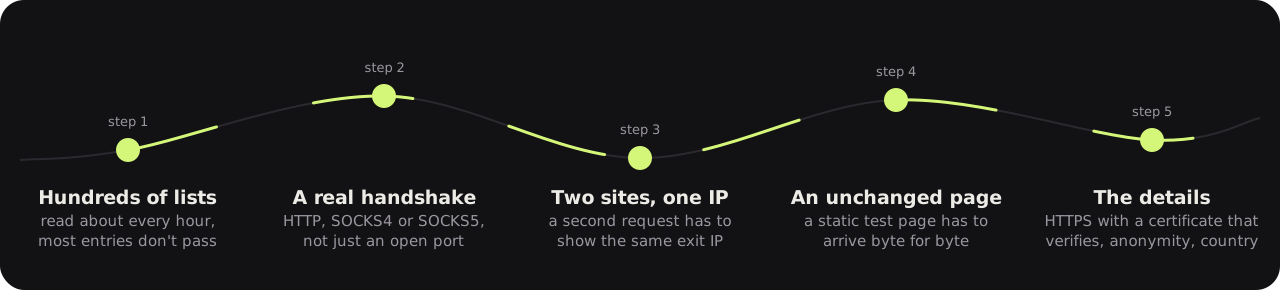
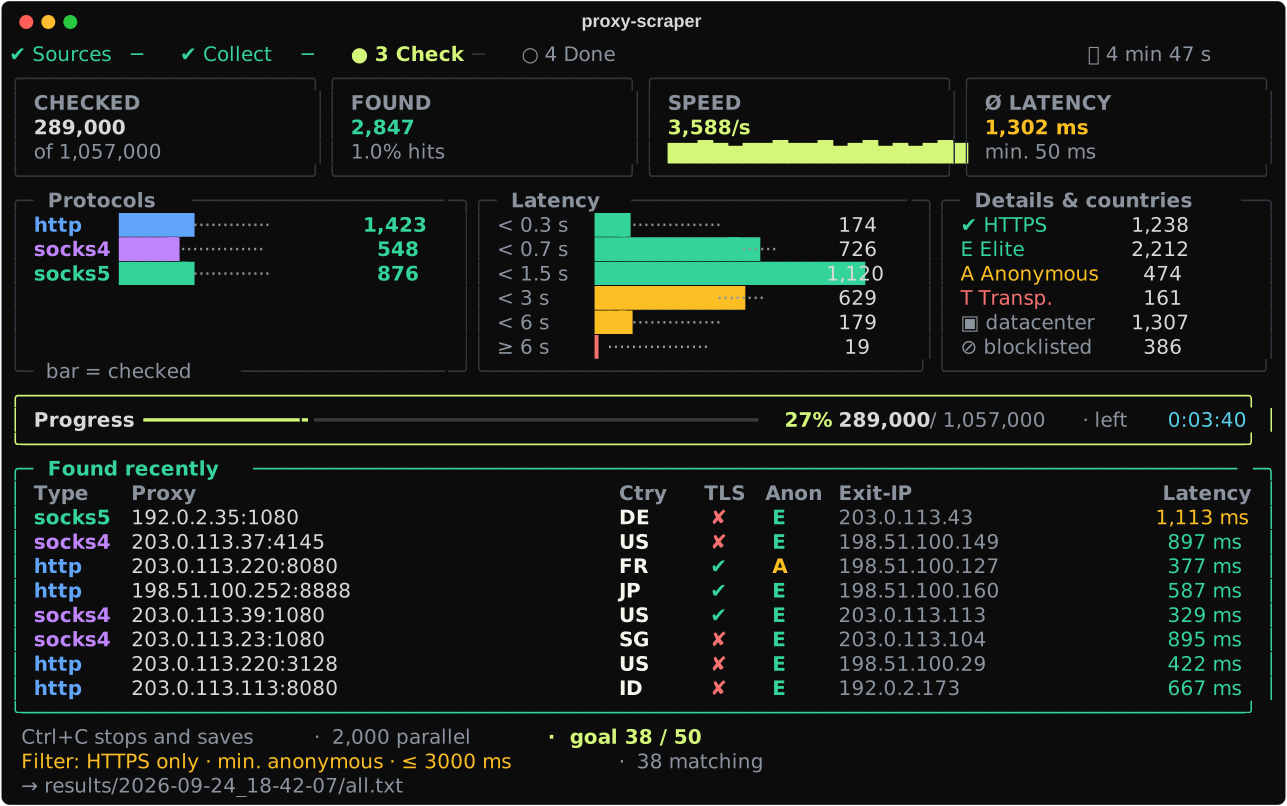
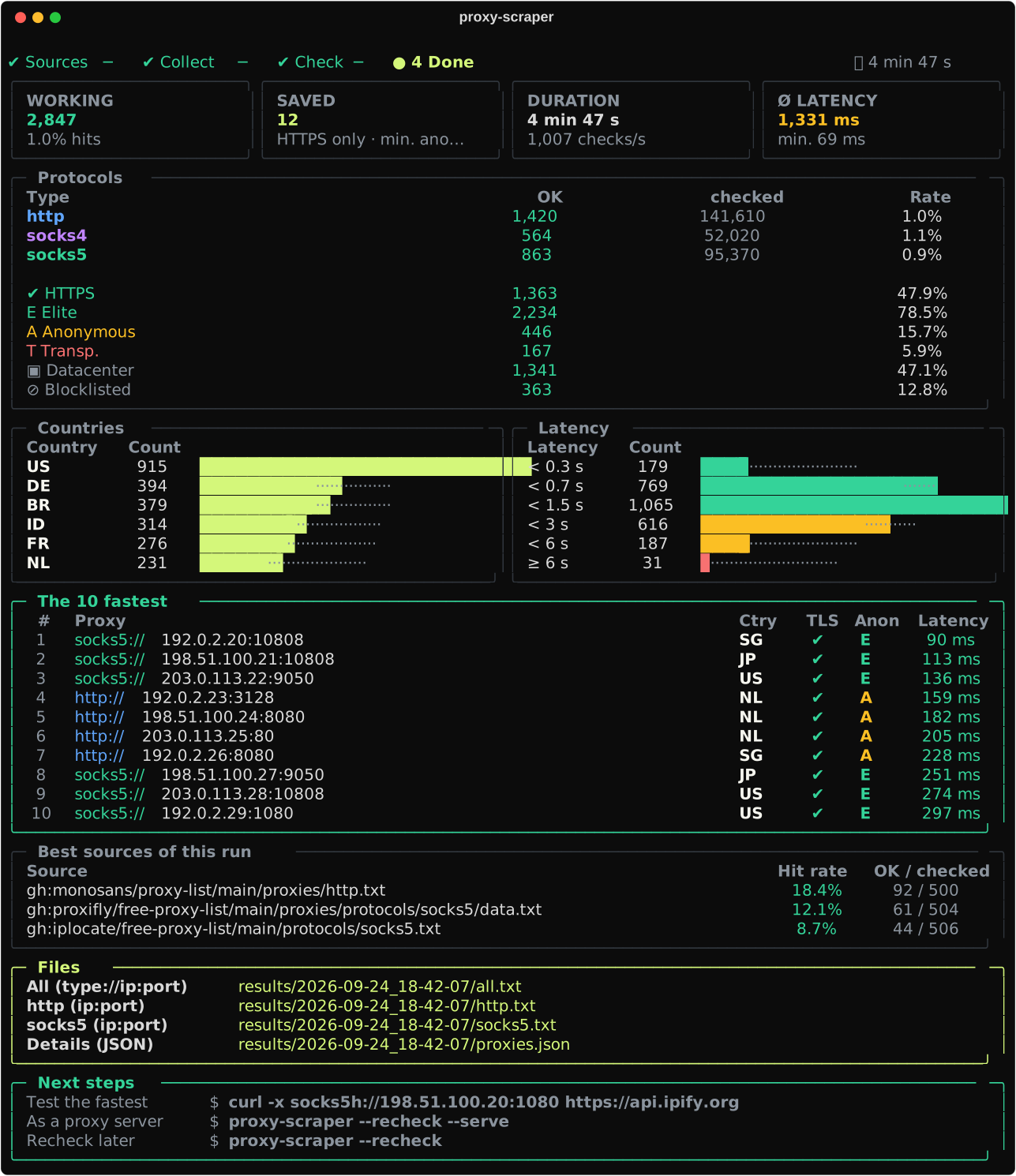 Illustration: the real interface, rendered with sample data by docs/make_demo.py. The numbers in it are made up.