---
## What is xiaodazi?
xiaodazi ("little buddy") is an open-source AI agent that **runs as a native desktop app** (Tauri). It keeps all data on your machine, operates your computer directly — managing files, automating apps, generating documents — and remembers your preferences across sessions.
### Demo
### Why xiaodazi?
| | Cloud AI Assistants | xiaodazi |
|---|---|---|
| **Data** | Stored on provider's servers | 100% local (SQLite, plain files) |
| **Memory** | Forgets between sessions | Remembers preferences via editable `MEMORY.md` + semantic search |
| **Skills** | Fixed capabilities | 200+ plug-and-play skills, add new ones by writing Markdown |
| **Models** | Locked to one provider | Switch between Claude, GPT, Qwen, DeepSeek, Gemini, GLM, or Ollama |
| **Errors** | Fails silently or retries | Classifies errors, backtracks from bad approaches, degrades gracefully |
---
## Quick Start
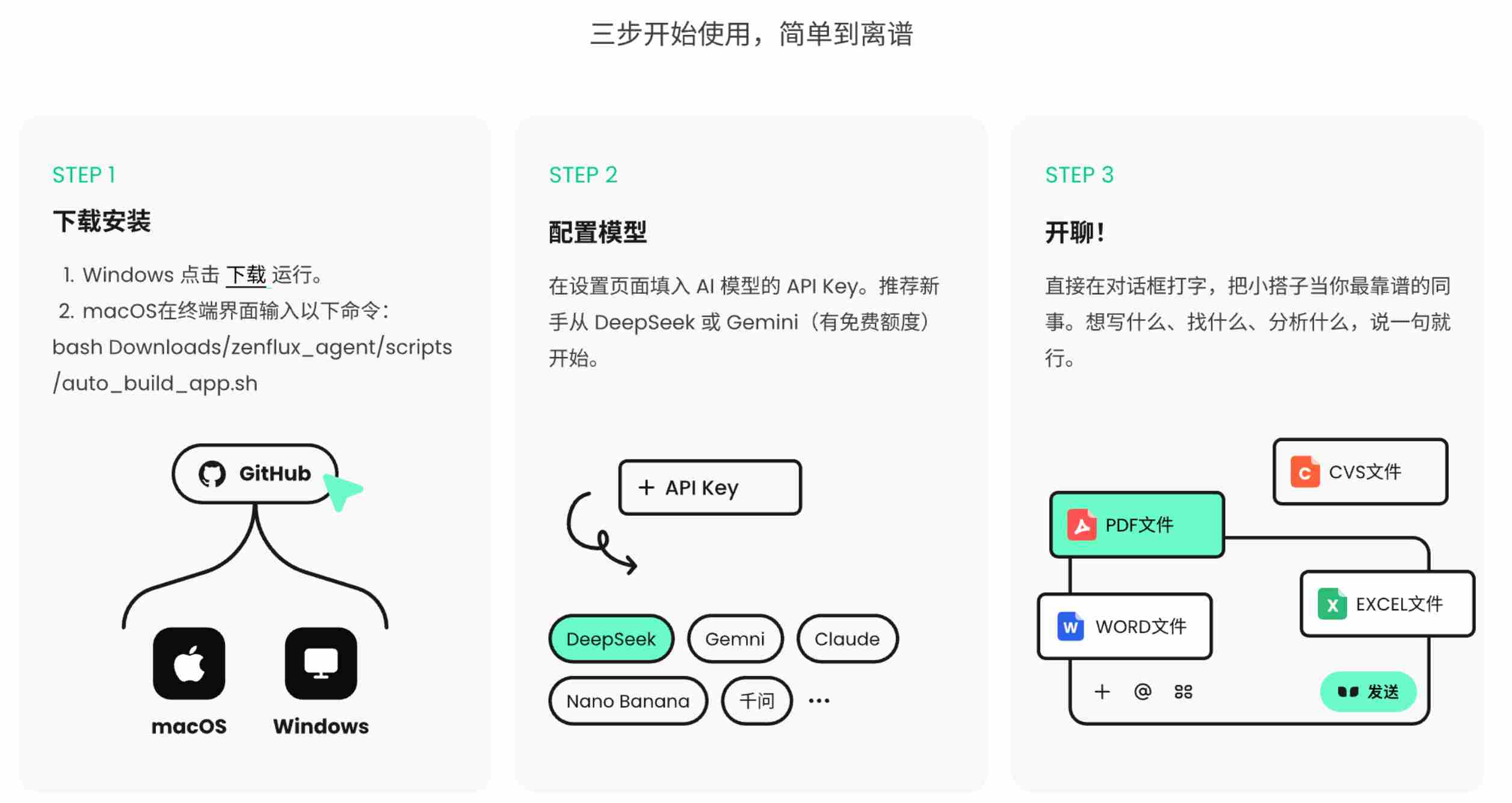
### Option A: One-click install (end users)
**Windows** — Download the installer from [Releases](https://github.com/malue-ai/dazee-small/releases), double-click to run.
**macOS** — Open Terminal and run:
```bash
bash <(curl -fsSL https://raw.githubusercontent.com/malue-ai/dazee-small/main/scripts/auto_build_app.sh)
```
Then configure an API key in the Settings page (DeepSeek or Gemini free tier recommended for beginners).
### Option B: From source (developers)
```bash
git clone https://github.com/malue-ai/dazee-small.git
cd dazee-small
python3 -m venv .venv
source .venv/bin/activate # Windows: .venv\Scripts\activate
pip install -r requirements.txt
```
Create `config.yaml` in the project root (or use the Settings page after starting):
```yaml
api_keys:
ANTHROPIC_API_KEY: sk-ant-api03-your-key-here # Recommended
# OPENAI_API_KEY: sk-xxx
# DASHSCOPE_API_KEY: sk-xxx # Qwen
# GEMINI_API_KEY: xxx # Gemini (free: 1500 req/day)
```
Start the backend:
```bash
uvicorn main:app --host 0.0.0.0 --port 8000 --reload
```
Start the frontend:
```bash
cd frontend
npm install && npm run dev
# Open http://localhost:5174
```
Desktop app (Tauri) — requires Rust toolchain
```bash
# Install Rust: https://rustup.rs/
# Requires Node.js >= 18 (Vite 5 requirement)
# 1. Build backend sidecar binary (requires PyInstaller)
pip install pyinstaller
python scripts/build_backend.py
# 2. Start Tauri dev / build
cd frontend
npm run tauri:dev # Development
npm run tauri:build # Production build
```
Fully offline with Ollama
Install [Ollama](https://ollama.ai), then set in `config.yaml`:
```yaml
llm:
COT_AGENT_MODEL: ollama/llama3.1
```
No API key needed. All inference runs locally.
---
## Key Design Decisions
### LLM-First — No keyword matching, ever
All semantic tasks — intent classification, skill selection, complexity inference, backtrack decisions — are performed by the LLM. Hard-coded rules exist only for format validation, numeric calculations, and security boundaries.
**Why it matters:** When a user says *"Don't make a PPT, just give me the key points"*, a keyword system matches "PPT" and loads the wrong tools. xiaodazi's LLM-driven intent analysis correctly loads zero PPT skills.
### Skills as Markdown — 200+ and growing
Each skill is a directory with a `SKILL.md` file. No Python code required for most skills — the LLM reads the instructions and uses built-in tools to execute them.
Despite 200+ skills, **zero are loaded by default**. Each request activates only the skill groups matching the user's intent (typically 0–15 out of 200+). A simple "hi" costs 0 skill tokens; a complex research task costs ~1,200.
### Command Execution Safety — Transparent rules for what AI can and cannot do
xiaodazi can execute commands directly on your computer (file operations, network diagnostics, script execution, etc.), but **every command passes through a built-in security policy engine**. Rules are evaluated top-to-bottom; the first match wins. Unmatched commands default to **allow**.
✅ Allowed commands
| Pattern | Description | Shell |
|---------|-------------|-------|
| `echo *` | Echo output | All |
| `Get-*` | PowerShell read-only query cmdlets | powershell / pwsh |
| `dir` / `dir *` | Directory listing | All |
| `hostname` | Hostname query | All |
| `whoami` | Current user | All |
| `systeminfo` | System information | All |
| `ipconfig` / `ipconfig *` | Network configuration | All |
| `ping *` | Network connectivity test | All |
| `type *` | Read file contents | cmd |
| `cat *` | Read file contents | All |
| `tasklist*` | Process list | All |
| `netstat*` | Network connections | All |
| `python *` / `python3 *` | Python script execution | All |
| `pip *` / `pip3 *` | Python package management | All |
| `git *` | Git version control | All |
| `node *` / `npm *` | Node.js runtime & package management | All |
🚫 Explicitly blocked dangerous commands
| Pattern | Reason |
|---------|--------|
| `Remove-Item *` / `rm *` / `del *` | Prevent accidental file deletion |
| `Format-*` | Prevent disk formatting |
| `Stop-Computer*` / `shutdown*` | Prevent unexpected shutdown |
| `Restart-Computer*` | Prevent unexpected restart |
| `*Invoke-WebRequest*` | Prevent downloading and executing unknown programs |
| `*Start-Process*` | Prevent bypassing security policy to launch processes |
| `*reg *` | Prevent registry modification |
| `net user*` / `net localgroup*` | Prevent account and permission tampering |
| `schtasks *` | Prevent scheduled task creation |
> **Customizable:** Policy rules are stored in a local `exec-policy.json` file. You can modify them via remote management commands (`system.execApprovals.get/set`) or by editing the JSON file directly. Adjust the allowlist and blocklist to fit your use case.
### Local-First — Your data stays on your machine
| Storage | Technology | Purpose |
|---|---|---|
| Messages & conversations | SQLite (WAL mode) | Async read/write, concurrent access |
| Full-text search | SQLite FTS5 | BM25 ranking, zero-config |
| Semantic vectors | sqlite-vec (optional) | Vector similarity, single file |
| User memory | `MEMORY.md` | Plain text, user-editable |
| File attachments | Local filesystem | Instance-isolated |
No cloud database, no external vector store, no third-party analytics. LLM inference uses cloud APIs by default, with full local model support via Ollama for completely offline operation.
---
## Architecture Overview
```
┌─────────────────────────────────────────────────────────────────────────────┐
│ Layer 1 — User Interface │
│ Tauri 2.10 (Rust) · Vue 3.4 + TypeScript · Apple Liquid Design │
├─────────────────────────────────────────────────────────────────────────────┤
│ Layer 2 — API & Services │
│ FastAPI (REST + SSE + WebSocket) · Multi-Channel Gateway │
├─────────────────────────────────────────────────────────────────────────────┤
│ Layer 3 — Agent Engine │
│ Intent Analyzer (LLM, 4-layer cache, <200ms) │
│ RVR-B Executor (React → Validate → Reflect → Backtrack) │
│ Context Engineering (3-phase inject, KV-Cache 90%+ hit, scratchpad) │
│ Plan Manager (DAG tasks, real-time progress UI) │
├──────────────────────────────┬──────────────────────────────────────────────┤
│ Layer 4 — Capability │ Layer 5 — Infrastructure │
│ 200+ Skills (20 groups) │ 7 LLM Providers + Ollama │
│ Tool System (intent- │ SQLite + FTS5 + sqlite-vec │
│ pruned) │ Instance Isolation │
│ 3-Layer Memory │ 3-Layer Evaluation │
│ Playbook Learning │ │
└──────────────────────────────┴──────────────────────────────────────────────┘
```
**Lifecycle of a request:** User message → Intent analysis (<200ms, cached) → Skill & tool selection → RVR-B execution loop (stream tokens, call tools, validate, backtrack if needed) → Memory extraction → Response complete.
What makes xiaodazi different from typical agent frameworks?
| Capability | xiaodazi | Typical frameworks |
|---|---|---|
| **Intent analysis** | LLM semantic analysis per request (4-layer cache, <200ms). Adjusts skill loading, planning depth, and token budget per request. | Route by session or fixed config. Same resource allocation for every request. |
| **Error recovery** | RVR-B loop: classify error → backtrack from wrong approaches → clean context pollution → degrade gracefully with partial results. | Retry + model failover. Solves infra failures, not strategy failures. |
| **Context management** | Proactive: 3-phase injection, progressive history decay, scratchpad file exchange (100x compression), KV-Cache optimization (90%+ hit). | Reactive: truncate or summarize when context overflows. |
| **Skill loading** | 0 skills loaded by default. Intent-driven lazy allocation. Token cost scales with task complexity, not library size. | Load all capabilities upfront, or manual tool selection. |
| **Planning** | Explicit DAG plan with UI progress widget and re-planning on failure. | Implicit chain-of-thought. No visibility, no recovery. |
| **Evaluation** | 3-layer grading (code + LLM-as-Judge + human), 12-type failure classification, auto-regression. | External eval tools or manual testing. |
| **Learning** | Playbook system: extract strategy → user confirms → apply to future tasks. | No built-in learning loop. |
---
## Tech Stack
| Layer | Technology |
|---|---|
| Desktop shell | Tauri 2.10 (Rust) |
| Frontend | Vue 3.4 + TypeScript + Tailwind CSS 4.1 + Pinia |
| Backend | Python 3.12 + FastAPI + asyncio |
| Communication | SSE + WebSocket + REST |
| Storage | SQLite (WAL) + FTS5 + sqlite-vec |
| LLM providers | Claude, OpenAI, Qwen, DeepSeek, Gemini, GLM, Ollama |
| Memory | MEMORY.md + FTS5 + Mem0 |
| Evaluation | Code graders + LLM-as-Judge + human review |
## Project Structure
Click to expand
```
xiaodazi/
├── frontend/ # Vue 3 + Tauri desktop app
├── core/
│ ├── agent/ # RVR-B execution, backtracking
│ ├── routing/ # LLM-First intent analysis
│ ├── context/ # Context engineering (inject, compress, cache)
│ ├── tool/ # Tool registry, selector, executor
│ ├── skill/ # Skill loader, group registry
│ ├── memory/ # 3-layer memory (Markdown + FTS5 + Mem0)
│ ├── playbook/ # Online learning (strategy extraction)
│ ├── llm/ # 7 LLM providers + format adapters
│ ├── planning/ # DAG task planning + progress tracking
│ ├── termination/ # Adaptive termination strategies
│ ├── state/ # Snapshot / rollback
│ └── monitoring/ # Failure detection, token audit
├── routers/ # FastAPI HTTP/WS endpoints
├── services/ # Business logic (protocol-agnostic)
├── tools/ # Built-in tool implementations
├── skills/ # Shared skill library
├── instances/ # Agent instance configs
├── evaluation/ # E2E test suites + graders
├── models/ # Pydantic data models
└── infra/ # Storage infrastructure (SQLite, cache)
```
---
## Extending xiaodazi
### Add a Skill (no code required)
Create a directory under `skills/` or `instances/xiaodazi/skills/` with a `SKILL.md`:
```markdown
# My Custom Skill
## When to Use
When the user asks to [describe the trigger scenario].
## Instructions
1. First, [step one]
2. Then, [step two]
3. Finally, [step three]
## metadata
os_compatibility: common
dependency_level: builtin
```
The skill is automatically discovered, classified, and available on next request.
### Add an LLM Provider
Implement a provider class in `core/llm/` following the existing adapters (Claude, OpenAI, Qwen, etc.). Register it in the `LLMRegistry`.
### Add a Messaging Channel
Implement a gateway adapter in `core/gateway/`. The `ChatService` is protocol-agnostic — your adapter only handles message format conversion.
---
## Known Issues
We are honest about what doesn't work well yet.
Stability
- **Long session memory pressure** — In 80+ turn conversations with heavy tool usage, context compression occasionally discards information the agent needs later.
- **Process crashes** — The Python backend can exit unexpectedly under concurrent file writes. The Tauri shell does not yet auto-restart the sidecar.
- **SQLite write contention** — When memory extraction, conversation save, and playbook extraction fire simultaneously, `database is locked` errors occur occasionally on slower disks.
Agent Quality
- **Backtracking timing** — The RVR-B loop sometimes backtracks too late or too eagerly. Error classification thresholds are still being calibrated.
- **Planning granularity** — Plans are sometimes too coarse or too fine. The complexity-to-depth mapping needs more real-world data.
Platform
- **macOS is the primary test platform.** Windows support exists but has received less testing.
- **Single-machine only.** No remote access, no mobile app, no multi-device sync.
- **Text only.** No voice input/output yet.
---
## Roadmap
- [ ] Windows platform hardening
- [ ] Sidecar auto-restart and health monitoring
- [ ] Importance-aware context compression
- [ ] Skill marketplace / community registry
- [ ] Parallel tool execution
- [ ] Voice input/output
- [ ] Additional messaging channels (Discord, Slack, WhatsApp)
---
## Documentation
| Document | Description |
|---|---|
| **[Architecture Overview](docs/architecture/README.md)** | Full 5-layer architecture with 12 deep-dive modules |
| [Frontend & Desktop](docs/architecture/01-frontend-and-desktop.md) | Tauri + Vue 3, Apple Liquid design |
| [API & Services](docs/architecture/02-api-and-services.md) | Three-layer architecture, preprocessing pipeline |
| [Intent Analysis](docs/architecture/03-intent-and-routing.md) | LLM-First semantic analysis, 4-layer caching |
| [Agent Execution](docs/architecture/04-agent-execution.md) | RVR-B loop, backtracking, adaptive termination |
| [Context Engineering](docs/architecture/05-context-engineering.md) | 3-phase injection, compression, KV-Cache |
| [Tool System](docs/architecture/06-tool-system.md) | 2-layer registry, intent-driven pruning |
| [Skill Ecosystem](docs/architecture/07-skill-ecosystem.md) | 200+ skills, 2D classification, lazy allocation |
| [Memory System](docs/architecture/08-memory-system.md) | 3-layer memory, dual-write, fusion search |
| [LLM Multi-Model](docs/architecture/09-llm-multi-model.md) | 7 providers, format adapters, failover |
| [Instance & Config](docs/architecture/10-instance-and-config.md) | Prompt-driven schema, instance isolation |
| [Evaluation](docs/architecture/11-evaluation.md) | 3-layer grading, E2E pipeline, failure detection |
| [Playbook Learning](docs/architecture/12-playbook-learning.md) | Closed-loop strategy learning |
---
## Contributing
We welcome contributions of all kinds:
- **Skill authoring** — The lowest-barrier way to contribute. Write a `SKILL.md`, open a PR.
- **Bug reports** — Especially on Windows. Every crash report improves the project.
- **Prompt tuning** — Help improve intent analysis accuracy or agent response quality.
- **Documentation** — Tutorials, examples, translations.
- **Code** — See the [Architecture docs](docs/architecture/README.md) to understand the codebase before diving in.
## Star History
## Contributors
## Authors
- **Yi Liu** ([@ironliuyi](https://github.com/ironliuyi)) — liuyi@zenflux.cn
- **Kangcheng Wang** — wangkangcheng@zenflux.cn
- **Mengqi Zeng** — zengmengqi@zenflux.cn
- **Haipeng Xie** — xiehaipeng@zenflux.cn
## License
[MIT](LICENSE) — Copyright (c) 2025-2026 ZenFlux