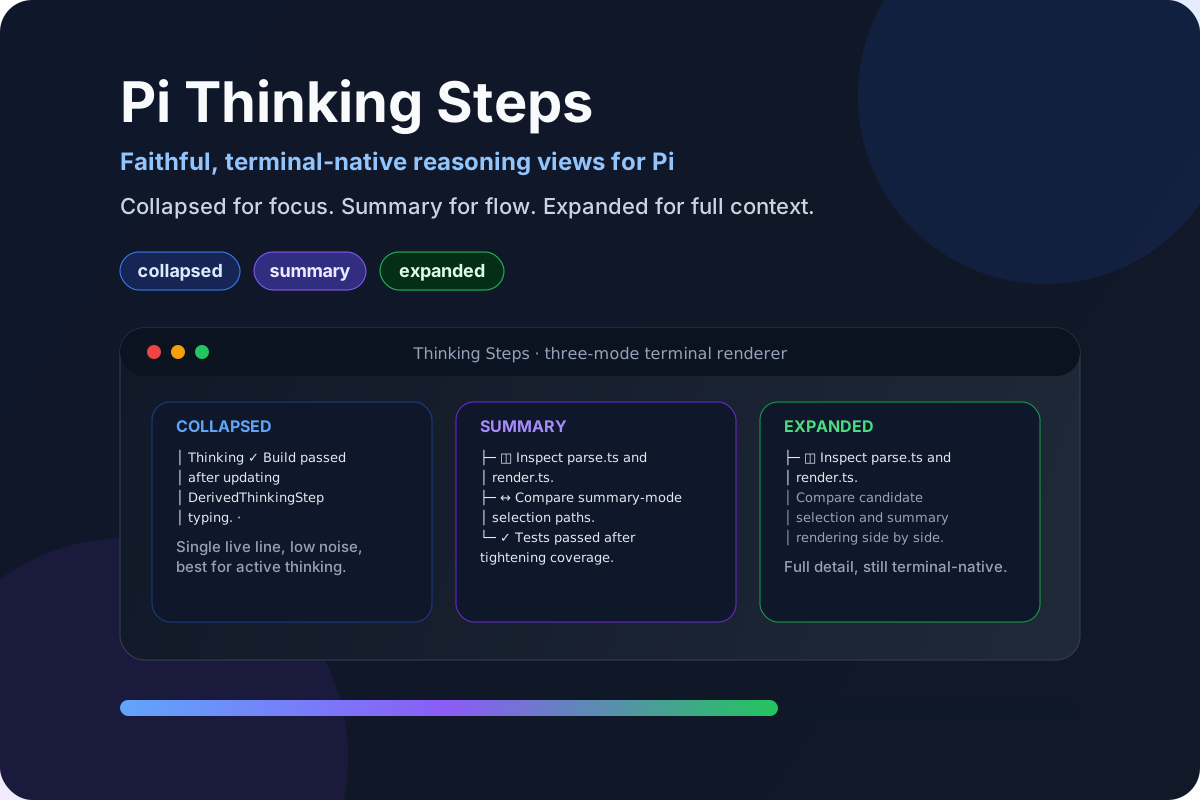
# Pi Thinking Steps
Faithful, terminal-native thinking visualization for Pi.
Turn raw provider reasoning into a clean, structured TUI view without changing what it means.




---
## Why this exists
Pi already exposes provider thinking, but raw reasoning streams are hard to scan in a real terminal. Pi Thinking Steps keeps the source text faithful while making it dramatically easier to follow:
- less visual noise while a model is still thinking
- more structure when you want the reasoning flow at a glance
- cleaner full-detail rendering when you need to inspect the exact text
- no invented reasoning, synthetic logic, or browser-style chrome
The goal is simple: **preserve meaning, improve readability, and stay native to Pi's TUI.**
---
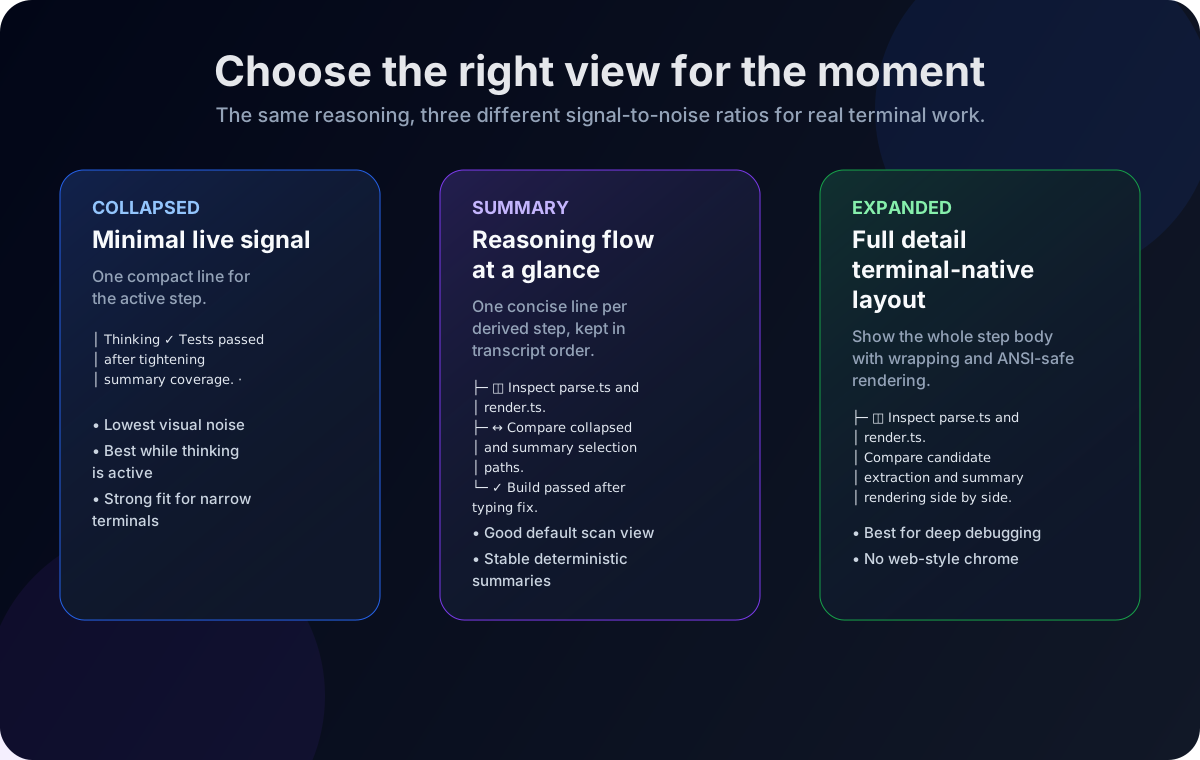
## Visual tour
---
## What you get
- **Three focused modes** — `collapsed`, `summary`, `expanded`
- **Terminal-first rendering** — width-aware, ANSI-safe, and live-update friendly
- **Faithful parsing** — deterministic step derivation and restrained summarization
- **Markdown-aware output** — headings, bullets, ordered lists, code spans, and emphasis render cleanly
- **Scoped persistence** — session, project, and global defaults with predictable restore precedence
- **Patch safety** — isolated, reversible, reference-counted runtime patching
- **Regression coverage** — parser, renderer, lifecycle, compatibility, and metadata checks
---
## The three modes
| Mode | Best for | Behavior |
|---|---|---|
| `collapsed` | Live active thinking | Shows a width-aware compact preview of the highest-signal active step; it may wrap in narrow terminals |
| `summary` | Flow at a glance | Shows a chronological top-N set of salient summaries, preserving active, failure, success, and decision context when space is limited |
| `expanded` | Deep inspection | Shows the full step text in a cleaner, structured terminal layout |
### `collapsed`
Use it when you want the smallest possible thinking footprint while the model is still working.
### `summary`
Use it when you want to understand the reasoning path quickly without reading the full transcript.
### `expanded`
Use it when you want the whole text, but formatted for a terminal instead of dumped as a raw stream.
---
## Control surface
| Action | Control |
|---|---|
| Cycle thinking view | `Alt+T` |
| Choose a mode interactively | `/thinking-steps` |
| Set session mode | `/thinking-steps collapsed` / `summary` / `expanded` |
| Save a project default | `/thinking-steps project ` |
| Save a global default | `/thinking-steps global ` |
| Clear a project default | `/thinking-steps project clear` |
| Clear a global default | `/thinking-steps global clear` |
---
## Persistence and restore precedence
Mode restoration follows this order:
1. session history
2. project default from `.pi/thinking-steps.json`
3. global default from `~/.pi/agent/state/thinking-steps.json`
4. built-in default `summary`
Use plain `/thinking-steps ` when the choice should stay local to the current session. Use `project` or `global` when you want future sessions to inherit that choice automatically.
---
## Example output
### Summary
```text
┆ Thinking Steps · Summary
├─ ◫ Inspect the current renderer implementation.
├─ ↔ Compare how visibility toggling works.
└─ ✓ Verify the refresh path after mode changes.
```
### Expanded
```text
┆ Thinking Steps · Expanded
├─ ◫ Inspect the current renderer implementation.
│ Inspect the current renderer implementation.
├─ ↔ Compare how visibility toggling works.
│ Compare how visibility toggling works.
└─ ✓ Verify the refresh path after mode changes.
Verify the refresh path after mode changes.
```
### Collapsed
```text
│ Thinking ✓ Verify the refresh path after mode changes. ·
```
---
## Rendering behavior
Pi Thinking Steps is built to improve readability **without changing meaning**.
### Parsing and step derivation
The parser uses deterministic rules to keep step boundaries believable and stable. Examples:
- standalone markdown headings stay attached to the body they introduce
- list items split into separate steps when that improves scanability
- blank-line continuation paragraphs stay attached to the correct list item
- standalone concluding prose after a list stays separate from the final list item
- provider-hidden reasoning remains clearly marked as hidden
### Display formatting
The renderer normalizes markdown-like content for terminal display:
- headings render as headings instead of leaking raw `#` markers
- unordered list items render with clean bullets
- ordered and lettered list markers are preserved
- backticks render as code-styled inline text
- emphasis markers render cleanly instead of leaking raw `*...*` / `_..._`
- raw control sequences from model output are stripped before rendering
### Terminal-first constraints
This extension is designed for a real terminal, not a browser UI. That means:
- width-aware wrapping matters
- ANSI-safe rendering matters
- over-decoration is intentionally avoided in the live TUI
- the output should remain readable in narrow layouts
---
## Technical approach
Pi currently exposes only a minimal public hook for built-in thinking rendering: `setHiddenThinkingLabel`.
To deliver a full three-mode thinking view, Pi Thinking Steps patches Pi's internal `AssistantMessageComponent` at runtime and replaces the default visible thinking rendering path with a custom renderer.
That patch layer is:
- **isolated** — patching lives in `internal-patch.ts`
- **reversible** — cleanup restores original methods
- **reference-counted** — multiple retain/release paths are handled safely
- **guarded** — compatibility checks fail loudly when Pi internals drift
- **tested** — integration and regression coverage protects the patch lifecycle
---
## Compatibility contract
This extension intentionally depends on Pi's current internal TUI implementation.
Today, the patch relies on these internal modules in `@mariozechner/pi-coding-agent`:
- `dist/modes/interactive/components/assistant-message.js`
- `dist/modes/interactive/theme/theme.js`
That means:
- upstream Pi internal changes can break the patch layer
- Pi upgrades should be treated as deliberate compatibility work
- the pinned Pi package versions and `package-lock.json` matter
- `npm test` is part of the maintenance contract, not an optional extra
- if patch install fails during `session_start`, the current session stays on Pi's native thinking renderer and live mode switching is disabled for that degraded session
- project/global default saves and clears remain available during a degraded session, but they apply only to future compatible sessions
- retained patch releases are scope-owned; cleanup runs on matching `session_shutdown`, failed final cleanup is retained for retry on a later matching same-scope shutdown, this package does not register a generic extension-unload hook, and missed shutdowns are not recovered by unrelated cwd shutdowns
- assistant message ownership is recorded from lifecycle events so patched rendering can keep a message on its original scope even if another scope becomes current later
- one registered extension instance still has a single active lifecycle scope for session-level events; Pi should not interleave new unowned sessions through one handler set without a new `session_start`/message ownership path
The current package uses Pi package version `0.69.0` as runtime dependencies in `package.json`, and compatibility-sensitive upgrades must update `package-lock.json` in the same change.
---
## Quick start
From the repository root:
```bash
pi -e ./index.ts
```
The package entry point is already configured in `package.json`:
```json
"pi": {
"extensions": ["./index.ts"]
}
```
---
## Development
Install dependencies:
```bash
npm install
```
Run the full validation suite:
```bash
npm test
```
Typecheck only:
```bash
npm run build
```
---
## Published package contents
The package ships:
- `README.md`
- `CHANGELOG.md`
- `LICENSE`
- the extension TypeScript sources
- `tsconfig.json`
- the published validation tests under `test/`
- the README SVG assets under `assets/`
That keeps the GitHub README, packaged validation surface, and published package presentation aligned.
---
## Project structure
- `index.ts` — extension entry point, commands, shortcut, lifecycle hooks
- `internal-patch.ts` — Pi runtime patching and cleanup
- `parse.ts` — thinking-step splitting, summaries, role inference, mode parsing
- `persistence.ts` — project/global mode preference storage
- `render.ts` — collapsed, summary, and expanded terminal rendering
- `state.ts` — shared mode, active-thinking state, patch lifecycle state
- `types.ts` — shared contracts
- `test/thinking-steps.test.ts` — unit and integration coverage
- `test/summarizer-challenger.test.ts` — focused summarizer-regression coverage
---
## Design principles
1. **Readable over flashy**
- The goal is clarity, not decoration.
2. **Faithful over clever**
- The renderer should not invent meaning the source text does not support.
3. **Terminal-native over web-like**
- The output should feel right in a terminal first.
4. **Small surface area**
- Parsing, rendering, state, and patching stay deliberately separated.
5. **Strict validation**
- Changes should be backed by tests, especially around patch lifecycle and compatibility.
---
## Versioning
For the canonical package version, see [`package.json`](./package.json). For release points, use the repository tags.
---
## License
This project is released under the [MIT License](./LICENSE).