# evo
[](https://pypi.org/project/evo-hq-cli/)
[](LICENSE)
[](https://github.com/evo-hq/evo/actions/workflows/ci.yml)
[](https://doi.org/10.5281/zenodo.20447923)
**Get started with autoresearch on any codebase - with two simple commands.**
Do you want to do more with autoresearch or need a custom, hands-on deployment?
[Request access to evo platform](https://evo-hq.com/beta) or email [hello@evo-hq.com](mailto:hello@evo-hq.com).
---
**[Try it](#try-it)** · **[Install](#install)** · **[How it works](#how-it-works)** · **[Dashboard](#dashboard)** · **[Upgrading](#upgrading)**
A plugin for your agentic framework that optimizes code through experiments
You give it a codebase. It discovers metrics to optimize, sets up the evaluation, and starts running experiments in a loop -- trying things, keeping what improves the score, throwing away what doesn't.
*Inspired by [Karpathy's autoresearch](https://github.com/karpathy/autoresearch)* -- where an LLM runs training experiments autonomously to beat its own best score. Autoresearch is a pure hill climb: try something, keep or revert, repeat on a single branch. Evo adds structure on top of that idea:
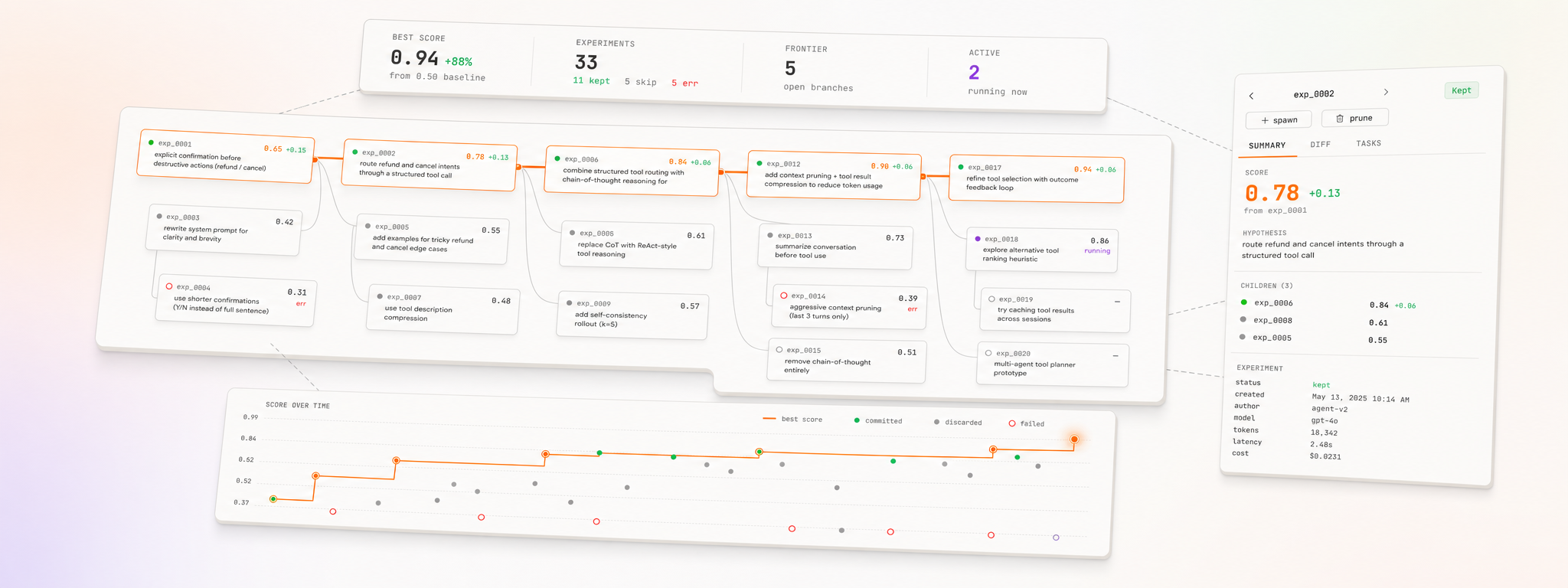
- **Tree search over greedy hill climb.** Multiple directions can fork from any committed node, so exploration doesn't collapse to one path.
- **Parallel semi-autonomous agents.** Spawn multiple subagents and run them simultaneously, each in its own git worktree. Each subagent reads traces, formulates hypotheses, and can run multiple iterations within its branch.
- **Shared state.** Failure traces, annotations, and discarded hypotheses are accessible to every agent before it decides what to try next.
- **Gating.** Regression tests or safety checks can be wired up as a gate. Experiments that don't pass get discarded.
- **Observability.** A dashboard to monitor your experiments.
- **Benchmark discovery.** The `discover` skill explores the repo, figures out what to measure, and instruments the evaluation.
Runs on Claude Code, Codex, Cursor, Kimi, OpenClaw, Hermes, Opencode, or Pi. Experiments run locally or on remote sandboxes — Modal, E2B, Daytona, AWS, Azure, SSH.
## Try it
Two commands:
```
/evo:discover # one-time code discovery: figures out benchmarks and creates gates against unintended changes
/evo:optimize # run the loop
```
`discover` asks what to optimize, the benchmark command, and the metric direction. Skip the questions by seeding the answer:
```
/evo:discover make the JSON parser at src/parser.py faster
```
Then run the loop:
```
/evo:optimize
```
evo sizes each round to your benchmark's resource profile — one experiment at a time when a run needs the whole GPU or another exclusive resource, wider when runs are independent — and keeps going until the score stops improving. By default it runs unattended and pushes edits through parallel subagents; say so in plain language if you'd rather it pause after each round or hold to one experiment at a time.
Invocation syntax is host-specific: `/evo:` on Claude Code, `$evo` on Codex, `/` skill menu on Cursor, natural language on Hermes, Opencode, OpenClaw, and Pi.
## Install
```bash
# 1. evo CLI
uv tool install evo-hq-cli
# 2. Host CLI (if you don't already have it)
npm install -g @anthropic-ai/claude-code # or @openai/codex, openclaw, @earendil-works/pi-coding-agent
# Cursor: install from cursor.com (IDE), or `curl https://cursor.com/install -fsS | bash` for the cursor-agent CLI
# Kimi: `curl -fsSL https://code.kimi.com/install.sh | bash`, or `npm install -g @moonshot-ai/kimi-code`
# 3. Plugin + host hooks
evo install # claude-code | codex | cursor | hermes | kimi | opencode | openclaw | pi
```
For remote backends, install with the matching provider extra: `uv tool install 'evo-hq-cli[modal]'` (or `[e2b]`, `[daytona]`, `[aws]`, `[azure]`, `[all]`).
### Codex hook trust
`evo install codex` trusts evo's hooks for you. To review them yourself first, pass `--no-trust-hooks`, then approve via `/hooks` inside codex.
## How it works
### Parallel
The orchestrator dispatches subagents in parallel. Each runs in its own isolated workspace, picks up shared state (failure traces, annotations, discarded hypotheses), forms a hypothesis, edits, and runs the benchmark. A subagent with iteration budget remaining continues on its branch within the same round when its prior edit warrants a follow-up.
### Frontier strategy
After each round, the orchestrator selects which committed branch to extend next. Available strategies:
- **argmax** — extend the highest-scoring branch
- **top_k** — round-robin among the K best
- **epsilon_greedy** — best most of the time, random sometimes
- **softmax** — sample weighted by score
- **pareto_per_task** — keep specialists the aggregate hides, inspired by [GEPA](https://arxiv.org/abs/2507.19457)
Configure in the dashboard's Frontier tab, which lists each strategy's parameters.
### Cross-cutting scans
Between rounds, [RLM](https://arxiv.org/abs/2512.24601)-inspired scan subagents read trace batches in parallel and surface compound failure patterns: gate-failure intersections, shared root causes across traces. Findings land in shared state, which the next round's subagents read at startup.
### Gates
evo introduces **gates**: pass/fail checks that run on every experiment. An experiment that fails a gate is discarded even if its score beats the current best. Without gates, the search will find ways to return a constant, skip work, or trade correctness for speed.
Any command that exits zero on pass and non-zero on fail qualifies as a gate: a test suite, an invariant script, a score floor on a held-out slice of the benchmark. Gates inherit down the experiment tree: a gate registered at the root runs on every descendant. Narrower gates can be attached to specific branches.
When `discover` builds a benchmark from scratch, it attaches a held-out-slice score-floor gate automatically. When the benchmark already exists in the repo, gates are opt-in.
## Where experiments run
| Backend | Where | Install |
|---|---|---|
| **worktree** *(default)* | local git worktree per experiment | included |
| **pool** | reuse a fixed set of local workspaces | included |
| **ssh** | your own SSH host | included |
| **modal** | Modal serverless cloud | `uv tool install 'evo-hq-cli[modal]'` |
| **e2b** | E2B cloud sandboxes | `uv tool install 'evo-hq-cli[e2b]'` |
| **daytona** | Daytona cloud workspaces | `uv tool install 'evo-hq-cli[daytona]'` |
| **aws** | AWS EC2 sandboxes | `uv tool install 'evo-hq-cli[aws]'` |
| **azure** | Azure VMs | `uv tool install 'evo-hq-cli[azure]'` |
Pick and configure in the dashboard's Backend tab.
## Dashboard
The dashboard starts automatically with `/evo:discover` (or `evo init`) and prints the URL in chat:
```
Dashboard live: http://127.0.0.1:8080 (pid 12345)
```
If `8080` is in use, evo increments to the next free port (`8081`, `8082`, …) and prints it. Subsequent runs reuse the chosen port. Start it manually with:
```bash
uv run --project /path/to/evo/plugins/evo evo dashboard --port 8080
```
## Upgrading
```bash
evo update # update CLI + every installed host
evo update # update one host (also bumps CLI to match)
evo update --version 0.4.1 # pin to a release
```
Every `evo install` / `evo update` keeps the CLI on PATH in lockstep with the host plugin version it just installed (`uv tool install --force evo-hq-cli` under the hood). Without a `--version` pin that resolves to the latest **stable** release, so running an unpinned `evo install`/`evo update` against a pre-release pulls the CLI back to stable — pin both sides for an alpha (see [Testing a pre-release](#testing-a-pre-release-alpha)). The CLI binary, the skill files, and the hook protocol share wire formats — letting them drift caused silent failures in earlier versions. Editable installs (`uv tool install --editable`, `pip install -e`) are detected and left untouched.
See `evo update --help` for `--force`, `--scope`, and additional flags.
### Migrating from any pre-0.4.4 version
```bash
uv tool install --force evo-hq-cli && evo update --force
```
`--force` wipes the host plugin cache and reinstalls, working around [anthropics/claude-code#14061](https://github.com/anthropics/claude-code/issues/14061): `/plugin update` returns success but does not replace cached plugin files.
### Hooks failing with exit 127
The host lost evo's hook binary. Fixed in 0.5.1; reinstall the host to repair:
```bash
uv tool install --force evo-hq-cli && evo install codex --force # or: evo install claude-code --force
```
`evo doctor ` confirms the result.
### Testing a pre-release (alpha)
`uv` and `pip` skip pre-releases by default. To install an alpha, pin both the CLI version and the host plugin tag:
```bash
uv tool install --force 'evo-hq-cli==0.4.1a2' && \
evo update --version 0.4.1-alpha.2 --force
```
Substitute the target alpha version. The CLI uses PEP 440 form (`0.4.1a2`); the marketplace tag uses the dash form (`v0.4.1-alpha.2`).
## Telemetry
evo sends anonymous telemetry and usage stats that helps us improve evo.
Disable it globally anytime:
```bash
evo telemetry off
```
Or for one command/session:
```bash
EVO_TELEMETRY=0 evo ...
```
## Dev install
For development on evo:
```bash
git clone https://github.com/evo-hq/evo
cd evo
uv tool install --editable plugins/evo
```
## License
Apache-2.0. See [LICENSE](LICENSE).
## Citation
If you use evo in your work, please cite it (see [`CITATION.cff`](CITATION.cff)):
```bibtex
@software{bishoyi_evo,
author = {Bishoyi, Alok Kumar},
title = {{evo: an autoresearch orchestrator for codebases}},
url = {https://github.com/evo-hq/evo},
doi = {10.5281/zenodo.20447923},
year = {2026}
}
```