1.2 - Earth’s Life Support Systems
Wordcount: 3500
Last modification: 09/04/2024
Written by: Oliver (100%)
License: CC BY-NC 4.0
“Without water and carbon I literally would not be here” - a wise man, 2024
1. How important are water and carbon to life on Earth?
The short answer to this is that the water and carbon cycles are very important.
The long answer? Well…:
Introduction to water
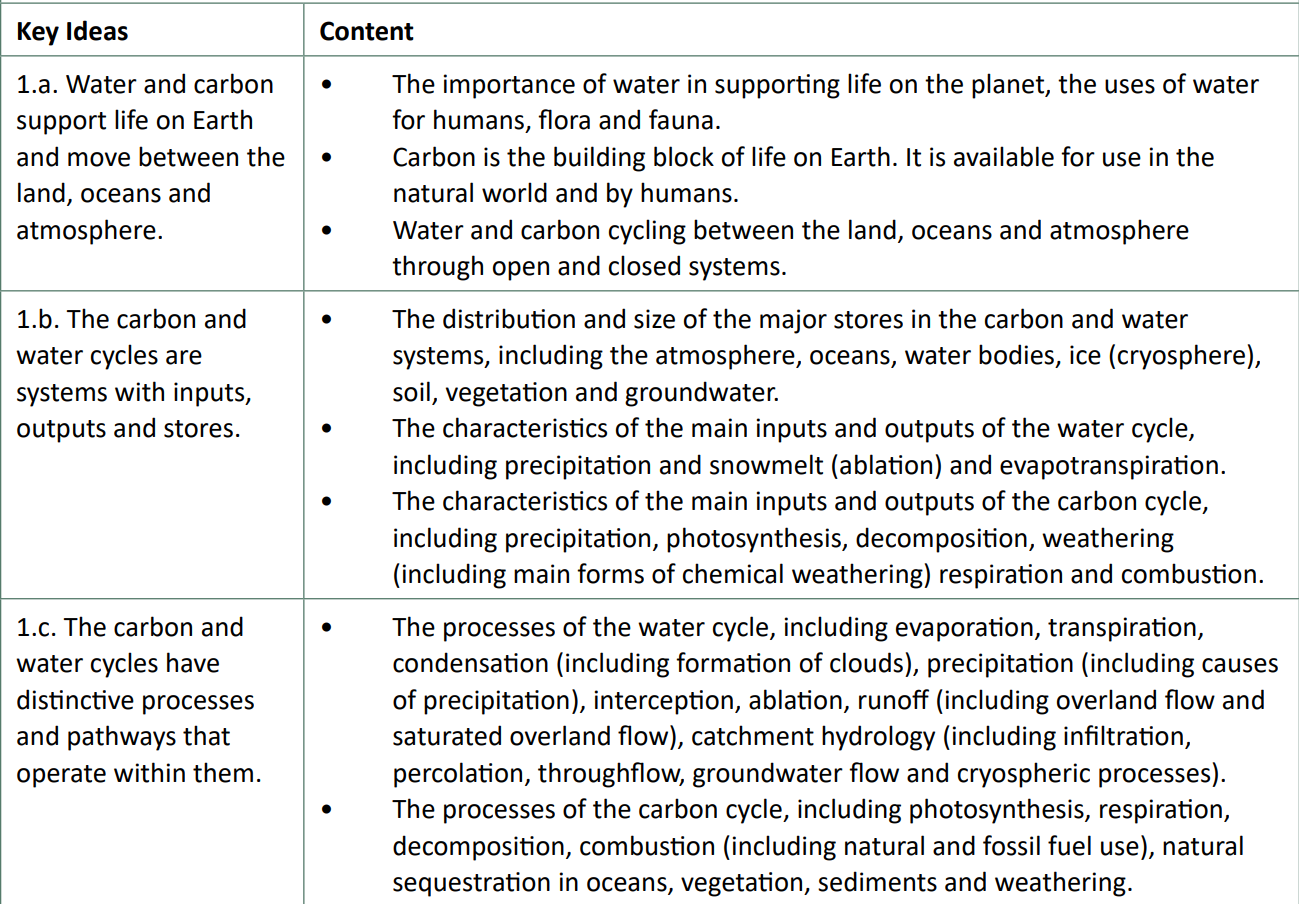
1a. Water and carbon support life on Earth and move between the land, oceans and atmosphere.
Water is a fundamental prerequisite for life, not just on Earth but it is considered by scientists as an essential necessity for any sort of life in the universe.
The Circumstellar Habitable Zone, or Goldilocks zone, is the habitable area around a star that is neither too close nor too far so that conditions for life are too hot or too cold, and categorised by allowing liquid water to be present. Otherwise, the water would be evaporated or be as solid ice. As such, liquid water allows life to form. Depending on the star, this zone can be further or closer to it, or the zone itself being wider or smaller.
It is described by astronomers as:
“The area around a stellar object which contains liquid water, making it habitable. The regulation of temperature and radiation facilitate respiration and photosynthesis”.
Water is essential to supporting life. The atmosphere is sustained by a continual cycle of evaporation and condensation through cloud formation. Water vapour itself is a very potent greenhouse gas, which regulates and moderates global temperatures: the climate is 15 degrees C warmer with water than without. As sun rays collide with the molecules in water vapour, they heat them up, causing them to vibrate and let off heat. In addition, water vapour is excellent as stopping long-wave radiation from causing harm for the biosphere. It makes up 65-95% of all the biospheric mass, including in people, flora and fauna.
Water itself is in a closed system, meaning that water cannot enter or leave the Earth. As the water cannot exit or enter, it is transferred, stored and moved around inside the system. This is known as the global hydrological cycle.An open system within the overall closed water cycle system may be a drainage basin: water can enter and exit at any time.
| Store | Size | % of total |
|---|---|---|
| Ocean | 1.33b km3 | 96.5% |
| Cryosphere | 24m km3 | 1.76% |
| Aquifers | 23m km3 | 1.69% |
| lakes | 176k km3 | 0.013% |
| pedosphere | 17k km3 | 0.0012% |
| atmosphere | 13k km3 | 0.00093% |
| rivers | 2.1k km3 | 0.00015% |
| biosphere | 1.1k km3 | 0.000081% |
- Data updated to match latest scientific research.
Introduction to carbon
Carbon is the building block of life on Earth. It is available for use in the natural world and by humans.
It is found across the planet, in a wide variety of stores, and is measured in Petagrams of Carbon - PgC - which is the same 1 gigatonne. It is stored as a gas in the atmosphere, in oceanic sediments, and is used in living organisms to… continue living, amongst other things. Carbon is also very useful as we can use it to power various electricity generators through hydrocarbons like oil.
Similarly to water, carbon is a closed system on Earth, but on a more local scale such as a rainforest it becomes an open system.
| Store | Amount | Format |
|---|---|---|
| Lithosphere | 100,000+ PgC | Fossil fuels, sedimentary rocks |
| Hydrosphere (deep) | 40,000 PgC | Mostly CaCO3 from dead shelled organisms and bicarbonate ions. |
| Pedosphere | 2,000 PgC | Litter from dead or decaying matter and near-surface soils |
| Cryosphere | 1,700 PgC | Permafrost |
| Hydrosphere (upper) | 1,000 PgC | Dissolved CO2 from atmospheric dissolution |
| Biosphere | 650 PgC | Living organisms, flora and fauna. |
| Atmosphere | 800 PgC | Carbon dioxide |
The data is somewhat variable and differs between scientific research.
Inputs, outputs and processes of water
1b. The carbon and water cycles are systems with inputs, outputs and stores.
1c. The carbon and water cycles have distinctive processes and pathways that operate within them.
In the global hydrological cycle, there are many interreated processes, stores, inputs and outputs, similar to that of a glaciated system. Flux is a term used to measure the rate of flow between stores, through mass over unit time (e.g. 3m/s). In total, around 505,000km2 of water is moved annually around this system.
Evapotranspiration
Evapotranspiration is the term used to denote the transfer of water into the atmosphere, combining evaporation and transpiration. Energy, such as insolation, when added to a mass of water like an ocean, increases particles’ energy and breaks the bonds between them, allowing for a state change to gas as water vapour, which then rises. This is evaporation. Transpiration on the other hand occurs only from the biosphere and mainly plants - this accompanies the process of respiration and photosynthesis. Leaves and plant surfaces lose water through their stomata via evaporation, and this water is replenished through effectively pulling more water and nutrients from the roots through the plant. On a local scale this may be insignificant but on a wider, perhaps national scale such as the Amazon Rainforest, the amount of water transpired through the plant, and evaporated by rivers and other stores, contribute significantly to changing global weather patterns. In total, transpiration accounts for around 10% of atmospheric water vapour.
Precipitation
One of the main processes in the water cycle is precipitation. Simply put, this is when water leaves the atmosphere through any form, such as rain, snow, sleet or hail. When water vapour reaches the critical dew point (temperature at which air becomes saturated with moisture), it condenses in the atmosphere as clouds. Provided that there exists condensation nuclei, then clouds will form. As these nuclei of ice crystals or water droplets aggregate, they become too heavy to be suspended in the atmosphere, thus reaching a critical size and then fall to the surface as precipitation. This process is known as the collision-coalescence theory.
Water produced by precipitation is then collected in a drainage basin and moves into rivers through runoff - a combination of processes including overland flow, in addition to soil infiltration, ground percolation and subsequent throughflow and groundwater flow. Most of this water will then enter the ocean again, ready for the cycle to repeat, or percolate further into permeable rocks and be part of an underground aquifer.
Some key points:
- Where precipitation occurs at high altitudes or in cold environments, snow is likely to form, and potentially remain on the ground for a long time, increasing the lag time visible on flood hydrographs.
- Duration is the length of time a period of precipitation lasts. Climatic depressions or frontal weather systems may cause this; there may also be high rates of overland flow with flooding for long durations.
- Intensity is how much precipitation falls over a given time period. This can also have an impact on reducing lag times with high intensity, causing more overland flow due to less time to infiltrate into the soil. The amount the soil can absorb is the infiltration capacity.
- Precipitation may also vary seasonally, with greater intensity in certain months. This variation can increase or decrease the amount of water in rivers and lakes.
Ablation
Ablation, whch you might remember from the Glaciated Landcapes unit, is the result of snowmelt. Glaciated environments and ice sheets contain the second highest amount of stored water on the planet - behind that of oceans - at 29 million cubic kilometres. Although most is in polar glaciers which take a longer time to melt due to the much colder temperatures, water is still released through meltwater, calving and sublimation. In addition, permafrost melting can also contribute to the creation of extra ponds and lakes, visible in thermokarst landscapes in the Arctic Tundra.
Condensation & cloud formation
There are some fundamental principles of cloud formation you need to know:
- As air rises, it cools, at a rate of 0.6 degrees C per 100m or so.
- Air rises when it moves over a mountainous region, or wind from below moves over a mountain.
- The atmosphere has less pressure with altitude. Therefore, the same amount of air in a ‘parcel’ will occupy a greater area at higher altitudes.
Air moves in ‘parcels’ which have their own temperatures, humidity, etc.
Adiabatic expansion
When air cools or expands adiabatically, this means that there is no heat exchange with the environment. The parcel of air purely changes based on the pressure being exerted on it by the atmosphere.
- The environmental lapse rate (ELR) is the decrease in air temperature with altitude for a specific time and place. this is 6.5 degrees C per km
- The dry adiabatic lapse rate (DALR) is the rate at which unsaturated air cools during ascent, or warms during descent. The DALR is 10 degrees C per km.
- The saturated adiabatic lapse rate (SALR) is the rate at which air at its dew point (and therefore condensing) cools as it rises. Condensation releases latent heat, making this lower than the DALR at around 7 degrees C per km.
These are significant as the determine how “stable” the atmosphere is.
Cloud formation
Clouds mainy form through convection. As an area of ground warms, the local air “parcel” rises - this is amospheric instability. For this example, let’s say that the dew point is 10degrees C lower than the temperature at the surface (as a result of insolation). Therefore, as the air has not reached its dew point, it moves upwards at the DALR, and reach the dew point at an altitude of 1km. Once it reaches this level, condensation will occur, forming a cloud. However, there is still convection occuring, as the cloud parcel is still warmer than the surrounding ELR. Eventually, the ELR and SALR will be in equilibrium at a given altitude, which marks the point of atmospheric stability and halt of cloud formation
Different areas at different times have different dew points. and rates of ELR
This may be hard to visualise as we cannot see individual clouds and water rising and falling. I like to resolve this by remembering that it’s not one cloud that forms: it’s a whole cloud system that can span 1000s of kilometres; the sun can cause this convection after heating whole continental areas of land.
If the dry envronmental lapse rate is lower than the ELR, the air parcel that would typically rise is unable to do so as it is cooler than the surroundings and can only rise through force (e.g. topographic changes) as the atmosperic conditions here are stable.
Inputs, outputs and processes of carbon
Precipitation
I’m not sure why the specification specifically states this, as this is mostly to do with the water cycle. However, rainwater and other forms of precipitation can combine with gaseous carbon (CO2) to form carbonic acid, which is able to break down some sedimentary rocks in situ, such as limestone. In addition, in oceans, calcium carbonate is a store of carbon in plankton and shelled organisms, and this may preciptate when the organisms die and lithfy on the ocean floor.
Photosynthesis
Photosynthesis is the process that transfers atmospheric carbon dioxide into the biosphere, accounting for 120 PgC per year. Plant stomata open and close and allow carbon to enter, combine with water, to create energy (glucose) for the plant, allowing it to grow and increase its transfer of carbon further. The respiration flux accounts for 118 PgC to be transferred back into the atmosphere from the biospheric store too.
Decomposition
Decomposers such as fungi and microbes break down dead organic matter, and in the process releasing most of the stored carbon into the atmospehre as carbon dioxide, and some into the soil too. This process occurs very quicly in environments where there is a lot of energy ususally given by heat along the equator in tropical rainforests and is slower in much colder locations like the tundra.
Weathering
Weatehring includes physical and chemical components. Physical weathering is the action of other factors such as water or biotic life mechanically breaking down rocks, for example roots cracking open rocks or freeze-thaw action. Chemical weathering can also be significant, such as carbonation, which occurs when carbonic acid is produced (see above) which breaks down carbonates in rock strata, which then releases CO2 gas or dissolved in water streams. This is largely how phytoplankton and other cretacious aquatic organisms obtain their carbon
Case study: the Amazon Rainforest
2a. It is possible to identify the physical and human factors that affect the water and carbon cycles in a tropical rainforest.
Case study: the Arctic Tundra
2b. It is possible to identify the physical and human factors that affect the water and carbon cycles in an Arctic tundra area.
The Arctic Tundra is located between 60 and 75 degrees N and includes parts of Russia, Canada, Norway, Iceland and Alaska, among others. It occupies a combines 8m km2 and is defined by having a July isotherm of 10 degrees C. This means that t warmest month reaches a maximum temperature of 10 degrees (this is roughly equivalent to the tree line). The Arctic Circle is the southernmost point where the sun can remain below the horizon for 24 hours during certain seasons.
The tundra is in a negative heat balance for 8-9 months of the year, releasing more heat than it takes in. This is a combination of polar cells n the atmosphere, and the Earth’s tilt meaning that areas remain below the horizon, thus being in complete darkness for 2 months of the year. During these times, tempreatures may reach -40degC. The inverse is true in the summer, where the long daylight hours somewhat comprensate for the short growing season.
Water cycle
Temperatures are low, with a mean of -15C. Precipitation is also low, with annual totals between 50 and 350mm - most of which is snow. Combined with the low levels of moisture in the atmosphere (little evaporation) means that there is low absolute humidity and very low ground and soil moisture. When there is a positive heat balance, the insolation goes into melting the snow and, should there be extra goundwater, permafrost inhibits groundwater infiltration and percolation (and definitely not any groundwater flowing!). This may result in the formation of wetland ponds, lakes and other thermokarst features in the summer when the active layer melts, but the permafrost remains inpermeable below.
Carbon cycle
Permafrost is estimate to contain
Interdependence
As I’ve hinted at and I’m sure you’ve realised by now, the water and carbon cycles are linked in many ways.
Additional Skills
The OCR specification also lists some specific skills ou must also have to ensure you get full marks. These topic-specific skills are:
- climate graphs
- simple mass balance (remember from glaciation?)
- rates of flow
- unit conversions
- analysis and presentation of field data