# [hep-th/0106112] [Maldacena] ThermoField Double
### References:
- Maldacena, [hep-th/0106112]
- Harlow's note, [1409.1231]
- Hartman's note, http://hartmanhep.net/topics2015/gravity-lectures.pdf
## What is a ThermoField Double?
$$
\ket{\mrm{TFD}}
\equiv \ket{\Psi}
= \sum_n \sqrt{p_n}\,
\ket{n}_L \ket{n}_R
\in \mcal{H}^*_L\otimes\mcal{H}_R
$$
$$
\rho_R
= \Tr_L \ket{\Psi} \bra{\Psi}
= \sum_m {}_L\bra{m}\,
\Big\{
\ket{\Psi} \bra{\Psi}
\Big\}\,
\ket{m}_L
= \sum_n p_n\,
\ket{n}_R \bra{n},
\quad
p_n = \frac{e^{-\beta E_n}}{Z}
$$
- First introduced in thermal field theory as a tool for doing calculations --- using a purified double instead of a mixed density matrix. Highly related to the Schwinger-Keldysh (real time) formalism in thermal field theory.
$$
\Tr[\mspace{2mu}\rho_R \mcal{O}_R]
= \mel{\Psi}{\mcal{O}_R}{\Psi}
$$
- Thermal equilibrium:
$$
\rho(t)
= e^{-iHt} \rho(0)\, e^{iHt}
= \rho(0)
$$
_Note that time evolution of the density matrix in the Schrödinger picture is different from that of an usual operator in the Heisenberg picture._
We expects that $\ket{\Psi(t)} = \ket{\Psi(0)}$, hence the left theory $L$ is evolved with negative time, or equivalently, with negative Hamiltonian:
$$
\ket{\Psi(t)}
= e^{-i\,(-H_R)\, t} e^{-iH_R t}\,\ket{\Psi(0)}
= \ket{\Psi(0)}
$$
> **Convention:** the double Hilbert space is usually taken to be $\mcal{H}^\ast_L\otimes\mcal{H}_R$, where the left theory is time-reversed *by definition*; note the star “$\ast$” in $\mcal{H}^*_L$.
>
> The unstarred Hilbert space $\mcal{H}_L$ corresponds to the Hamiltonian $H_L$, while for the time-reversed $\mcal{H}^*_L$ we have $(-H_L)$. The total Hamiltonian is thus $H = H_R - H_L$.
>
> In the construction of TFD we have $\mcal{H}_L\cong\mcal{H}_R$, so $H = H_R - H_L$ acts trivially on states like $\ket{n}_L \ket{n}_R$. However it is imprecise to say $H_L = H_R$ since they act on different subspaces (as is pointed out by Yuan). More precisely, we have:
>
> $$
\begin{array}{rrcl}
H_R =& \mathds{0} & \otimes & H_R \\
H_L =& H_R & \otimes & \mathds{0} \\
H = H_R - H_L
=& -H_R & \otimes & H_R \\
\end{array}
$$
>
> See e.g. [1610.01940].
- To prepare (construct) $\ket{\Psi}$ in field theory: Euclidean path integral over a cylinder with length $\tau = \frac{\beta}{2}$ and two ends _unfixed_; note the $\sqrt{p_n}$ coefficient in the definition.
$\ket{\Psi} = $ 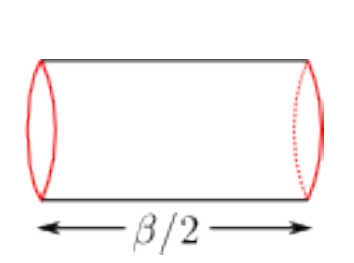 $
\sim \displaystyle\int_\bullet^\star
\DD{\phi}\,e^{-S[\phi]}
= \mel{\bullet}{e^{-\beta H}}{\star}
$
$
\sim \displaystyle\int_\bullet^\star
\DD{\phi}\,e^{-S[\phi]}
= \mel{\bullet}{e^{-\beta H}}{\star}
$
- More specifically, by the path integral definition of $\ket{\Psi}$ (unnormalized), we have (see _Hartman_, Chapter 17):
$$
\begin{align}
\bra{\phi'}_L \bra{\phi}_R \,\ket{\Psi}
&\equiv \mel{\phi}{e^{-\beta H/2}}{\phi'^*}
\quad \small\text{(by definition)} \\[1ex]
&= \sum_n \mel{\phi}{e^{-\beta H/2}}{n}
\bra{n}\ket{\phi'^*} \\
&= \sum_n e^{-\beta E_n/2}
\bra{\phi}\ket{n}
\bra{\phi'}\ket{n} \\
\end{align}
$$
“$*$”: conjugate, more precisely $CPT$ (see _Harlow_'s discussions on Rindler decomposition). Joining two cylinders: $\rho_R = \Tr_L \ket{\Psi}\bra{\Psi}$. Further joining two ends: $Z$.
## $\mrm{AdS}_{d+1}/\mrm{CFT}_d$
- So far, purely field theoretical. **With AdS/CFT,** asymptotic AdS spacetime $\leftrightarrow$ state in CFT, $\ket{\mrm{TFD}}$ becomes a **CFT description** of the AdS Schwarzschild blackhole:
> Two copies of the CFT in the particular pure (entangled) state $\ket{\mrm{TFD}}$ is _approximately_ described by gravity on the extended AdS Schwarzschild spacetime.
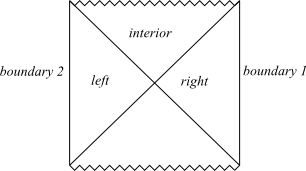 An analog: Rindler vs Schwarzschild; note that there is a $\mbb{R}^{d-1}$ suppressed at each pt in the Rindler diagram, while there is an $S^{d-1}$ suppressed at each pt in the BH Penrose diagram.
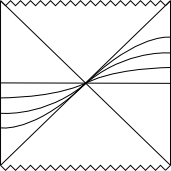
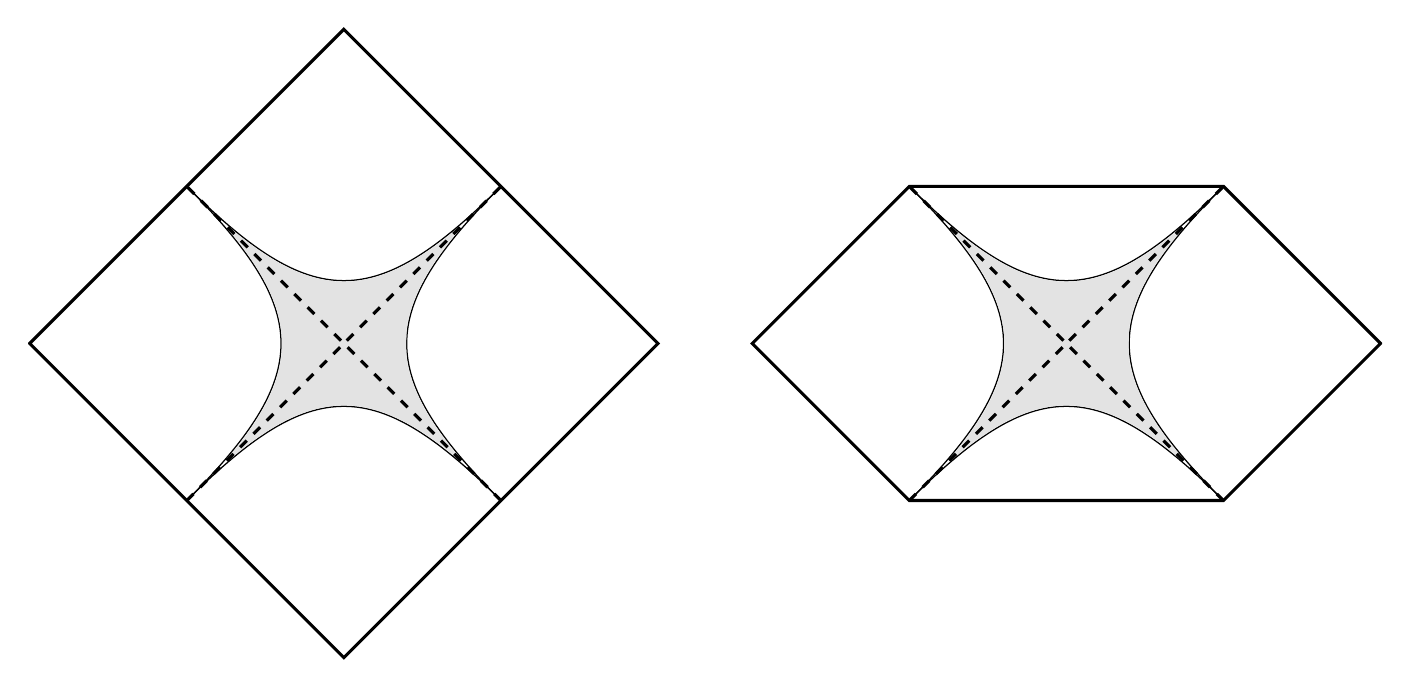 - $H = H_R - H_L$ is dual to the bulk Hamiltonian that generates time evolution along the isometry $\pd_t$. Recall that the Schwarzschild $t$ coordinate runs ‘backwards’ on the left side.
 - What is the corresponding description in the bulk? **Hartle--Hawking state**.
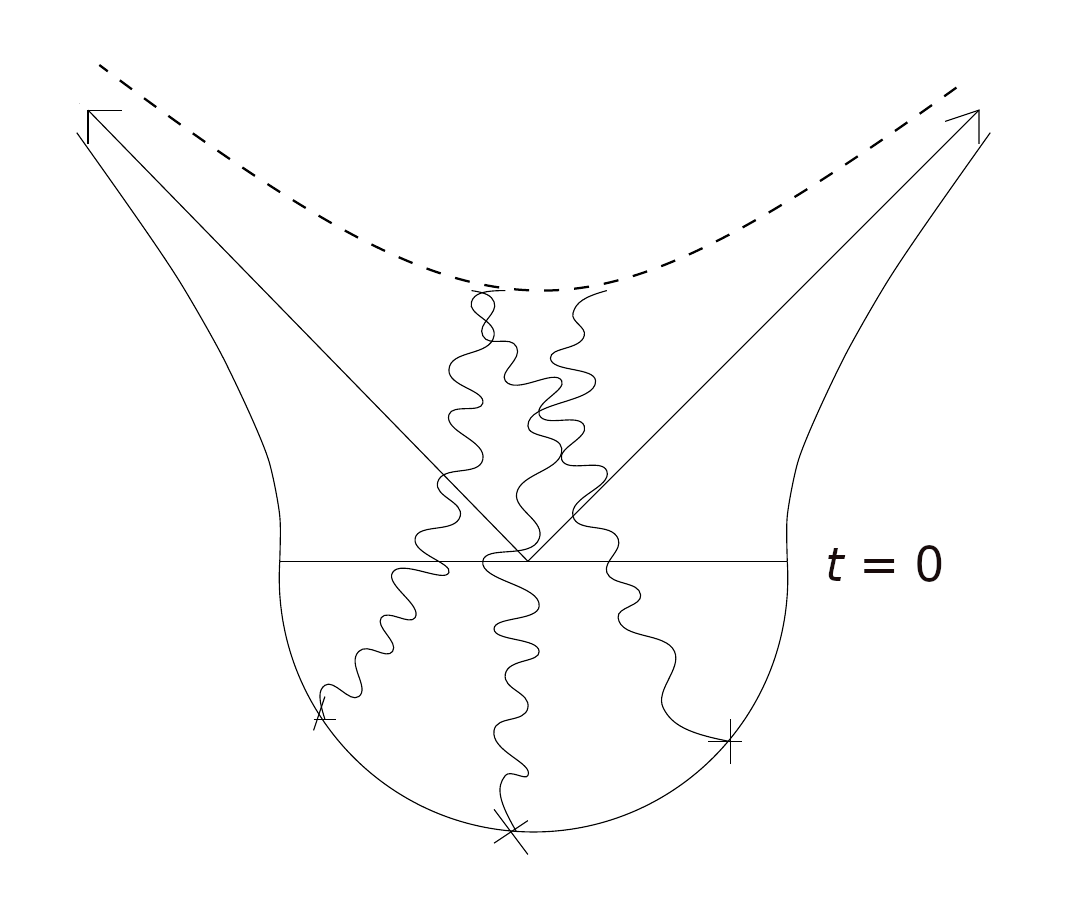 Bottom half is the 'Wick-rotated' AdS-Schwarzschild, with radius $r$. At each point in the diagram there is a suppressed $S^{d-1}$. _**Boundary**_ topologies:
$$
\begin{align}
\text{Lorentzian $\pd\,\mrm{AdS}_{d+1}$:}
&&& \mbb{R}\times S^{d-1}
&& \text{(cylinder)} \\
\text{Euclidean boundary:}
&&& S^1_\beta \times S^{d-1}
&& \text{(donut)} \\
\text{Half Euclidean boundary:}
&&& [0,\tfrac{\beta}{2}] \times S^{d-1}
&& \text{(“wormhole”)} \\
\end{align}
$$
Bottom half is the 'Wick-rotated' AdS-Schwarzschild, with radius $r$. At each point in the diagram there is a suppressed $S^{d-1}$. _**Boundary**_ topologies:
$$
\begin{align}
\text{Lorentzian $\pd\,\mrm{AdS}_{d+1}$:}
&&& \mbb{R}\times S^{d-1}
&& \text{(cylinder)} \\
\text{Euclidean boundary:}
&&& S^1_\beta \times S^{d-1}
&& \text{(donut)} \\
\text{Half Euclidean boundary:}
&&& [0,\tfrac{\beta}{2}] \times S^{d-1}
&& \text{(“wormhole”)} \\
\end{align}
$$
 > More about the Euclidean geometry:
> Euclidean black holes are completely smooth solutions; they do not have an interior or a singularity! In 3D, we have (per Maldacena's convention):
>
> $$
\dd{s}^2
= \pqty{r^2 - 1} \dd{\tilde{\tau}}^2
+ \frac{1}{r^2 - 1} \dd{r}^2
+ r^2 \dd{\tilde{\phi}}^2
$$
>
> There is an apparent singularity at $r = 1$. However, with certain periodicities the singularity is resolved; the geometry 'caps off' at $r = 1$ (in _Harlow_'s words).
>
> **Note**: Behind the "horizon", we have $r<1$, and the signature is no longer Euclidean but $(--+)$, which makes no sense for an Euclidean theory. Therefore the interior is simply discarded.
>
> With $\tilde{\phi}\in\mathbb{R}$, this describes the 'Rindler' patch of AdS, and the horizon is just that of an accelerated observer; $J = 0$ BTZ, on the other hand, comes from identifying:
>
> $$
\tilde{\phi} \cong \tilde{\phi} + 2k\pi
$$
>
> See e.g. the (BTZ + Henneaux) paper [gr-qc/9302012]. Here we fix the horizon at $r = 1$, therefore the BH mass is in fact encoded in $k$.
> With $\phi = \tilde{\phi}/k,\ \tau = \tilde{\tau}/k$, we get the usual $\phi \cong \phi + 2\pi$ coordinate.
>
> With $
\rho = \cosh^{-1} r
$ or $r = \cosh \rho$, at $\rho \simeq 0$ or $r \simeq 1$, we get:
>
> $$
\dd{s}^2
\simeq \rho^2 k^2 \dd{\tau}^2
+ \dd{\rho}^2
+ k^2 \dd{\phi}^2
$$
>
> Non-singular if $
\tau \cong \tau + \frac{2\pi}{k}
$, in other words $
\beta = \frac{2\pi}{k}
$.
>
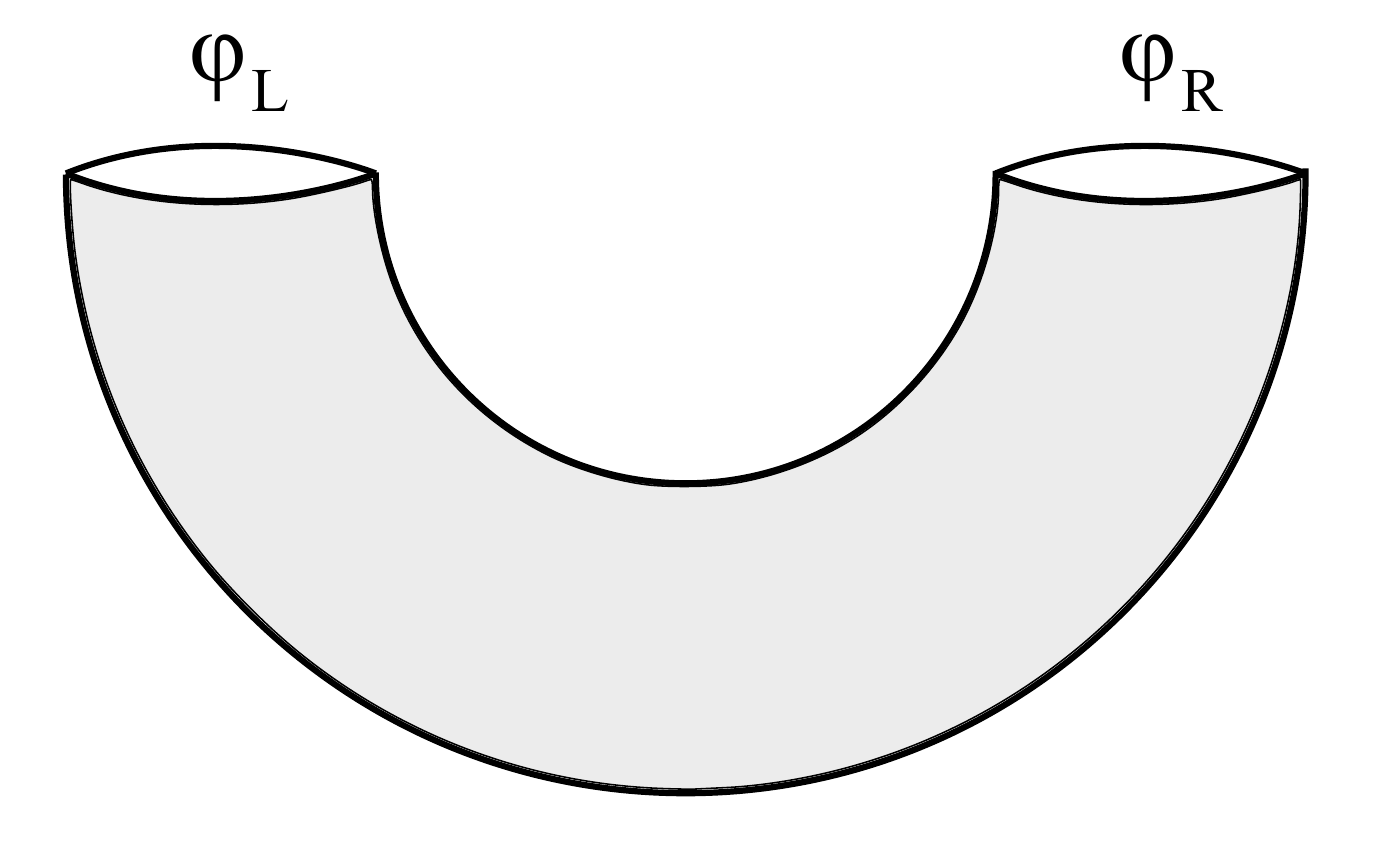
Hartle-Hawking state is then given by the path integral over _half_ of the Euclidean geometry, with both boundary _unfixed_. Why half? Recall our objective: To find the bulk state that corresponds to $\ket{\mrm{TFD}}$: a CFT state.
- Matching topologies $[0,\tfrac{\beta}{2}] \times S^{d-1}$
- Matching temperature $\frac{\beta}{2}$
> The connection between the extended Schwarzschild geometry and “thermofield dynamics” was first noticed by Israel in 1976. Here we are just pointing out that that in the context of AdS-Schwarzschild geometries this connection becomes _precise_ and that it gives, in principle, a way to describe the interior.
- A similar construction: Minkowski is the purification of Rindler; see Hartman, Chapter 5. Also recall the calculation of Unruh temperature (journal club by Boyang in the last semester), see _Harlow_.
## What can we do?
- **Thermal CFT correlations from AdS:** BTZ is a quotient of AdS, hence we can get $n$-point functions of BTZ using the known results in AdS, via the method of images. Here the operator insertion is at the boundary (CFT).
- **BH physics from CFT:** _In principle_, we can look behind the event horizon with the help of CFT. Although the mapping between states in bulk & boundary can be very complicated.
- **Spinning BH:** adds a factor of $
e^{-\beta \mu \ell_n/2}
$ in the double state.
- **Bulk particles:** insertions on the Euclidean boundary.
- **Generalizations:** AdS/AdS slicing, multiple boundaries, etc.
- **One-sided BH:** $\mbb{Z}_2$ quotient, and we have a particular BH pure state.
### Information paradox
- Information loss: left-right correlation calculated in the bulk decays fast: $\propto e^{-\lambda t/\beta}$. Bulk string theory in $\mrm{AdS}_3$, e.g. $\mrm{SL}(2,\mbb{R})$ WZW model gives the same result at tree level. This contradicts unitary of the CFT.
- CFT calculation shows that left-right correlation is bounded below by $e^{-\lambda'S}$, while $S\sim \frac{1}{G_N}$ --- non-perturbative effects in the bulk! _Partial_ resolution: sum over other geometries, e.g. thermal AdS saddle. AdS-Schwarzschild is only the leading contribution.
> More about the Euclidean geometry:
> Euclidean black holes are completely smooth solutions; they do not have an interior or a singularity! In 3D, we have (per Maldacena's convention):
>
> $$
\dd{s}^2
= \pqty{r^2 - 1} \dd{\tilde{\tau}}^2
+ \frac{1}{r^2 - 1} \dd{r}^2
+ r^2 \dd{\tilde{\phi}}^2
$$
>
> There is an apparent singularity at $r = 1$. However, with certain periodicities the singularity is resolved; the geometry 'caps off' at $r = 1$ (in _Harlow_'s words).
>
> **Note**: Behind the "horizon", we have $r<1$, and the signature is no longer Euclidean but $(--+)$, which makes no sense for an Euclidean theory. Therefore the interior is simply discarded.
>
> With $\tilde{\phi}\in\mathbb{R}$, this describes the 'Rindler' patch of AdS, and the horizon is just that of an accelerated observer; $J = 0$ BTZ, on the other hand, comes from identifying:
>
> $$
\tilde{\phi} \cong \tilde{\phi} + 2k\pi
$$
>
> See e.g. the (BTZ + Henneaux) paper [gr-qc/9302012]. Here we fix the horizon at $r = 1$, therefore the BH mass is in fact encoded in $k$.
> With $\phi = \tilde{\phi}/k,\ \tau = \tilde{\tau}/k$, we get the usual $\phi \cong \phi + 2\pi$ coordinate.
>
> With $
\rho = \cosh^{-1} r
$ or $r = \cosh \rho$, at $\rho \simeq 0$ or $r \simeq 1$, we get:
>
> $$
\dd{s}^2
\simeq \rho^2 k^2 \dd{\tau}^2
+ \dd{\rho}^2
+ k^2 \dd{\phi}^2
$$
>
> Non-singular if $
\tau \cong \tau + \frac{2\pi}{k}
$, in other words $
\beta = \frac{2\pi}{k}
$.
>
Hartle-Hawking state is then given by the path integral over _half_ of the Euclidean geometry, with both boundary _unfixed_. Why half? Recall our objective: To find the bulk state that corresponds to $\ket{\mrm{TFD}}$: a CFT state.
- Matching topologies $[0,\tfrac{\beta}{2}] \times S^{d-1}$
- Matching temperature $\frac{\beta}{2}$
> The connection between the extended Schwarzschild geometry and “thermofield dynamics” was first noticed by Israel in 1976. Here we are just pointing out that that in the context of AdS-Schwarzschild geometries this connection becomes _precise_ and that it gives, in principle, a way to describe the interior.
- A similar construction: Minkowski is the purification of Rindler; see Hartman, Chapter 5. Also recall the calculation of Unruh temperature (journal club by Boyang in the last semester), see _Harlow_.
## What can we do?
- **Thermal CFT correlations from AdS:** BTZ is a quotient of AdS, hence we can get $n$-point functions of BTZ using the known results in AdS, via the method of images. Here the operator insertion is at the boundary (CFT).
- **BH physics from CFT:** _In principle_, we can look behind the event horizon with the help of CFT. Although the mapping between states in bulk & boundary can be very complicated.
- **Spinning BH:** adds a factor of $
e^{-\beta \mu \ell_n/2}
$ in the double state.
- **Bulk particles:** insertions on the Euclidean boundary.
- **Generalizations:** AdS/AdS slicing, multiple boundaries, etc.
- **One-sided BH:** $\mbb{Z}_2$ quotient, and we have a particular BH pure state.
### Information paradox
- Information loss: left-right correlation calculated in the bulk decays fast: $\propto e^{-\lambda t/\beta}$. Bulk string theory in $\mrm{AdS}_3$, e.g. $\mrm{SL}(2,\mbb{R})$ WZW model gives the same result at tree level. This contradicts unitary of the CFT.
- CFT calculation shows that left-right correlation is bounded below by $e^{-\lambda'S}$, while $S\sim \frac{1}{G_N}$ --- non-perturbative effects in the bulk! _Partial_ resolution: sum over other geometries, e.g. thermal AdS saddle. AdS-Schwarzschild is only the leading contribution.