# StyleSeed Engine Architecture
StyleSeed converts product intent and visual evidence into an enforceable design method for
coding agents. The architecture separates **fixed judgment**, **task-specific grammar**, and
**project-specific choices** so consistency does not collapse into one universal aesthetic.
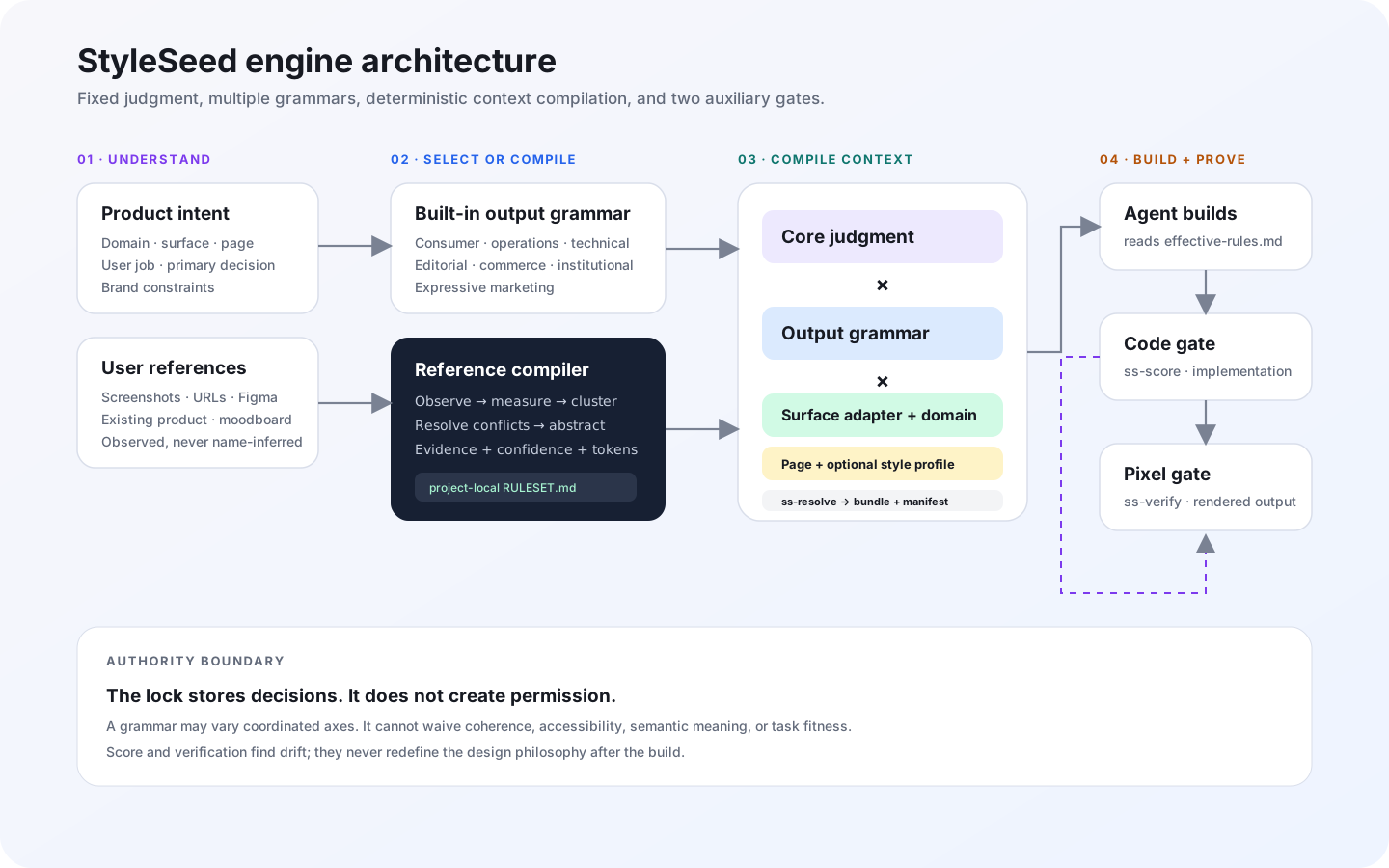
## System flow
```mermaid
flowchart LR
A[Product brief
domain · surface · page] --> B{Grammar source}
R[User references
images · URLs · existing UI] --> C[Reference compiler]
C --> D[Project-local grammar
evidence · confidence · tokens · checks]
B --> E[Built-in output grammar]
D --> F[Context compiler
ss-resolve]
E --> F
P[Core judgment
non-negotiable] --> F
S[Surface adapter
canvas · renderer · export] --> F
X[Domain + page type] --> F
Y[Optional style profile] --> F
L[STYLESEED.md
bounded selections] --> F
F --> K[Effective rule bundle
manifest + source hashes]
K --> G[Agent build method]
G --> H[Code gate
ss-score]
H -->|fix loop| G
H --> I[Pixel gate
ss-verify]
I -->|fix + re-render| G
I --> J[Designed output
score + visual evidence]
```
## Layers and authority
| Layer | Responsibility | May change | May not change |
|---|---|---|---|
| Product constitution | Stable design judgment | maintained invariants | per-project aesthetics |
| Output grammar | Organize attention and action for an output class | bounded twelve-axis contract | accessibility or core coherence |
| Surface adapter | Translate method into an artifact/render contract | canvas, safe zones, export, surface QA | visual authority or product judgment |
| Reference compiler | Derive a local grammar from evidence | local rules with confidence | global built-ins or protected assets |
| Domain + page playbooks | Contextual composition bias | content/order/detail decisions | grammar identity |
| Aesthetic profile | Coordinated look adjustment | radius, density, tone, motion within bounds | task structure |
| Design lock | Persist selected values | known enums and project tokens | invent exceptions or waive rules |
| Context compiler | Emit the selected method with provenance | deterministic bundle + manifest | silently invent or merge unknown IDs |
| Build skills | Apply the compiled method | implementation | self-certify without evidence |
| Score + verify | Detect code and pixel drift | fixes needed to comply | redefine the chosen method |
## Grammar sources
### Built-in
Maintained in `RULESETS.md`. Built-ins require independent evidence, counterexamples, rendered
samples, and regression coverage. They are selected by output job: consumer service,
operations console, technical instrument, editorial reading, commerce conversion,
institutional service, or expressive marketing.
### Reference-compiled
`/ss-reference` runs `REFERENCE-COMPILER.md`. It ingests user references, fills the same
twelve-axis schema, cites evidence and confidence, and writes a project-local grammar under
`.styleseed/rulesets/`. A transfer screen proves that the result is a reusable language rather
than a clone of one source screen.
## Runtime compilation
`ss-resolve` resolves conflicts by authority and writes one effective rule set for the agent:
```text
effectiveRules, manifest = compile(
coreJudgment,
outputGrammar,
surfaceAdapter,
domainPlaybook,
pageType,
optionalStyleProfile,
boundedDesignLock
)
```
The default output is `.styleseed/effective-rules.md` plus `.styleseed/manifest.json`. A typical
built-in selection is 10–20KB, while `llms-full.txt` remains an archive/debug mirror. The
manifest records the exact selection, source hashes, bundle hash, and byte size; `--check`
fails when the stored bundle no longer matches its sources or lock.
The design lock stores selections; it is not executable policy. Unknown grammar, adapter,
domain, page, or profile IDs are rejected. Project-local reference grammars require a maintained
built-in fallback.
## Non-web outputs
`ADAPTERS.md` lets the same method drive product UI, social carousels, slide decks, documents,
and single-frame graphics. The companion renderer owns physical production constraints. For
example, StyleSeed supplies the `sequential-story` grammar and brand system while the Claude
`carousel-build` skill owns Instagram canvas, safe zones, crop, PIL rendering, and export QA.
## Verification model
StyleSeed uses two auxiliary gates because source correctness and rendered quality fail in
different ways:
- `ss-score` reads implementation evidence: tokens, hierarchy, states, semantics, coherence,
and characteristic grammar tells.
- `ss-verify` renders the result and checks pixels: actual focal dominance, type loading,
balance, optical rhythm, responsive behavior, and state rendering.
Both gates return to the build loop. Neither gate is the design engine; the composed method is.
## Extension boundary
- Add a new built-in grammar only after the promotion rule in `RULESETS.md` passes.
- Use `/ss-reference` for project-specific or emerging languages.
- Add a new aesthetic profile only when it is a full coordinated axis contract, not a mood word.
- Keep components and skins downstream. They implement a decision; they do not decide.