# pi-fusion
[](https://www.npmjs.com/package/@alexeiled/pi-fusion)
[](https://github.com/alexei-led/pi-fusion/actions/workflows/test.yml?query=branch%3Amaster)
[](https://nodejs.org/)
[](./LICENSE)
> Parallel models. One judge. Better answers.
`pi-fusion` is a Pi extension for hard technical questions.
It uses `pi-subagents` to send the same prompt through a small parallel model panel,
then asks a judge agent to compare the outputs and return the best realistic answer.
CI covers lint, typecheck, unit tests, integration tests, package smoke tests,
and `npm pack --dry-run`.
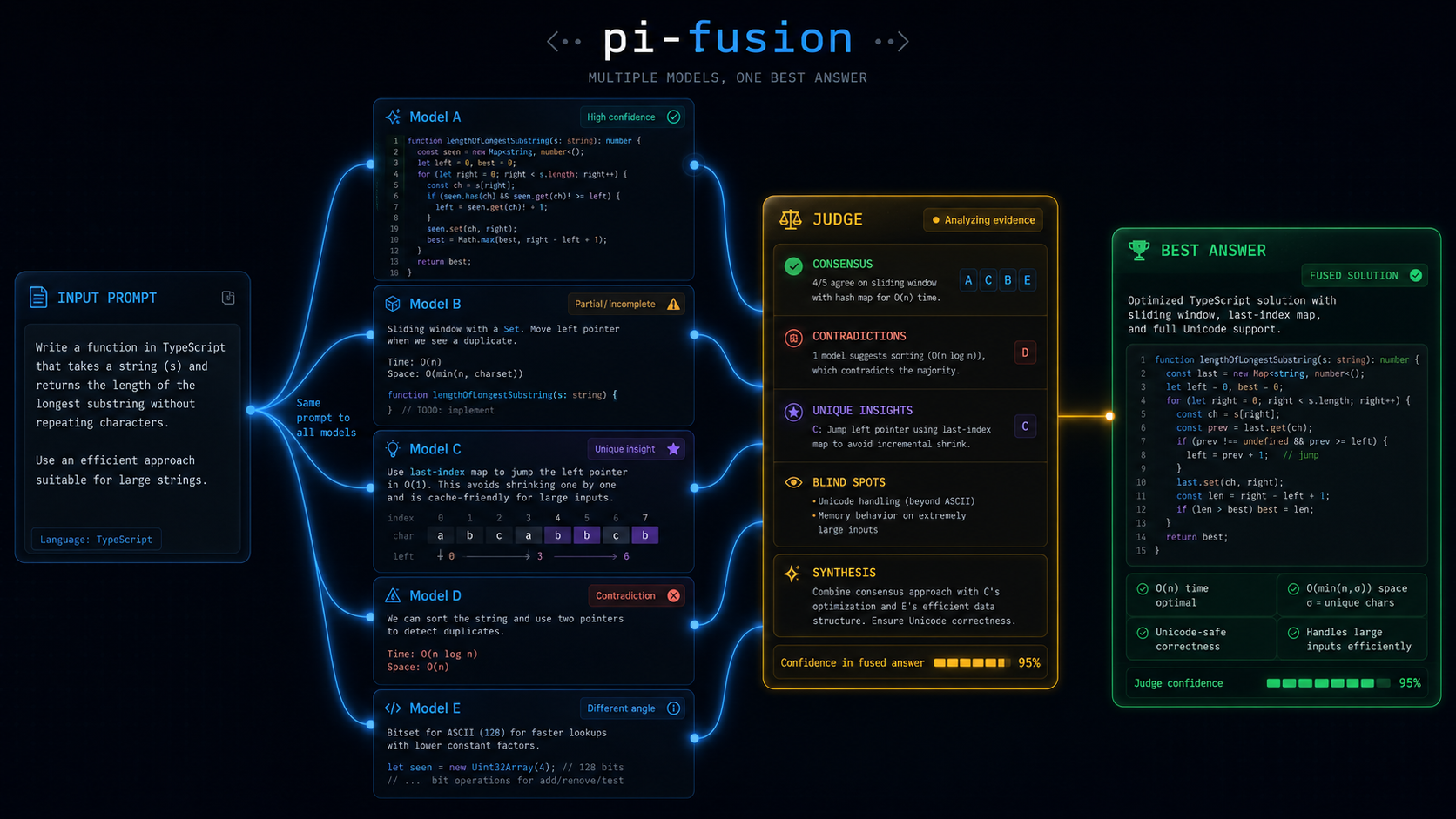
## Why Fusion exists
Hard questions are often bottlenecked by one model's search path.
`pi-fusion` trades latency for diversity:
- the same prompt fans out to several model runs in parallel
- each model explores the problem from a different training prior and reasoning path
- overlap raises confidence
- disagreement exposes risk
- the judge keeps the strongest parts and drops weak, partial, or conflicting ones
This is evidence selection, not majority vote.
```mermaid
%%{init: {"theme": "base", "flowchart": {"curve": "basis", "nodeSpacing": 28, "rankSpacing": 48}, "themeVariables": {"background": "#050816", "fontFamily": "ui-monospace, SFMono-Regular, Menlo, Monaco, Consolas, monospace", "primaryTextColor": "#E5F0FF", "lineColor": "#38bdf8", "tertiaryColor": "#0b1220"}}}%%
flowchart LR
classDef prompt fill:#071321,stroke:#38bdf8,color:#dbeafe,stroke-width:2px;
classDef modelA fill:#081223,stroke:#38bdf8,color:#dbeafe,stroke-width:2px;
classDef modelB fill:#120826,stroke:#a855f7,color:#f3e8ff,stroke-width:2px;
classDef modelC fill:#08180f,stroke:#22c55e,color:#dcfce7,stroke-width:2px;
classDef modelD fill:#241307,stroke:#f59e0b,color:#fef3c7,stroke-width:2px;
classDef modelE fill:#260712,stroke:#ff4d8d,color:#ffd1e7,stroke-width:2px;
classDef judge fill:#2b1905,stroke:#f59e0b,color:#fef3c7,stroke-width:3px;
classDef answer fill:#062814,stroke:#22c55e,color:#dcfce7,stroke-width:3px;
classDef note fill:#0b1220,stroke:#475569,color:#cbd5e1,stroke-width:1px;
P["input prompt
same question to every model"]:::prompt
subgraph PANEL[parallel model panel]
direction TB
A["model A
strong baseline candidate"]:::modelA
B["model B
finds contradiction"]:::modelB
C["model C
adds unique insight"]:::modelC
D["model D
fast practical path"]:::modelD
E["model E
catches edge case"]:::modelE
end
J["judge
consensus • contradictions • blind spots"]:::judge
R["best answer
selected or synthesized"]:::answer
N["not majority vote
best evidence wins"]:::note
P --> A
P --> B
P --> C
P --> D
P --> E
A --> J
B --> J
C --> J
D --> J
E --> J
J --> R
J -.-> N
linkStyle 0,5 stroke:#38bdf8,stroke-width:3px;
linkStyle 1,6 stroke:#a855f7,stroke-width:3px;
linkStyle 2,7 stroke:#22c55e,stroke-width:3px;
linkStyle 3,8 stroke:#f59e0b,stroke-width:3px;
linkStyle 4,9 stroke:#ff4d8d,stroke-width:3px;
linkStyle 10 stroke:#22c55e,stroke-width:4px;
linkStyle 11 stroke:#94a3b8,stroke-width:2px,stroke-dasharray: 5 5;
```
## Why a panel can beat one model
Single-model answers are brittle on hard tasks. They are limited by one model's
priors, one reasoning path, and one failure mode.
A panel helps because:
- different models are trained differently and make different bets
- errors are less correlated, so blind spots do not line up perfectly
- consensus is a useful confidence signal without pretending certainty
- disagreement tells you where the answer is fragile
- a judge can select or synthesize the best realistic answer from the set
The result is slower, but usually better for design choices, risk review,
tricky debugging, and research-heavy questions. It is not intended for routine
edits, formatting, or obvious one-step fixes.
## What the judge actually does
The judge gets:
- the original prompt
- every panel output
- panel failures and blind spots
- the configured judge model
It then:
- finds consensus
- preserves real disagreements
- spots weak or incomplete answers
- pulls forward unique insights worth keeping
- returns one clear recommendation and next step
It does not edit files or spawn more subagents. It does one job: choose or
synthesize the best realistic answer.
## Good fit
Use it for questions like:
- Which design should we choose?
- What will break if I change this?
- Is this PR or release flow safe?
- What did I miss?
- What is the right test strategy here?
Do not use it for trivial edits, formatting, or obvious one-step fixes.
## Commands
```text
/fusion
/fusion
/fusion --profile
/fusion -p
/fusion status
/fusion stop
/fusion init
```
## Plan execution RPC
Other Pi extensions can control Fusion through the versioned event-bus contract
`fusion:rpc:v1`:
- emit requests on `fusion:rpc:v1:request`
- listen for the response on `fusion:rpc:v1:reply:` before emitting
- send `{ "version": 1, "requestId": "...", "method": "...", "params": {} }`
- receive `{ "version": 1, "requestId": "...", "method": "...", "success": true, "data": {} }` or a failure with a typed `error`
Methods:
- `ping` — return the RPC version and supported methods
- `start` — requires `prompt` and a non-empty `operationId`; accepts optional `profile`. Reusing an operation ID returns the original run instead of starting another, including after Fusion restores the Pi session history.
- `status` — return structured run state by `operationId`, `runId`, or the current/last run
- `result` — return a terminal run and report; active runs return `not_ready`
- `cancel` — cancel the selected active run, or report that the selected terminal run was not cancelled
- `adopt` — confirm and return a run from restored session history by `runId`
`start` returns `{ operationId, replayed, run }`. `status` and `result`
return `{ run }`. `cancel` returns `{ cancelled, run? }`. `adopt` returns
`{ adopted: true, run }`. Run state contains `runId`, optional `operationId`,
`phase`, `terminal`, and optional `report` or `error`.
Failure codes are `invalid_request`, `unsupported_method`, `busy`, `not_found`,
`not_ready`, `unavailable`, `start_failed`, `cancel_failed`, and `internal`.
`busy`, `not_ready`, and lookup failures include structured details when available.
## Quick start
Requirements:
- Pi
- Node.js 22.19+
- `pi-subagents`
```bash
pi install npm:pi-subagents
pi install npm:@alexeiled/pi-fusion
```
Then reload Pi:
```text
/reload
```
For commands, config, and troubleshooting details, see [`docs/user-guide.md`](./docs/user-guide.md).
## Notes
- Bare `/fusion` shows a short command summary.
- Config is optional. Defaults work. Use `/fusion init` when you want project config.
- Project config lives at `.pi/fusion.json`. Global config lives at `~/.pi/agent/fusion.json`.
- Output appears as a Pi custom message. Active progress also uses the `fusion` status key.
- Active runs are reconciled from `pi-subagents` lifecycle artifacts, not only completion events.
- `pi-fusion` does not own the footer.
- Prompts and inspected snippets may be sent to every configured panel provider and to the judge through `pi-subagents`.
- Reports include available per-panel and judge time, aggregate model time, usage, estimated cost, and model failure details. Missing provider usage is shown as unknown; `$0.0000` remains a known zero-cost value.
- `Model` is lifecycle metadata. `Configured model` is the profile request; both appear when execution differs from the request.
- `stopWhenPanelAgrees` is an opt-in profile setting. It requires matching high-confidence decision records with no request for more evidence, stops only unfinished panelists, and still runs the judge.
## Read more
- [`docs/user-guide.md`](./docs/user-guide.md) — commands, config, profiles, privacy, troubleshooting
- [`DEVELOPMENT.md`](./DEVELOPMENT.md) — contributor workflow